Deal execution
Meeting Booked. Now the Real Work Begins.
Enterprise sales is not one motion. It is eleven — each with different risks, assets, and next steps. Bruce is the execution layer that runs through Google Workspace while the AE owns the room.
Meeting booked.
The prospect accepted. Time is on the calendar. The AE has a live opportunity. But the deal still has to move through discovery, qualification, demo, stakeholders, POC, business case, procurement, legal, and close — each stage demanding a different definition of progress.
The real work is turning every meeting into disciplined deal execution — knowing where to spend energy at every stage.
Bruce is the execution layer
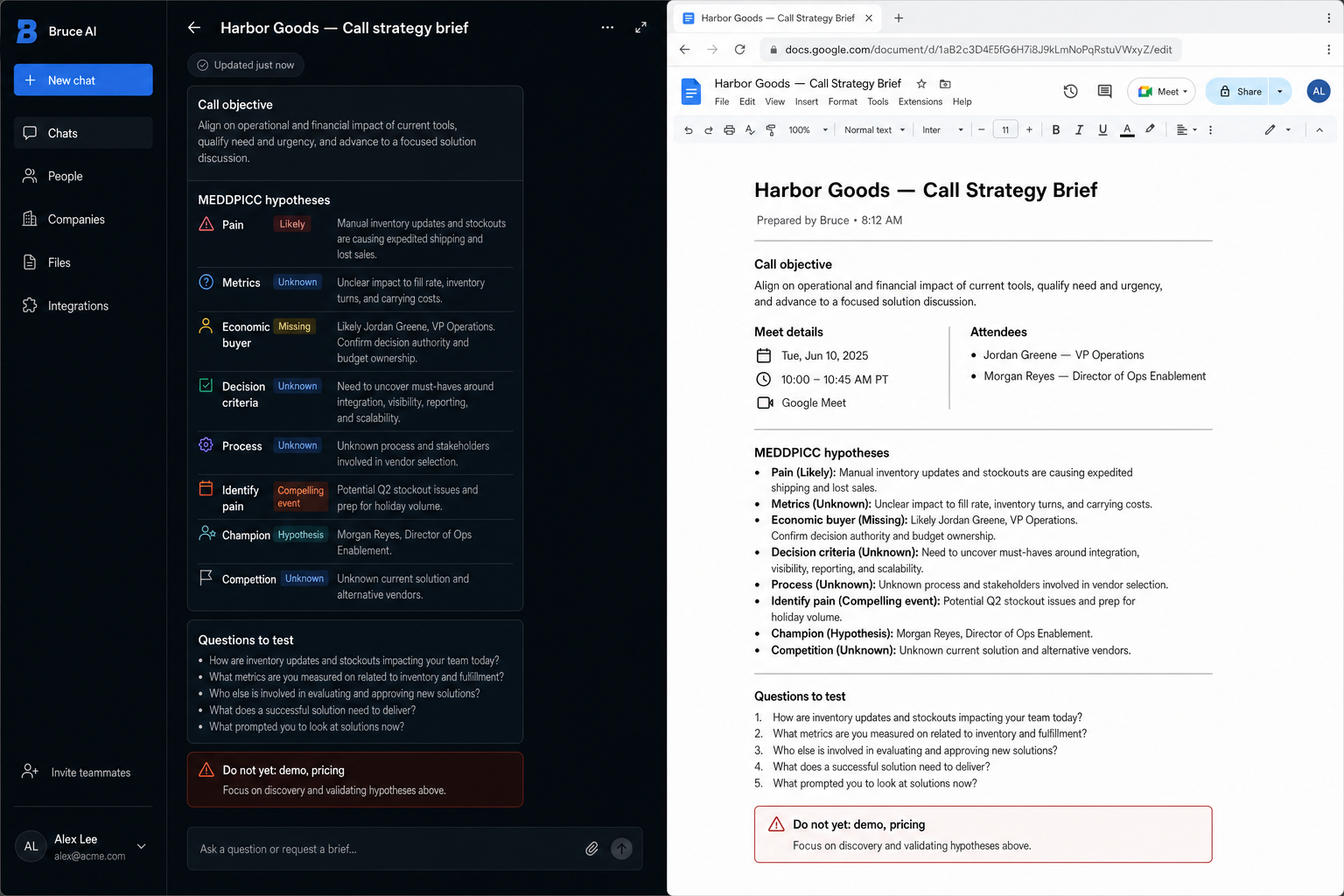
Bruce sits between meeting booked and deal advanced — reviewing account context, prior Gmail threads, Calendar history, and patterns from similar wins and losses, then answering the question every AE needs before a call: What has to happen now for this deal to move forward?
Not a company summary. Not a transcript dump. A call strategy brief — call objective, hypotheses to test, stage risk, and what not to do yet — delivered in Google Docs and linked to the Calendar event before the AE joins the Meet.
It reads with the discipline of MEDDPICC — but inverted. Not blank fields to fill after the call. Not interrogation on the call. Bruce assembles deal hypotheses from Gmail, Calendar, and account context before the conversation; discovery validates them, it does not extract them. The same inversion as MEDDPICC before discovery.
Tuesday, 8:12 AM
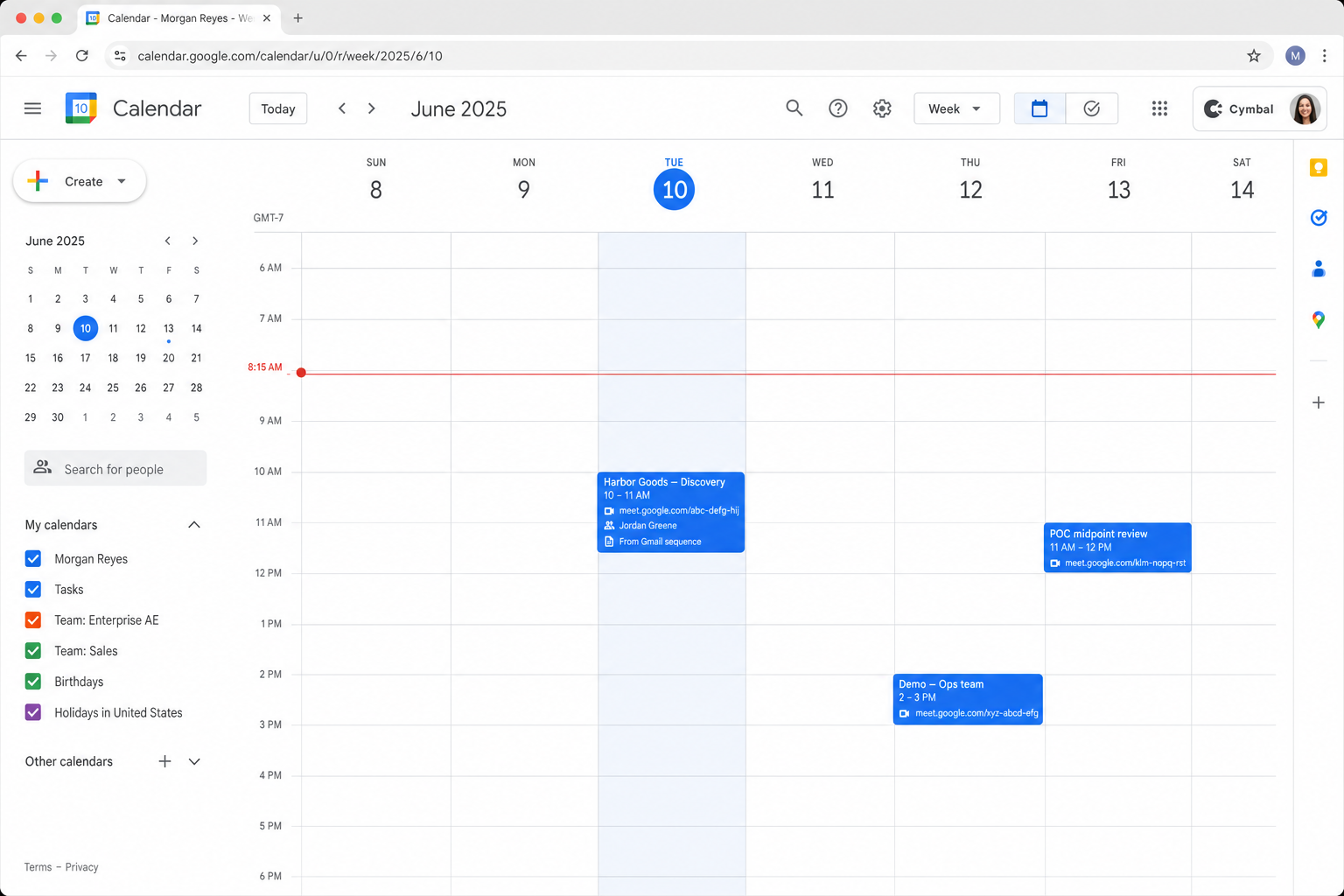
Morgan opens Google Calendar. Harbor Goods discovery at 10:00 — Jordan Greene, VP Ops, Google Meet. The meeting landed from the six-touch outreach sequence Bruce ran in Gmail. Bruce already built the call strategy brief in Docs — call objective, hypotheses to test, stage risk — and linked it to the event. Morgan does not open a blank MEDDPICC worksheet. She opens a plan.
Morgan's job on the call: validate whether shipping SLA pain is real, urgent, and owned. Bruce's job: make sure she does not leave with a vague “good conversation” or advance the stage before the hypotheses are confirmed.
After the call — update the truth
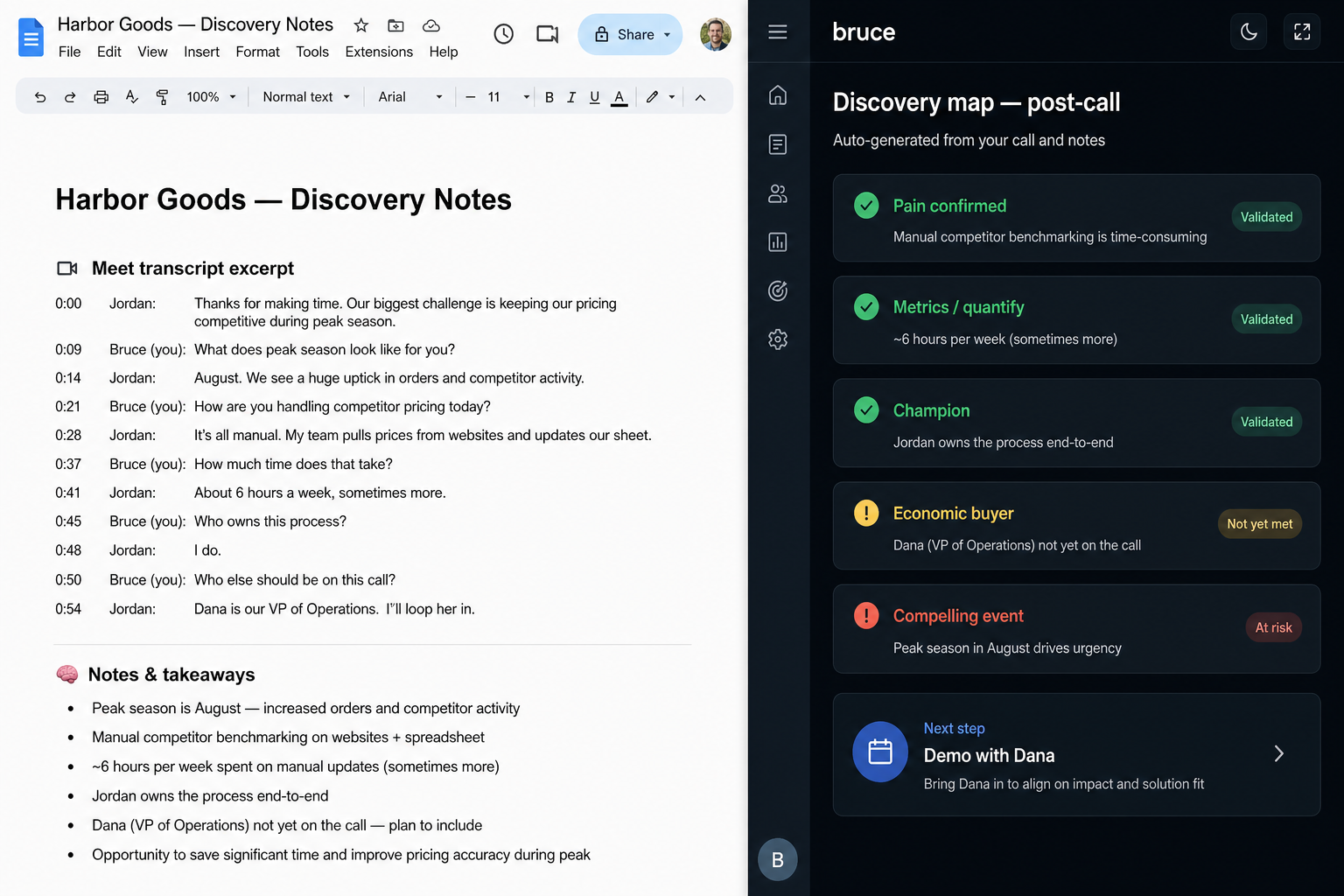
Meet generates notes in Docs. Bruce maps what moved from hypothesis to confirmed — and what is still missing. Jordan confirmed margin pressure on the 2-day delivery promise and ~6 hours/week of manual carrier benchmarking. Pain: validated. Metrics: still a gap. Economic buyer: still missing. Peak season in August becomes the compelling event to test next.
Qualification — hypotheses scored, not fields filled
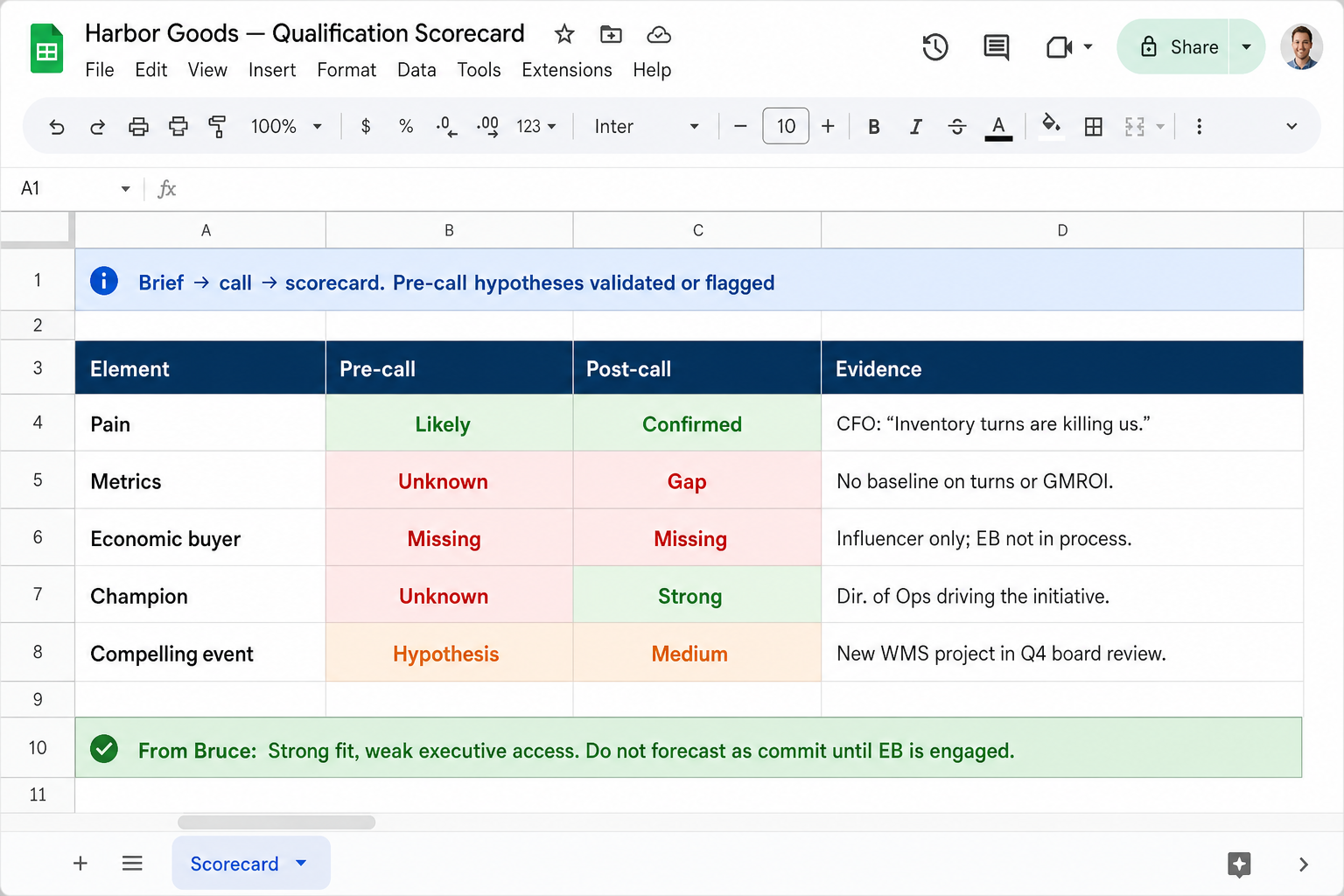
Post-call, Bruce updates the scorecard in Sheets. Champion: strong. Economic buyer: still missing. Metrics: gap. The deal is medium risk — not commit. Same rigor as MEDDPICC, but the framework reflects what the call actually proved, not what the rep remembered to type in afterward.
Demo — prove the right thing to the right buyer
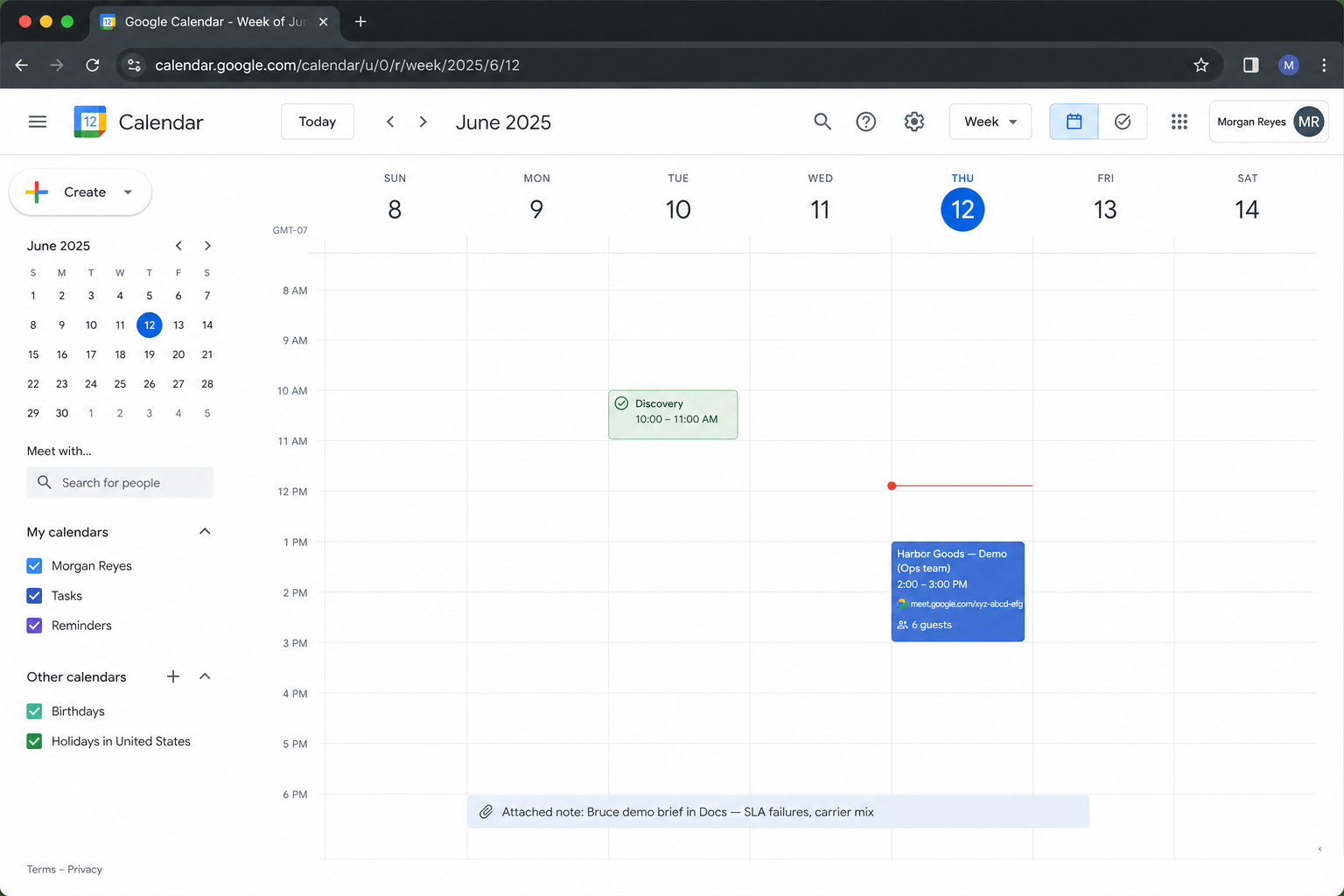
Thursday at 2:00 PM: ops team on Meet, six attendees. Bruce anchored the demo brief in Docs around SLA failures and carrier mix — not feature breadth. Practitioner workflow for the room; executive outcomes saved for when Dana Whitfield, VP Ops, enters the thread.
Stakeholders — expand the room
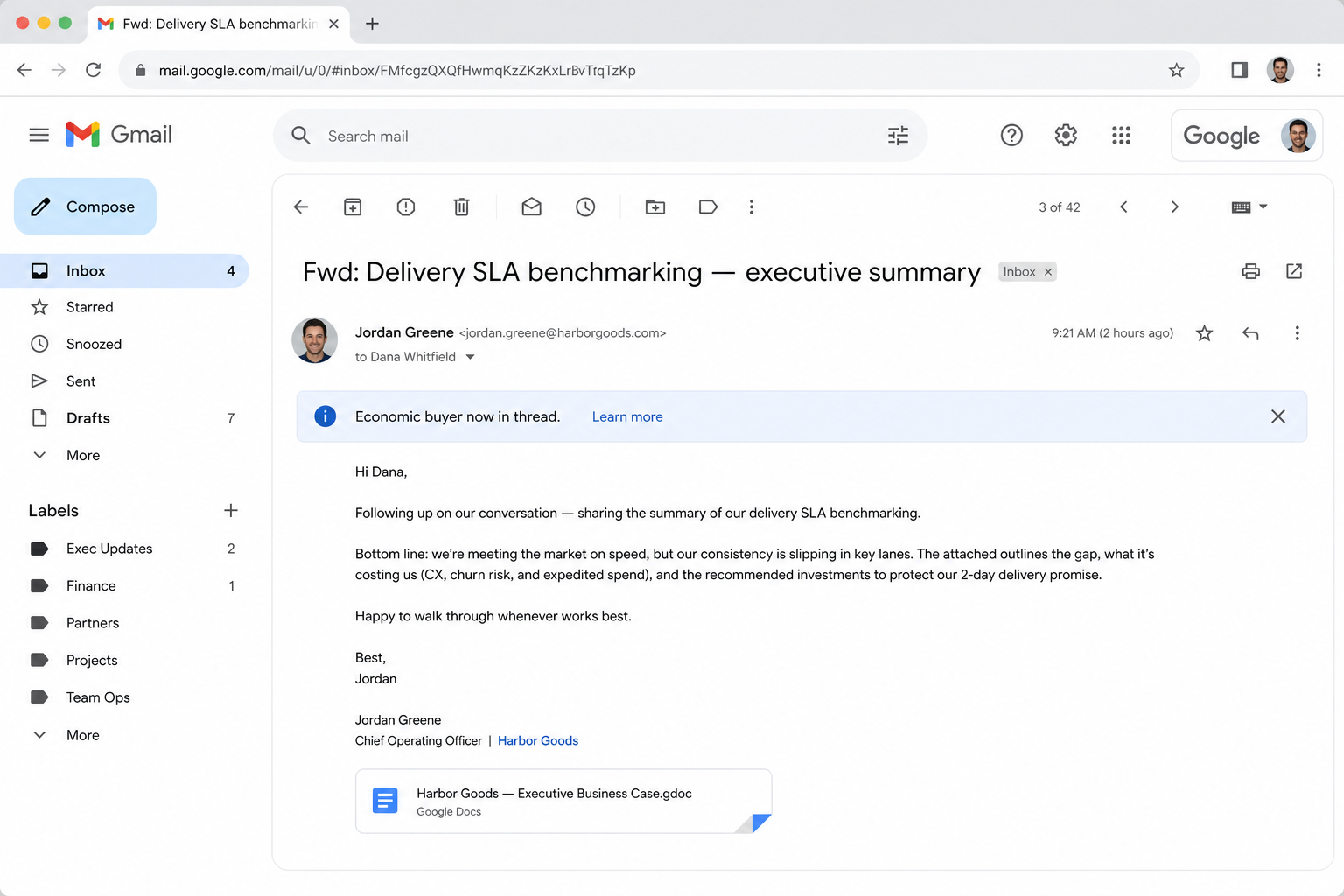
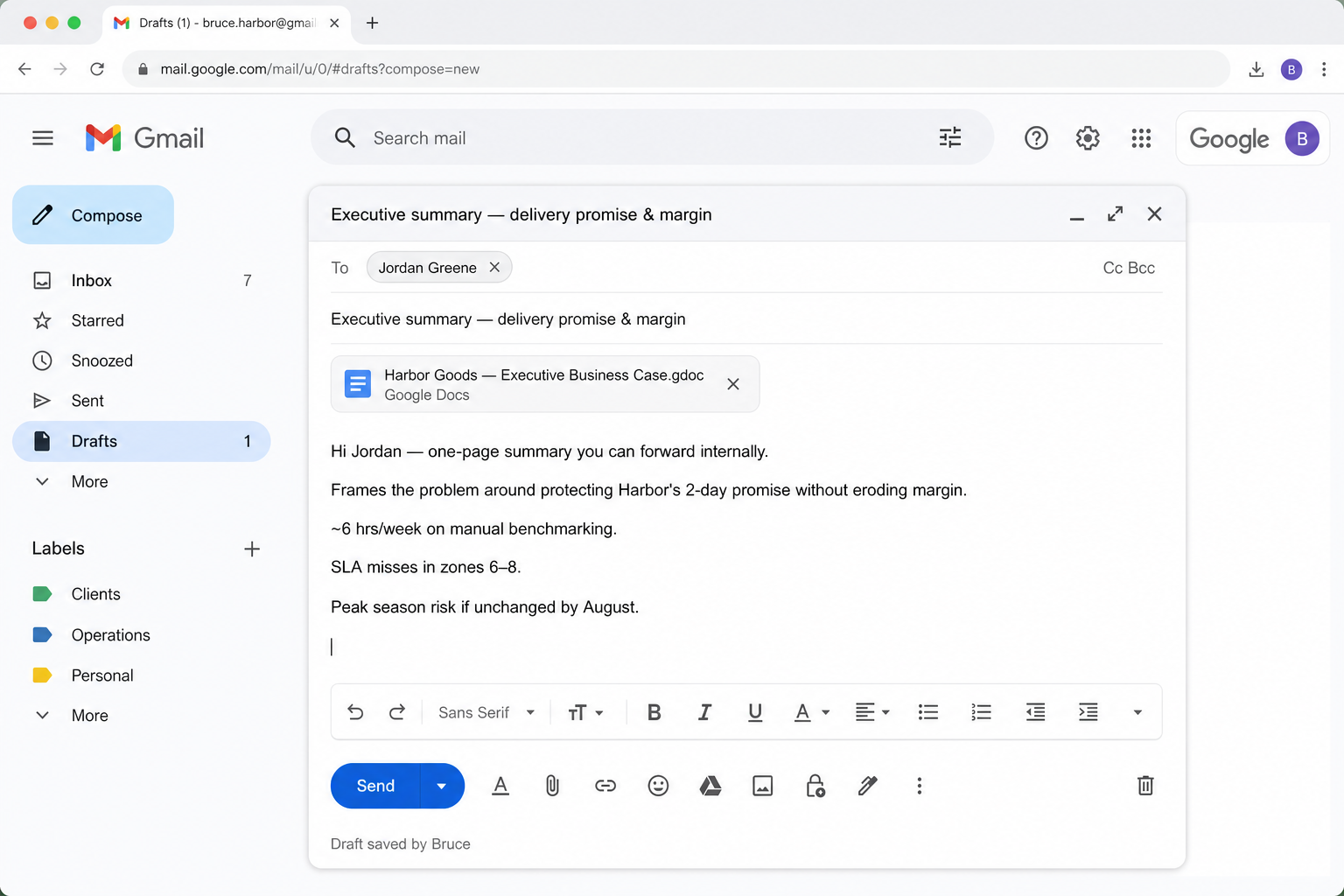
Enterprise deals are won by committees, not contacts. Jordan forwards Morgan's executive summary in Gmail to Dana — looping in the economic buyer Bruce flagged as missing since discovery.
POC — managed validation, not a sandbox
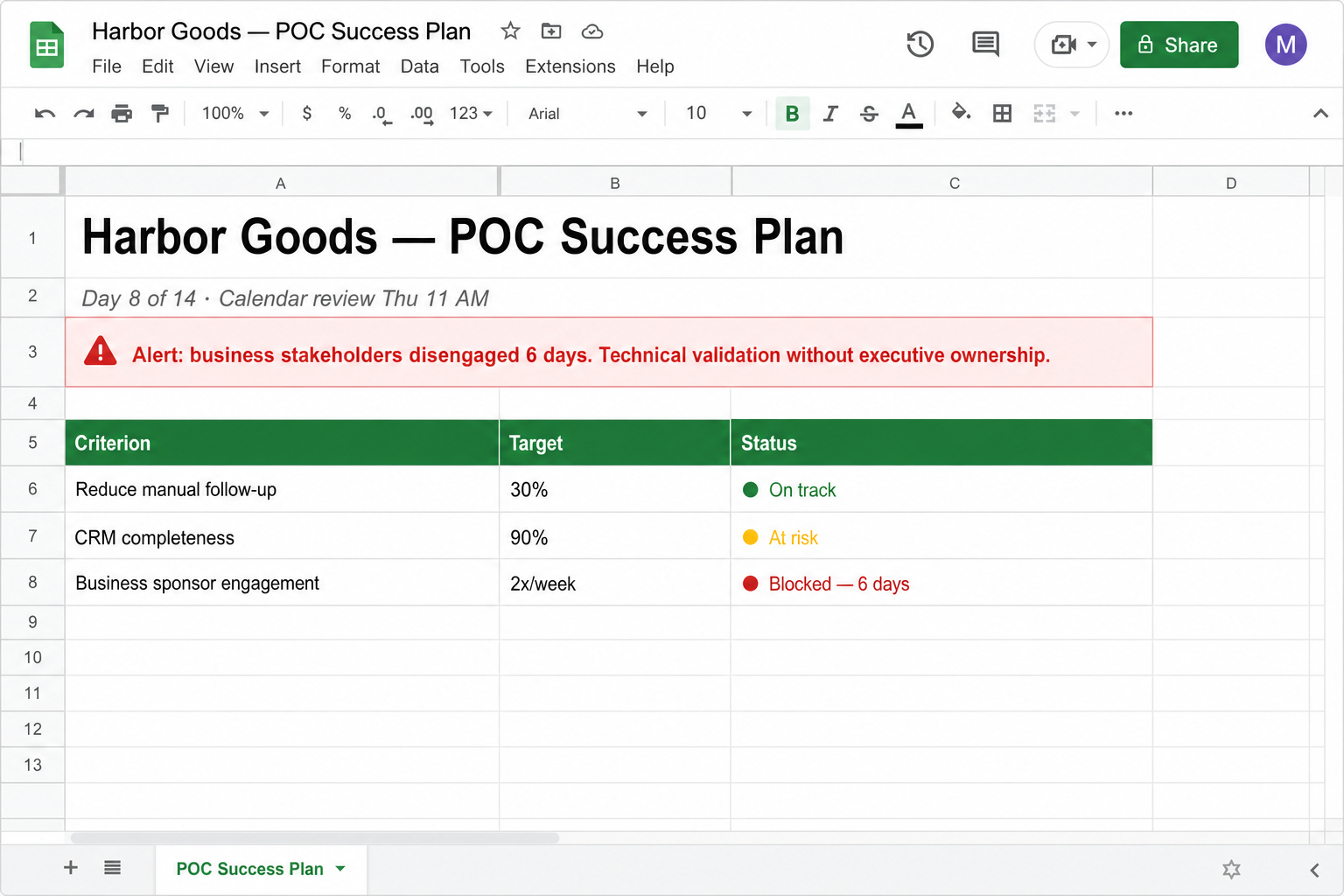
Fourteen days. Success criteria in Sheets: reduce manual follow-up, improve pipeline hygiene, surface deal risk. Day eight: technical usage strong, business sponsor silent six days. Bruce alerts Morgan before the Calendar midpoint review — the same discipline as POC as the new funnel.
Business case — justify the purchase internally
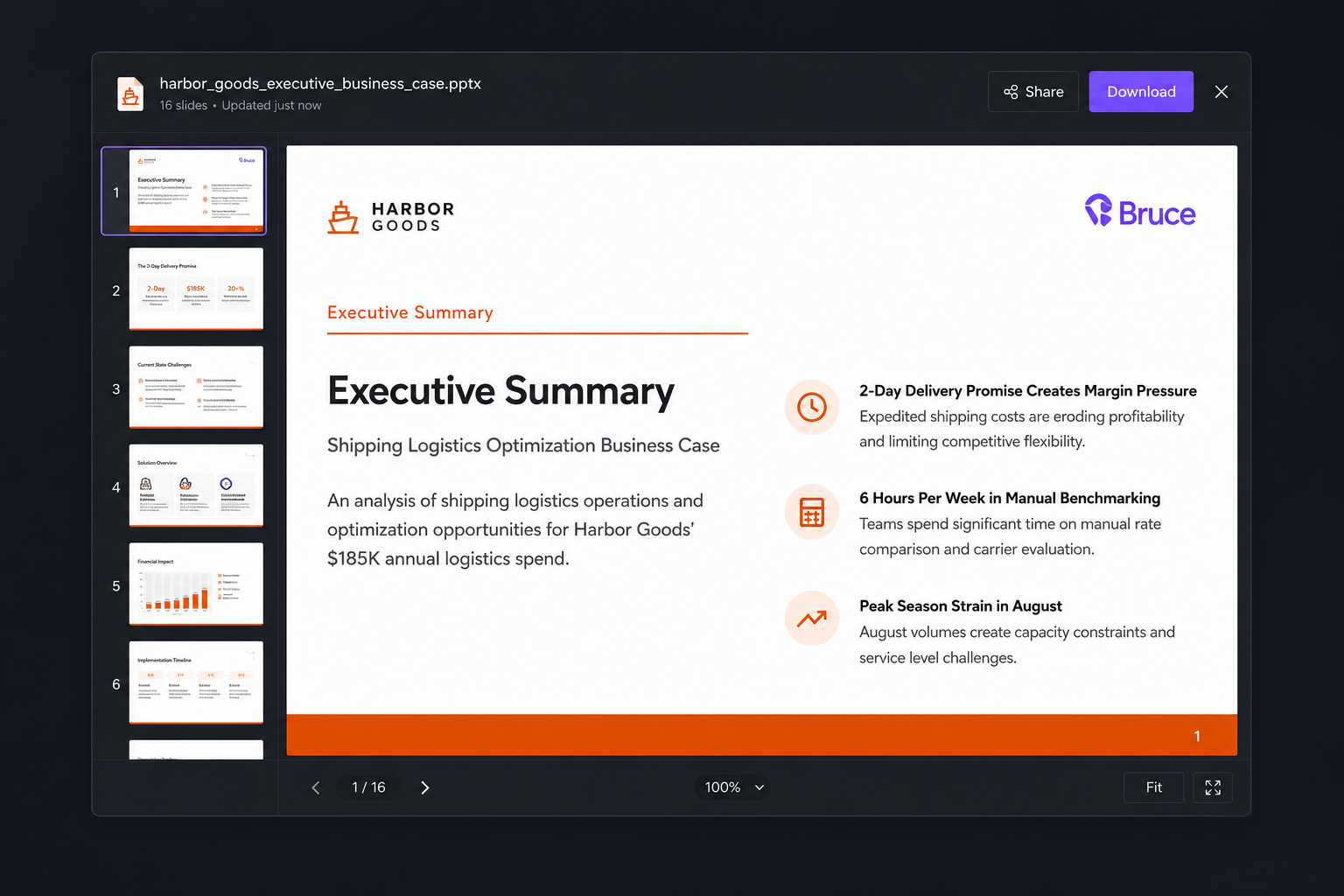
Liking the product is not enough. Someone at Harbor Goods has to justify it. Bruce drafts the executive summary in Docs, generates a data-driven PowerPoint from the call strategy brief and validated Meet notes — pain confirmed, metrics gap, compelling event in August — and puts the Gmail send ready for Jordan to forward. Framed around protecting the 2-day promise without eroding margin, not workflow automation for its own sake.
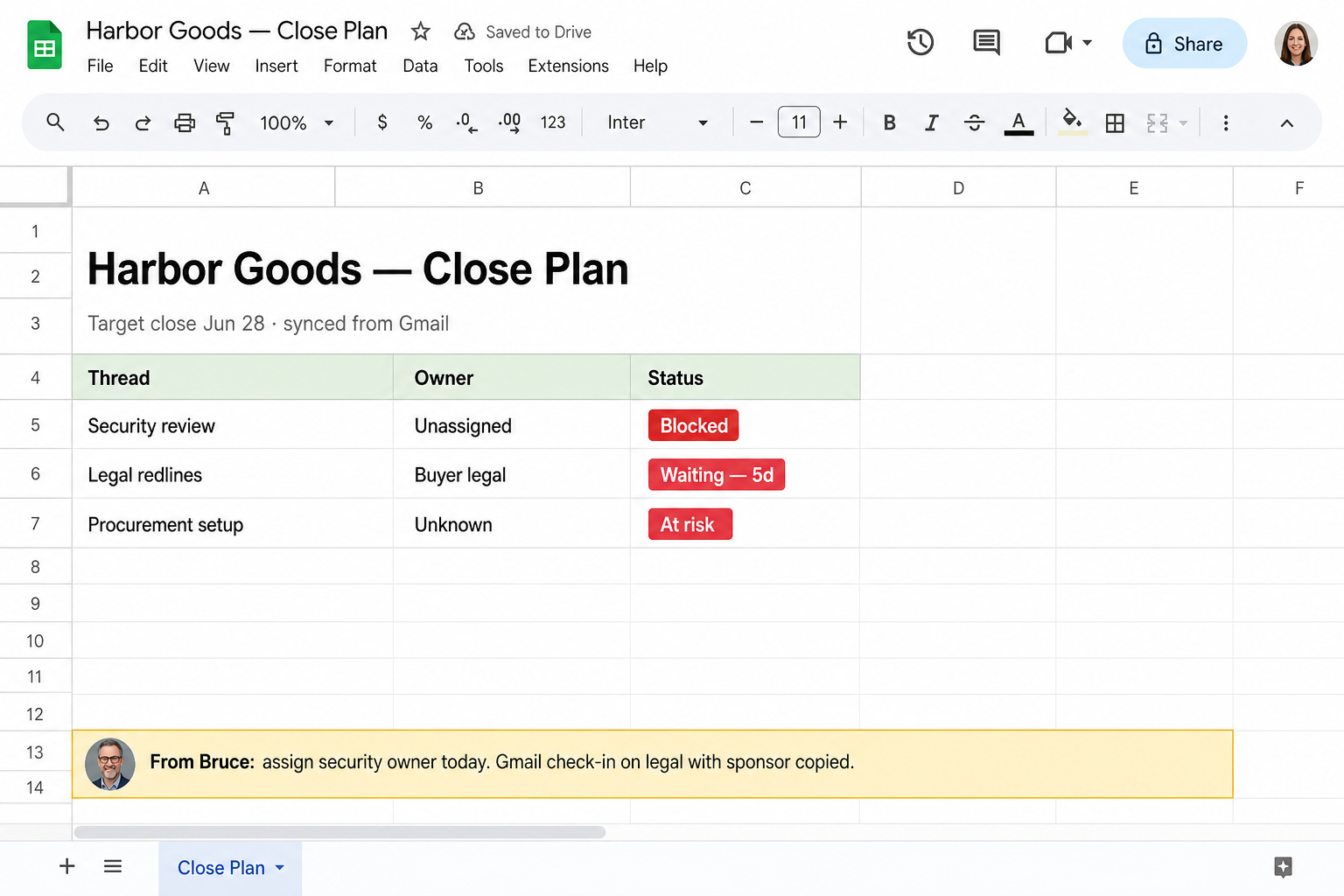
Pricing waits until the business case lands. Proposal in Docs, value anchors first. When procurement and legal enter, Bruce tracks every thread in Sheets — security, redlines, vendor setup — synced from Gmail so nothing drifts.
The new enterprise sales motion
The seller owns trust, judgment, conversation, negotiation, and executive presence. Bruce owns prep, next steps, follow-up, risk, stakeholder mapping, POC tracking, business case creation, presentation generation, and close plan execution — all through Gmail, Calendar, Docs, Sheets, Meet, and PowerPoint.
Thursday, 4:30 PM
Morgan opens Calendar. Harbor Goods — contract signed, $185K. Kickoff with CS on Meet tomorrow morning. The handoff doc is already in Drive: original pain, success criteria, stakeholders, POC findings, expansion signals. Jordan does not repeat the story.
Same AE who inherited a booked meeting three weeks ago. Same Google Workspace. One motion left the AE coordinating eleven stages manually. The other ran an execution layer through the inbox and calendar — and turned a BDR sequence into signed revenue.
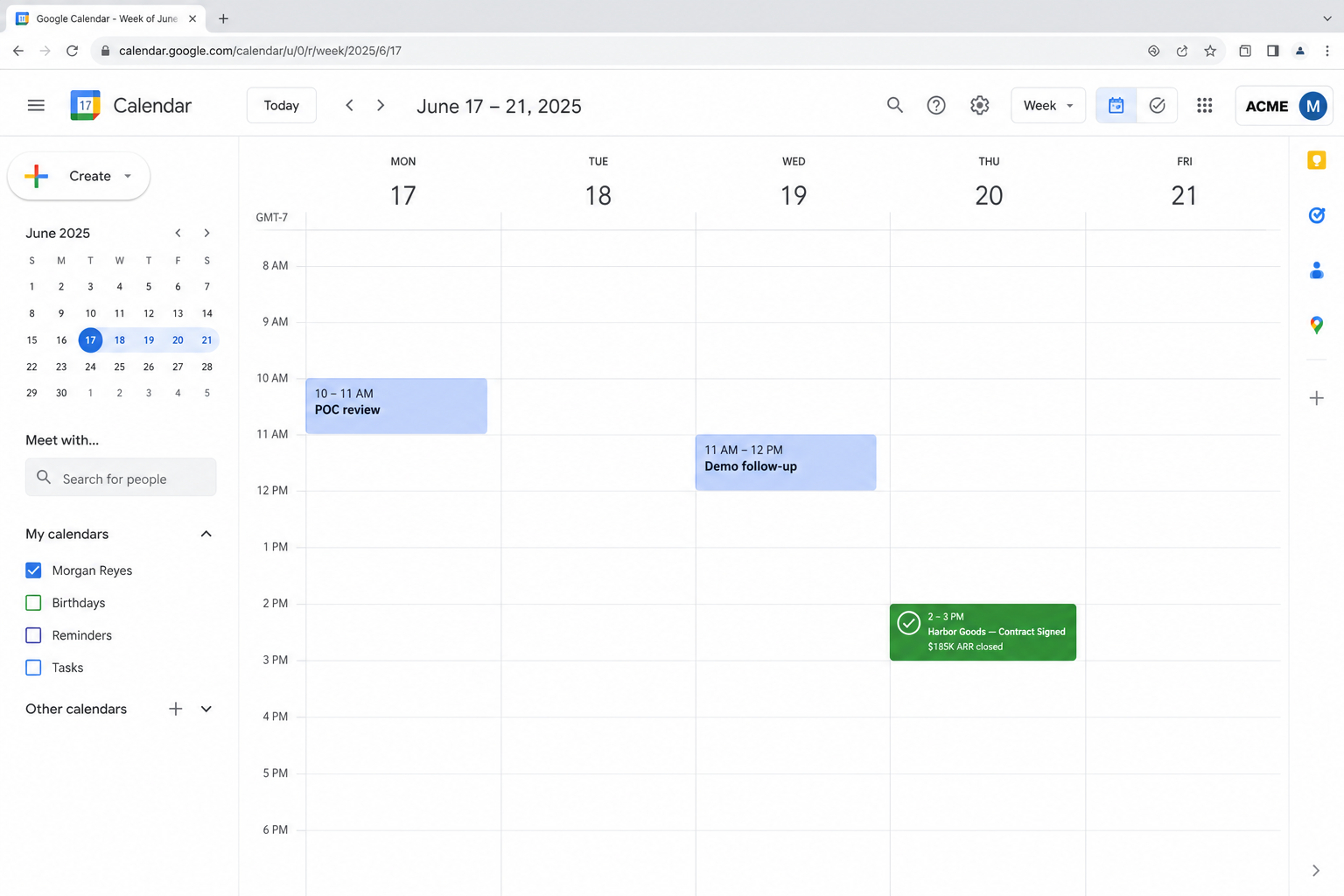
Meeting booked. Bruce makes sure it becomes revenue — from autonomous outbound through deal rigor and value intelligence.
Field Notes
Continue
MEDDPICC Before Discovery
Call-time MEDDPICC extraction is backwards. AI-native GTM pre-contextualizes deal intelligence before the first meeting — discovery validates hypotheses, not extracts them.
The Command Pattern
Heads of Sales and Customer Success run teams from Command — shared reality, automation on the motion, leader judgment on exceptions only. Manage by exception, not inspect everything.
POC Is the New Funnel
Enterprise buyers commit in proof-of-value, not at demo. Why the funnel's center of gravity moved to POC — and what GTM must measure and execute in evaluation.