

Case study
Building the AI-Native Wholesale Distributor
How Bruce turns a plumbing, heating and hardware wholesaler's orders, books and field activity into completed work, while people keep every pricing, customer and purchasing decision.
Download the PDF- Customer
- A plumbing, heating and hardware wholesaler
- Industry
- Wholesale distribution (plumbing, heating and hardware supply)
- Functions
- Order-to-Invoice
- Finance and Business Intelligence
- Field Sales
- Inventory Planning
- Business Development
- from emailed order to QuickBooks invoice, for 4 in 5 orders
- Under 10 min
- to answer the owner's sales and profit questions
- Under 1 min
- of new buying accounts this fall first surfaced by Bruce's daily visit lists
- 23%
Executive summary
The company, a wholesale distributor of plumbing, heating and hardware supplies, runs on QuickBooks, a small field sales team and a busy WhatsApp group. Every order had to be re-keyed into an invoice and every sales figure assembled by hand.
Since July 2026, Bruce has executed that work across the company's systems. It writes QuickBooks invoices from emailed and messaged orders, four in five within ten minutes. It answers the owner's sales and profit questions in under a minute, plans each rep's day, surfacing about a quarter of this fall's new accounts, and flags imported stock to reorder. People approve what reaches a customer or the books, and resolve every exception Bruce names.
Re-keying between systems gives way to Bruce executing the routine work, while people decide prices, priorities and relationships.
01
The structural challenge
Why the traditional operating model constrains execution
A trade wholesaler wins on availability, price and turnaround, across many small orders from about a hundred repeat accounts. At the wholesaler, orders arrived as emailed purchase orders, phone photos and WhatsApp messages. Staff matched each line to the catalog, looked up the customer's last price and keyed the invoice. Reps chose stores by weekday habit, and imported stock takes six months to arrive, so a late reorder becomes a stockout.
QuickBooks, HubSpot and Gmail were already in place; the constraint was the human effort of moving information between them. That called for redesigning the work, not another tool.
02
The AI-native operating model by function
Redesigning the division of labor between humans and agents
Bruce executes defined work in five functions; employees keep pricing, customer, purchasing and approval decisions.
Order-to-Invoice (production; WhatsApp early)
Functional objective: Turn every order into an accurate QuickBooks invoice at the customer's price, the day it arrives.
| Functional responsibility | Bruce executes | Humans lead |
|---|---|---|
| Order intake | Reads emailed purchase orders and orders sent in chat or WhatsApp | Staff own the buyer conversation |
| Matching | Matches each line to the catalog and the customer's last price | Reps confirm new item mappings and prices |
| Invoicing | Writes the invoice to QuickBooks with the PO number printed | Reps approve every chat and WhatsApp invoice on a card |
| Exceptions | Holds lines it cannot price, flags price conflicts, bills only stock on hand, blocks duplicates | Staff resolve every held line |
Operating-model transformation: Order entry starts from a drafted invoice; staff handle the exceptions Bruce names.
Evidence of execution: Dozens of invoices a month since August, about half with a named hold instead of a guessed price. WhatsApp invoicing began in late October and is a pilot.
Finance and Business Intelligence (production)
Functional objective: Give the owner a current view of sales, gross profit and receivables without manual reporting.
| Functional responsibility | Bruce executes | Humans lead |
|---|---|---|
| Reporting | Daily sales, receivables aging and a 3 p.m. gross profit report; weekly briefs | The owner decides what is tracked |
| Answers | Sales, profit and customer questions from live QuickBooks, in chat or WhatsApp | The owner interprets and acts |
| Dashboards and reports | A custom dashboard of 17 live tiles re-run against QuickBooks twice a day; reports built in chat and shared as links | Leadership sets account strategy |
Operating-model transformation: Reporting becomes a standing service, and gross profit ties to the profit and loss report.
Evidence of execution: The owner asked for the 3 p.m. profit report in one WhatsApp message in October; it has run daily since.
Field Sales (production; adoption not yet measured)
Functional objective: Put each rep in front of the right stores and keep account records current.
| Functional responsibility | Bruce executes | Humans lead |
|---|---|---|
| Visit planning | Posts each rep's weekday list: regulars due a visit plus lapsed accounts | Reps choose the route |
| Visit logging | Turns pasted visit notes into CRM notes and follow-up tasks | Reps approve each write |
| Field visibility | Posts yesterday's visits and follow-ups each morning | The owner coaches and follows up |
Operating-model transformation: Planning and record-keeping stop competing with selling time.
Evidence of execution: Of the 13 accounts that first ordered between September and mid-November, 3 had been flagged on a rep's visit list as new prospects before any visit; the owner credits two to the list.
Inventory Planning (production, read-only)
Functional objective: Reorder imported top sellers before they run out, given a six-month lead time.
| Functional responsibility | Bruce executes | Humans lead |
|---|---|---|
| Cover monitoring | Each Monday, computes months of cover for the top 50 items | The team reviews the list |
| Reorder signal | Lists items under 9 months of cover, with order quantities | The team places supplier orders |
| Rule ownership | Applies the team's own sales rate and alert line | The team sets the rule |
Operating-model transformation: Reorder risk surfaces on a schedule, not at the shelf.
Evidence of execution: When the team challenged a cover figure in October, Bruce showed its rule and the team set a new one.
Business Development (early production; reactivation is a pilot)
Functional objective: Open new stores and win back lapsed customers.
| Functional responsibility | Bruce executes | Humans lead |
|---|---|---|
| Prospecting | Builds lists of independent hardware and plumbing stores | The team sets the territory and excludes competitors |
| Outreach | Runs short email sequences from the reps' mailboxes; sends the price sheet on request | Reps answer replies and quote |
| Reactivation (pilot) | Drafts notes naming each lapsed account's usual items | Drafts are reviewed before sending |
Operating-model transformation: Prospecting runs weekly without taking reps off the road.
Evidence of execution: About a dozen new stores have asked for the price sheet since late September; the first reactivation wave reached about twenty accounts.
03
Inside the execution
From business objective to completed work
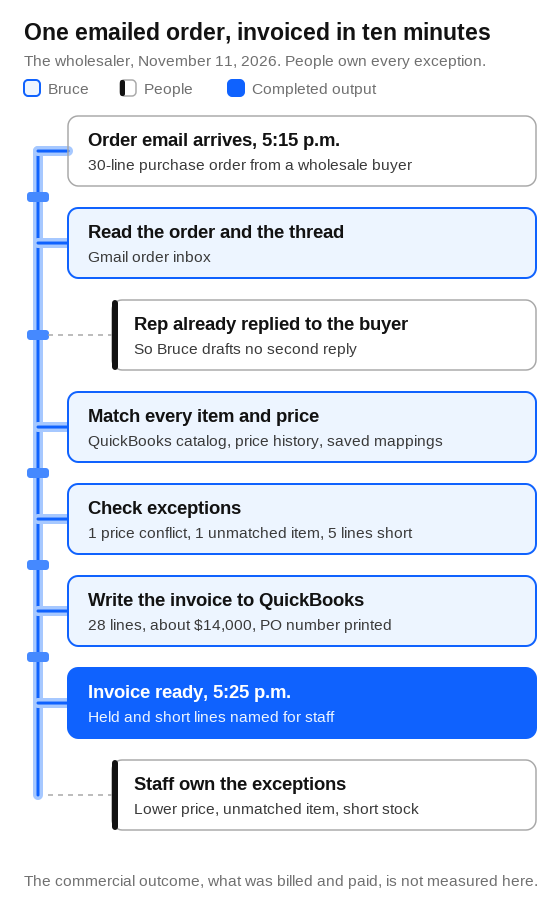
Business objective: Invoice a large restocking order the same afternoon, correctly priced, without billing missing stock.
Trigger: At 5:15 p.m. on November 11, 2026, one of the company's largest wholesale customers emailed a 30-line purchase order.
Intelligence & context: The order, the customer's price history, the catalog, stock on hand, saved item mappings and the email thread, where a rep had already replied.
Reasoning & decisions: Bruce matched 28 lines. One line's price contradicted the catalog and one item had no confident match, so both were held back rather than guessed. Five lines exceeded stock and were billed at what was on hand. With the rep's reply already sent, Bruce drafted none.
Execution: At 5:25 p.m., Bruce wrote a 28-line invoice of about $14,000 to QuickBooks, PO number printed, with the held and short lines named for staff.
Human leadership: The rep owns the buyer conversation; staff decide on the lower price, the unmatched item and the short stock.
Completed outcome: A priced invoice ten minutes after the order: a completed deliverable and system action; what was billed and paid is not measured.
04
The unified enterprise execution layer
From individual functions to organizational capability
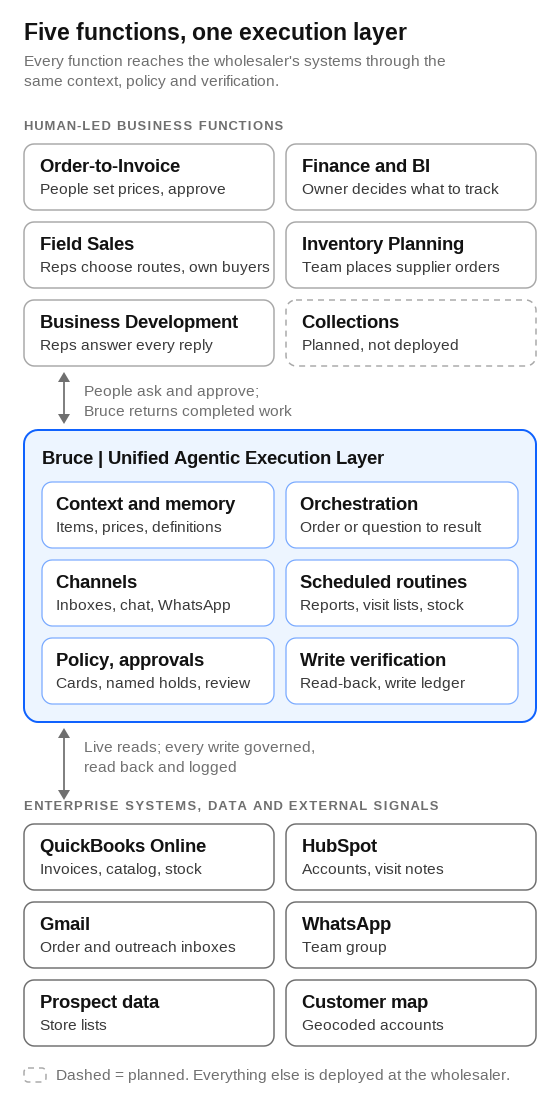
All five functions run on one Bruce deployment. They share a live connection to QuickBooks and HubSpot, one memory of item mappings, prices and report definitions, and the same channels: order inboxes, chat and WhatsApp. Scheduled routines deliver reports, visit lists and stock checks unprompted. Every write passes one policy layer: approval cards, named holds, read-back and a write ledger.
05
Business outcomes & human leverage
Measuring the impact of the new division of labor
Execution throughput: Dozens of invoices a month, hundreds of scheduled reports, daily visit lists, 100+ visit logs and a weekly reorder list.
Execution velocity: Four in five emailed orders are invoiced within ten minutes, about seven typically, and the owner's questions are answered in under a minute.
Execution quality: About half of emailed-order invoices carry named holds instead of guesses, and every write is read back. Early errors, including a duplicate invoice, led to today's duplicate check and stock limits.
Human leverage: Staff move from keying invoices and compiling reports to exceptions, pricing and buyers.
Business impact: 3 of the 13 new buying accounts from September to mid-November were first surfaced by Bruce's visit lists. No financial impact is claimed.
| Dimension | Traditional operating model | AI-native operating model |
|---|---|---|
| Intelligence | Sales and profit compiled by hand | Live answers in under a minute; dashboards twice daily |
| Decision-making | Stores by habit; prices looked up per order | Same decisions, on Bruce's lists, price history and holds |
| Execution | Staff keyed invoices and wrote reports | Bruce writes invoices, reports, CRM notes, visit and reorder lists |
| Human role | Data entry and report assembly | Exceptions, pricing, approvals and relationships |
| Business outcomes | Manual invoice time not recorded | About seven minutes from order to invoice; 3 of 13 new accounts first surfaced by Bruce |
06
The enterprise implication
The future of wholesale distribution
In distribution, speed and accuracy on many small transactions decide margin. When an agent executes the order, reporting and follow-up work in a distributor's own systems, the constraint moves from staff hours to judgment: which price to honor, which store to visit, what to reorder. The pattern repeats: connect the books, start with every order, surface every exception, keep approvals where money moves, then add the next function.
Figures come from Bruce's production records, July to November 2026.
In an AI-native distributor, every order still meets human judgment, but only where judgment is needed.
Download this case study
The full story as a PDF, to read offline or share with your team.