Outbound
The Anatomy of Effective Outreach: Why BDRs Should Think Like Netflix
You do not trust Netflix because it guessed your name. You trust it because it synthesized your history, your taste, and people like you into a prediction you actually want. Outreach works the same way — or it fails.
Outbound is a ranking problem
BDR teams treat personalization like a checkbox — first name, LinkedIn mention, send. That is window dressing on a volume play, not personalization. The message that lands is not the one with the cleverest opener. It is the one that synthesizes the right inputs into an offer the prospect was already primed to receive.
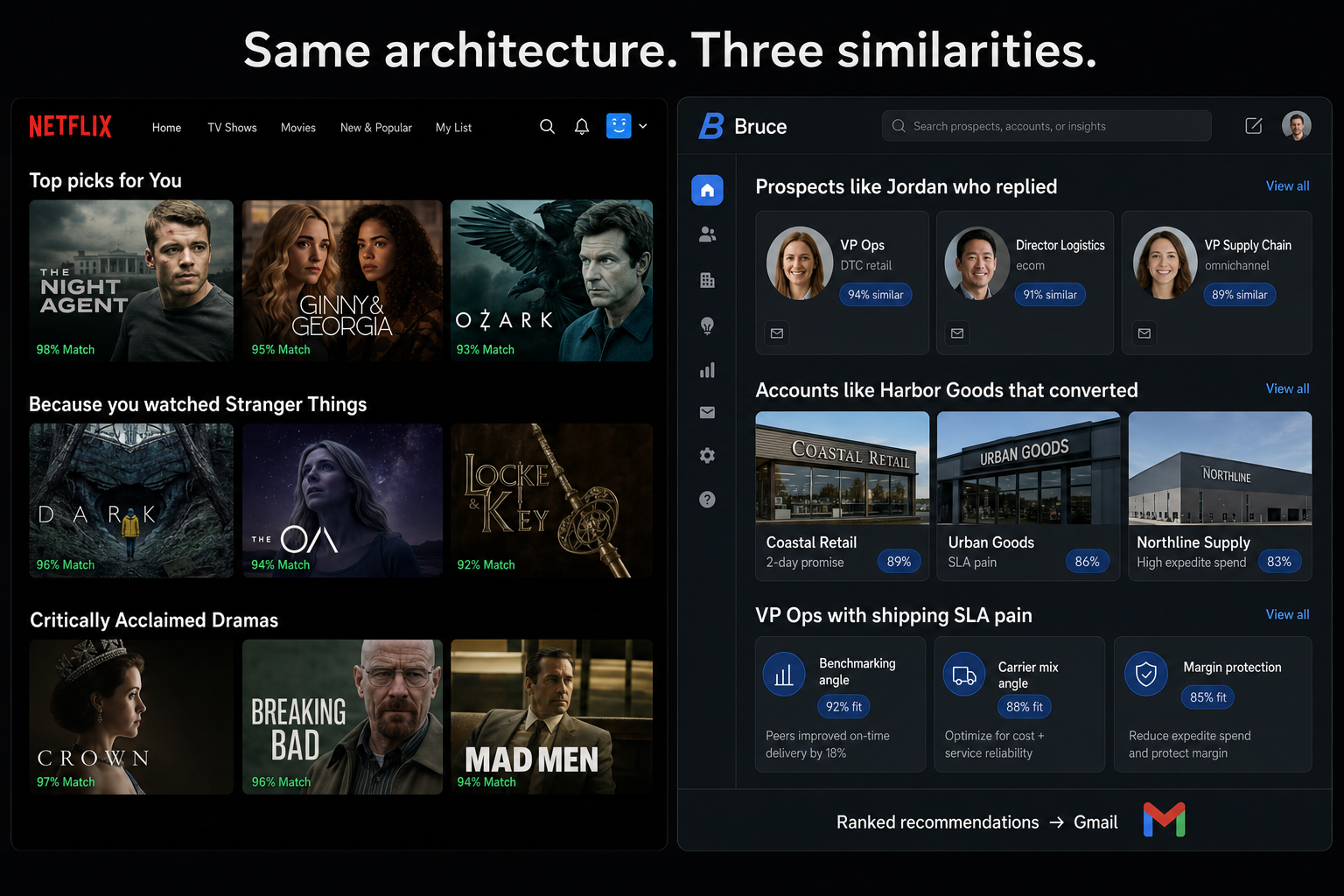
Netflix does not win by customizing thumbnails. It embeds taste, history, cohort behavior, and context — then ranks what sits closest. Cold outreach runs the same architecture. BDR teams that optimize subject lines while ignoring fit, persona, and timing are optimizing the thumbnail, not the recommendation.
When outreach fails, the algorithm — your BDR, your AI SDR, your sequence — was not fed the right inputs. Not because sentence two needed another adjective.
Three similarities Bruce ranks on
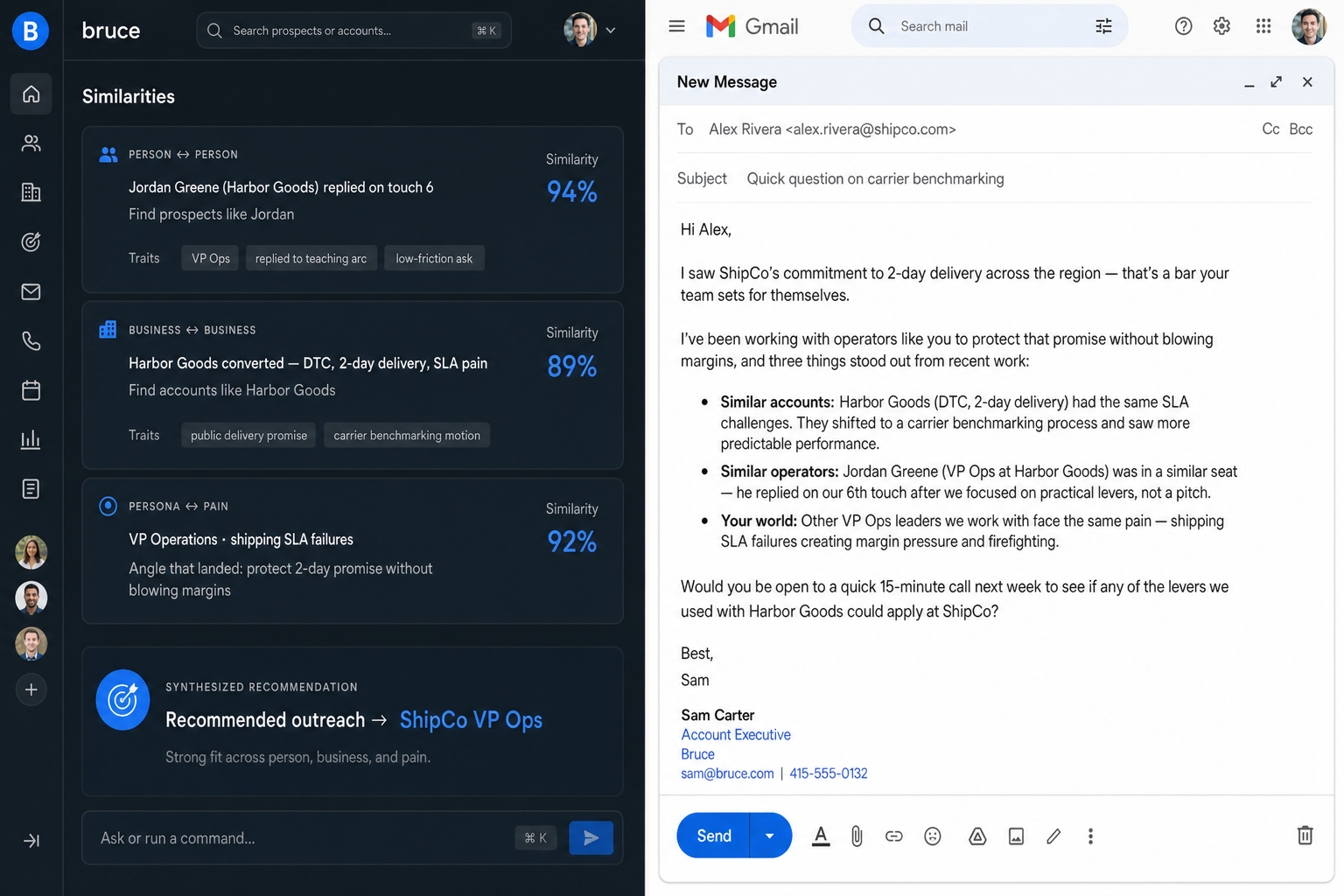
Netflix does not recommend with a mail merge. It runs three similarity signals in parallel — users like you, titles like the one you watched, genres you consistently choose — then ranks what sits at the intersection. Bruce personalizes outbound the same way.
1. Person ↔ person similarity
Who replied, who forwarded, who engaged on touch six instead of touch one? Bruce finds prospects who look like the buyers who already converted — same seniority, same engagement pattern, same tolerance for a teaching arc. Collaborative filtering for pipeline: people like Jordan replied; find more Jordans.
2. Business ↔ business similarity
Which accounts won, and what did they have in common? DTC with a public delivery promise. Mid-market SaaS post-Series C. Distribution with margin compression. Bruce maps business-to-business similarity — accounts that look like Harbor Goods get the outreach that worked on Harbor Goods, not a generic industry template.
3. Persona ↔ pain similarity
The same account needs different angles for different roles. VP Operations cares about SLA failures and carrier mix; a CISO cares about compliance exposure. Bruce matches persona to pain cluster — the operator language, the observable trigger, the value frame that landed for that role on that problem. Not a job title token. A pain-persona embedding.
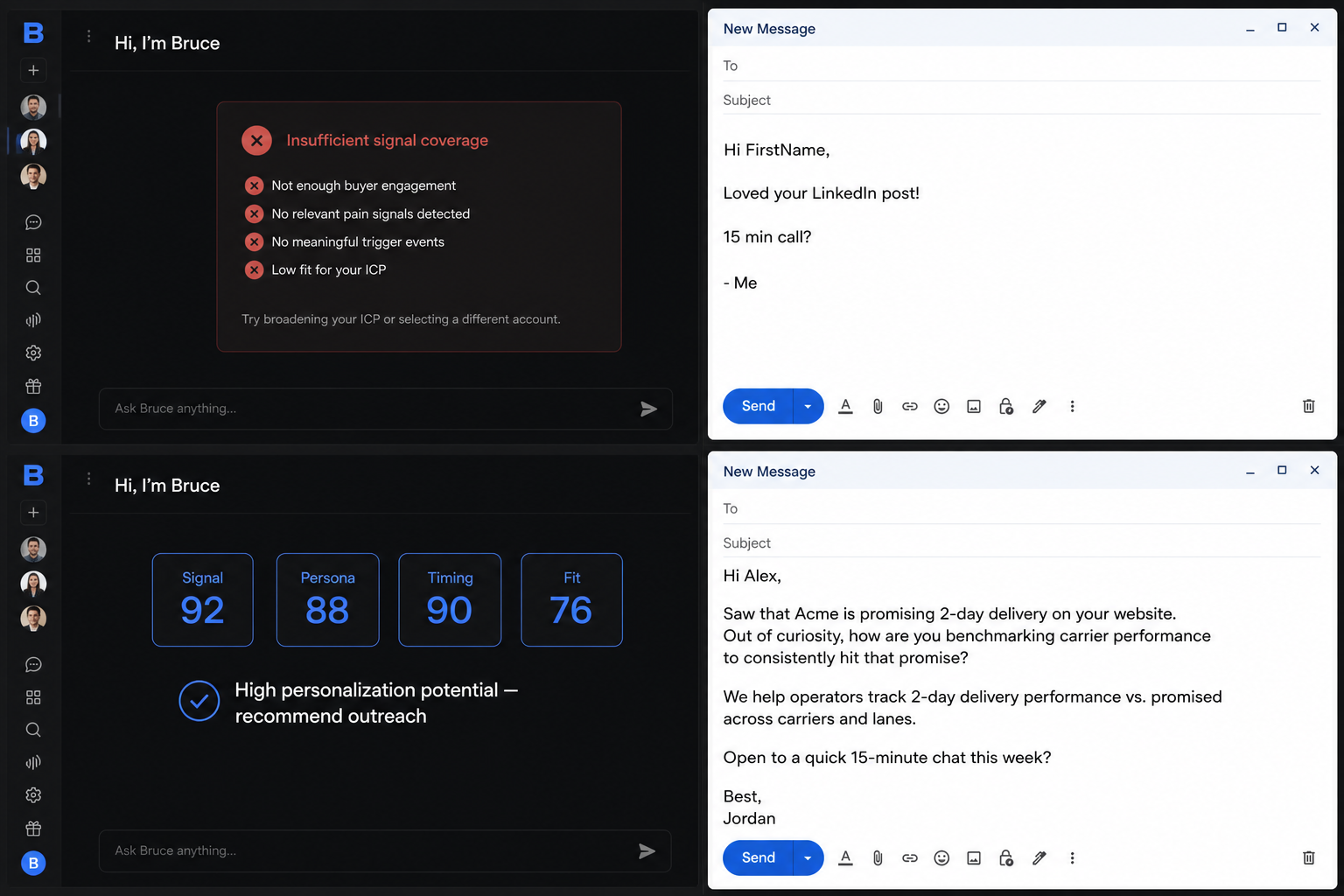
Token personalization populates one dimension and leaves the other two empty. That is why “Loved your LinkedIn post” reads generic — it never ran person-person, business-business, or persona-pain similarity.
What a winning sequence looks like
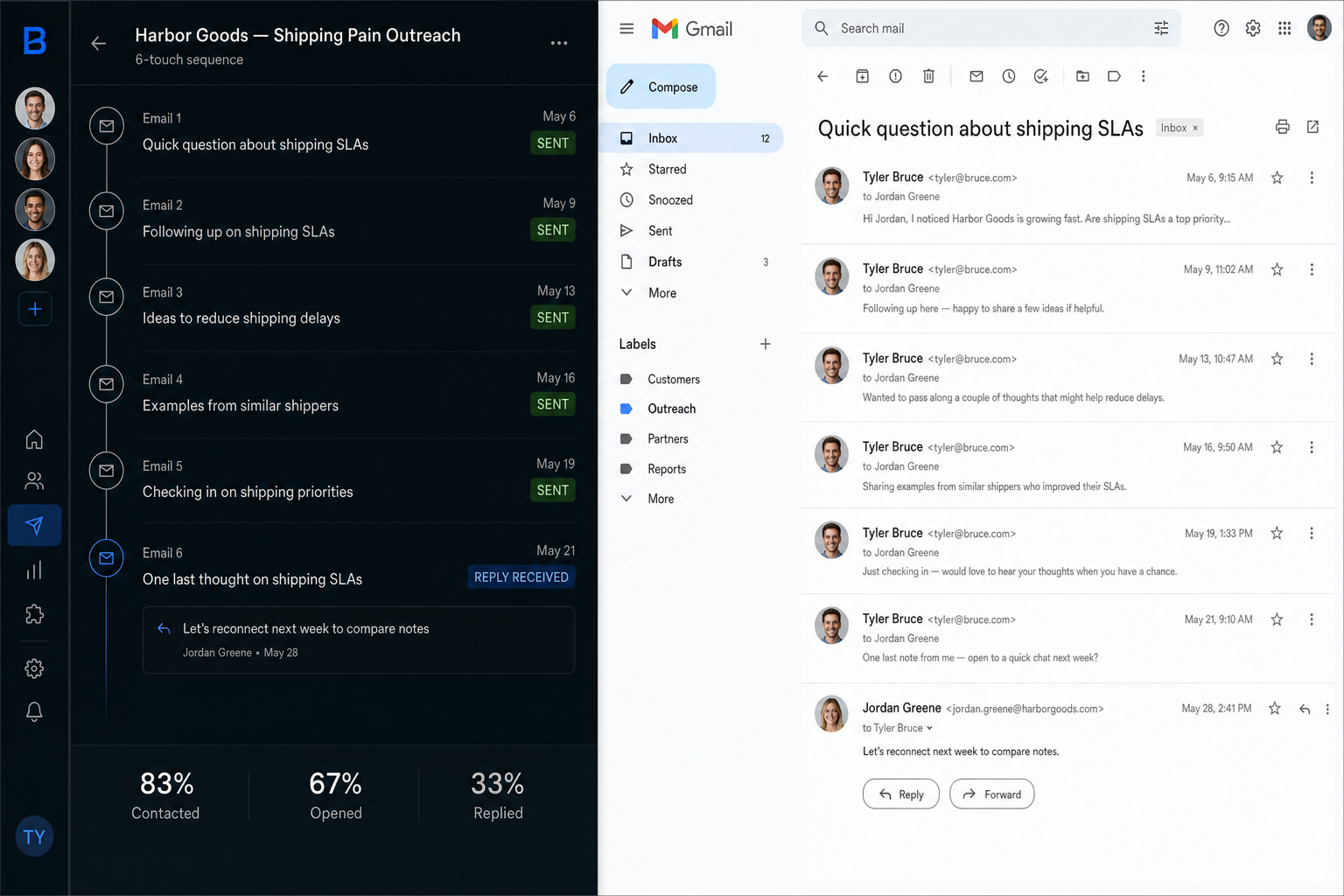
Six emails. Twenty-two days. Reply on touch six: “Let's reconnect next week to compare notes.” Retail ops leader at a DTC brand. Shipping and logistics pain. No cold opener magic — a teaching arc that built recognition before it asked for anything.
The arc
Same problem space every touch: shipping performance, SLA pressure, carrier mix. The sequence did not pivot randomly or rewrite positioning each week. Each email added a layer — how are you evaluating shipping today, costs beyond label price, benchmarking and orchestration, a data point on 12–18% savings in similar programs. Familiarity compounded. Credibility compounded. By email six the sender was recognized, not cold. Most teams optimize email one. Winning teams optimize the arc.
The language
The sequence never pitched “we optimize shipping.” It anchored on a public 2-day delivery promise, bulky and residential complexity, SLA failures and margin pressure — specifics the prospect could not ignore. The vocabulary was operator-grade: zones, accessorials, carrier mix. Not buzzwords. Not feature dumps. Persona nuance through language, not job title tokens.
The ask
Never “15 minutes this week?” Always “Are you the right person, or who owns this?” Easy to answer. Low commitment. The prospect replied while out sick — the ask matched his capacity. The final touch shifted to “compare notes,” not “book time.” No pitch pressure. Meet the prospect where they are, not where your quota calendar is.
When he said yes to comparing notes, Bruce handled what came next — follow-up, scheduling, time on the seller's calendar. No handoff thread. No Calendly ping-pong. The arc ended where outbound is supposed to end: with a meeting booked.
The system behind the arc
Most AI-SDR tooling automates the send loop — more variants, more tokens, more throughput, usually in another tab your reps never wanted. That is a faster mail merge, not a paradigm shift. Bruce runs an adaptive recommender autonomously through the tools your team already uses — Gmail, CRM, calendar — not a parallel outbound stack.
Sense context, score three similarities, execute the sequence in Gmail, learn from what converts. When a prospect engages — “compare notes,” “let's talk,” a forward to the right person — Bruce handles the follow-up and books the meeting on the seller's calendar. Straightforward touches go out on their own. Complex accounts get a draft in Gmail when a human should weigh in first. Either way, the motion runs in the inbox — not exported to a separate send tool.
The same graph that ranks accounts for outbound feeds targeting before messaging and insight-driven calls.
Tuesday, 8:15 AM
A BDR opens their sequence tool. Fifty accounts due today. The AI wrote fifty opening lines — each mentions something from LinkedIn. Reply rate last week: 1.2%. Meeting rate: flat.
Same BDR opens Gmail. Bruce ranked fifteen accounts signal-high overnight — Series C in the last thirty days, leadership change, evaluation intent. Four six-touch sequences are already running autonomously in Gmail, touch three sent before the rep logged in. Two more started this morning. One sensitive account has a draft waiting for a quick review before Bruce sends touch one. Replies are already in the inbox.
Same seller opens their calendar. Two discovery calls appeared overnight — booked from sequences the rep never manually scheduled. Teams running Bruce see this regularly: the recommender runs in Gmail, and meetings just show up. No scheduling thread. No “what times work?” back-and-forth.
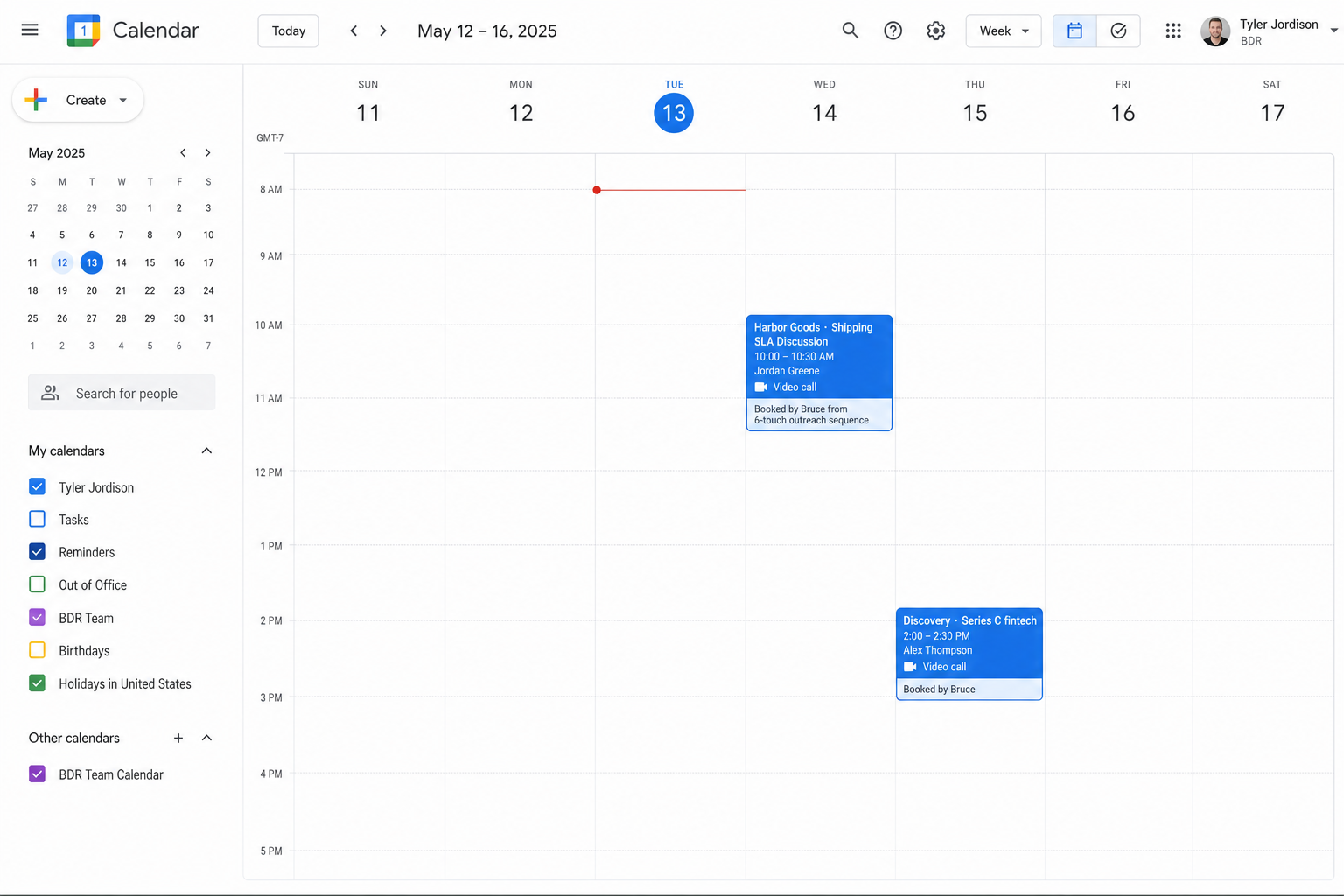
Same rep. Same quota. One motion optimizes sends in a tool nobody lives in. The other runs a recommender autonomously — and puts meetings on the calendar.
Bruce ranks accounts on signal, scores person-person, business-business, and persona-pain similarity, executes outbound through Gmail and CRM, and books meetings on the calendar — Autonomous Outbound Engine.
Field Notes
Continue
Targeting Beats Messaging
For net-new pipeline, targeting effectiveness dominates messaging personalization — across SaaS verticals, trade distributors, retail, CPG, and services businesses. Who you reach matters more than copy polish.
Why Enterprise AEs Dread Cold Calling
The cold call tax — psychological load, admin grind, and prospect pain. AI-native outbound removes the grunt layer with real-time briefs: stack, objections, and peer KPIs per persona.
Meeting Booked. Now the Real Work Begins.
Jordan Greene replied on email six. Bruce runs Harbor Goods from Calendar discovery through Sheets close — Google Workspace, not a parallel stack.