

Case study
Building the AI-Native Education Services Organization
How a K-12 education services company turned Salesforce into an execution layer, with Bruce running the recurring work of school research, outreach, program delivery and pipeline management.
Download the PDF- Customer
- A K-12 education services company
- Industry
- K-12 education services
- Functions
- Partnership development and outreach
- Program operations
- Sales operations and pipeline
- Leadership and department intelligence
- routines the company runs on Bruce
- 103
- of staff with a Bruce account used it in the past month
- 89%
- departments use Bruce: sales, programs, HR, marketing and grants
- 5
Executive summary
The company delivers tutoring, enrichment and college-access programs to school districts in many states. Winning that work means finding schools while their funding is open; delivering it means launching every program on time. Both ran on manual research and follow-through.
The company now runs 103 routines on Bruce, each created by describing it in chat: school campaigns from reps' own inboxes, launch alerts for every program manager, pipeline reports and Salesforce repairs. Bruce runs them hundreds of times a week across five departments. People approve every campaign, own every district relationship and decide what happens next.
The company moved from people searching for the work to people deciding it, with Bruce doing the searching, writing and checking every day.
01
The structural challenge
Why the traditional operating model constrains execution
The company grows by reaching districts while funding is open and launching each program on schedule. Before Bruce, that work was manual from end to end. Partnership development managers, meeting-booking reps and program managers searched for and researched schools by hand. When someone spotted a school signal, such as a new grant, an RFP or a board decision, the outreach that followed was written and sent by hand, one district at a time. Launch readiness, purchase orders and pipeline numbers were checked the same way, when someone remembered.
The data already lived in Salesforce. The constraint was people's time: every campaign and every program check competed for the same hours. Another application would not change that; the work itself had to be redesigned.
02
The AI-native operating model by function
Redesigning the division of labor between humans and agents
Five departments use Bruce: sales, program delivery, HR, marketing and grants. In each of four functions below, Bruce executes defined, recurring work against live Salesforce data, while employees decide what the routines do, approve what reaches customers and act on what Bruce surfaces.
Partnership development and outreach
Functional objective: Reach every district with funding and need while its window is open.
| Functional responsibility | Bruce executes | Humans lead |
|---|---|---|
| School research and lists | Researches schools and builds contact lists, excluding customers and open deals | Choose the campaign, territory and audience |
| Multi-step sequences | Drafts first touches and follow-ups in the rep's voice, paces sends and forwards replies | Approve the playbook and campaign; own every reply |
| Funding signals (emerging) | Screens grant, RFP and board-meeting signals; routes districts to territory reps | Decide which signals to pursue |
| LinkedIn and calls | Adds LinkedIn connection steps to each rep's task list beside the emails; drafts follow-up emails after Dialpad calls | Connect, call and send |
Operating-model transformation. Reps choose the audience and approve the campaign instead of researching and writing each email. 39% of campaign emails are follow-ups no one had to schedule.
Evidence of execution. Before a state tutoring-grant deadline, a campaign to that state's principals went from approved lists to sending within a day: about 150 personalized emails from three reps' inboxes.
Program operations
Functional objective: Launch every contracted program on time and keep it healthy through close-out.
| Functional responsibility | Bruce executes | Humans lead |
|---|---|---|
| Launch readiness | Emails each program manager five business days before any launch still red or yellow | Fix staffing; decide whether a launch proceeds |
| Purchase orders | Alerts the opportunity owner when an at-risk launch has no purchase order | Obtain the purchase order from the district |
| Program health and close-out | Flags long-red programs, missing close-out documents and unanswered program threads | Intervene with the school and hold the post-service meeting |
Operating-model transformation. Risk arrives in each manager's inbox, scoped to their programs, on the day it becomes actionable.
Evidence of execution. In an audit, the launch alerts matched an independent rebuild from Salesforce exactly.
Sales operations and pipeline
Functional objective: Keep meeting booking, proposals, pipeline and CRM records accurate and moving.
| Functional responsibility | Bruce executes | Humans lead |
|---|---|---|
| Meeting-booking activity | Daily and week-to-date caller reports; hourly list of calls with no disposition | Coach callers and set targets |
| Proposals and pipeline | Flags meetings with no proposal; daily stage changes and a Monday brief | Write proposals and forecast |
| Record stewardship | Repairs school accounts, files proposal PDFs, opens opportunities on request | Approve uncertain matches |
Operating-model transformation. Coaching numbers arrive on schedule, and record upkeep happens inside the work.
Evidence of execution. For each new school opportunity, a routine researches the school's website and logo and repairs the account: several hundred updates so far.
Leadership and department intelligence
Functional objective: Give leaders and every department a current view of districts, programs, staffing and pipeline without building reports.
| Functional responsibility | Bruce executes | Humans lead |
|---|---|---|
| Conversational analytics | Answers questions with read-only Salesforce queries | Ask the questions and decide |
| Briefs and dashboards | Daily leadership brief, weekly strategy brief, live dashboards | Set priorities |
| District and school reports | Engagement, win-back and launch-success reports | Choose what to share |
| Staffing and HR questions | Answers questions such as assignments by role and tutors per launch | Staff programs and hire |
Operating-model transformation. Visibility no longer depends on report builders: education, HR, marketing and grants staff ask Bruce directly.
Evidence of execution. The daily leadership attention brief was delivered on 28 of 29 weekdays since mid-October.
03
Inside the execution
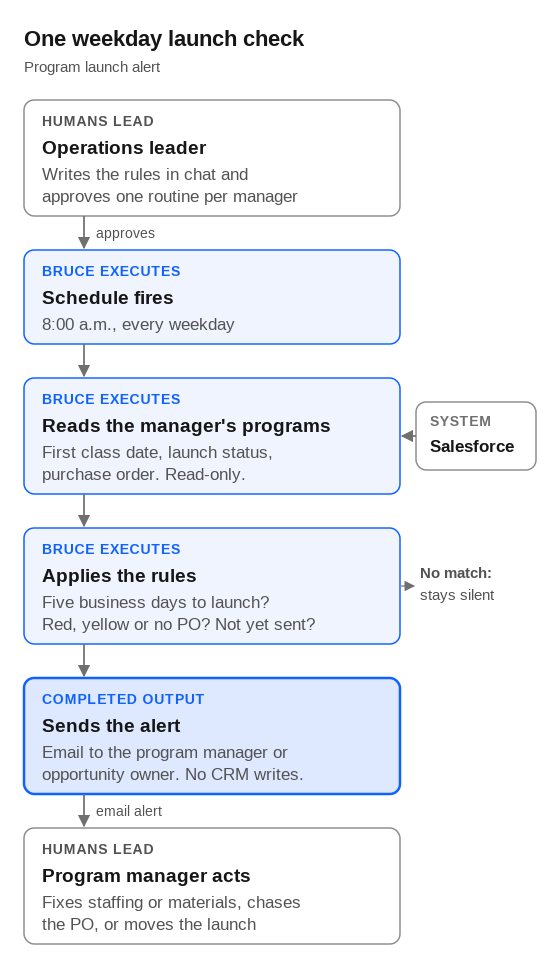
From business objective to completed work: the program launch alert
Business objective. Launch every program on schedule with staff, materials and a purchase order in place.
Trigger. 8:00 a.m. each weekday, one routine per program manager and opportunity owner, more than forty in all.
Intelligence & context. Each program's manager, first class date, launch status and purchase-order flag in Salesforce, plus the alerts already sent.
Reasoning & decisions. Bruce counts back five business days from each launch and acts only on that day, for programs red, yellow or missing a purchase order. It skips repeats, never mixes owners and stays silent when nothing qualifies.
Execution. Bruce emails the program manager, or the opportunity owner for a missing purchase order, naming each program, its status and its launch date. It writes nothing to Salesforce.
Human leadership. An operations leader wrote the rules and the email template in chat and approved each routine. Staff set launch status; managers fix staffing, chase the purchase order or move the launch.
Completed outcome. About 1,450 checks have run with one failure, sending about 120 alerts that matched an independent Salesforce rebuild. The output is a correct, timely alert; whether launches improved has not been measured.
04
The unified enterprise execution layer
From individual functions to organizational capability
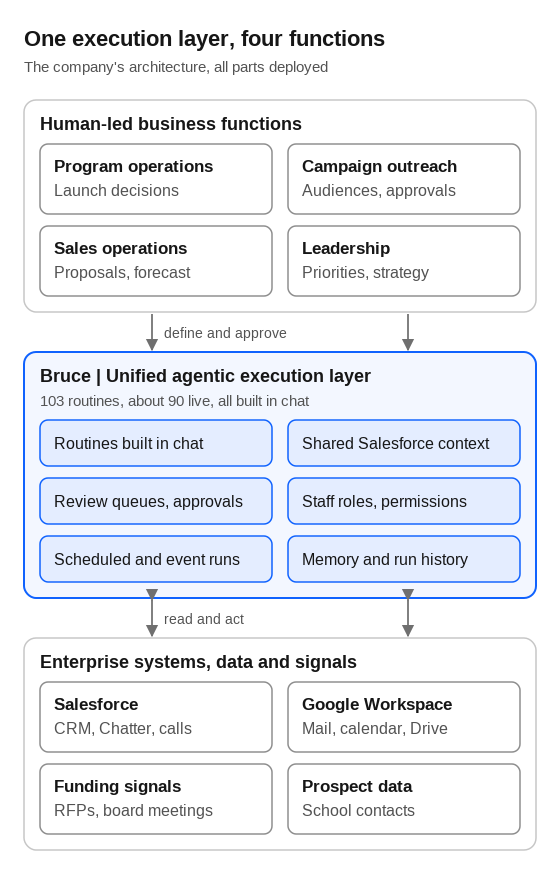
The four functions share one execution layer, not four AI tools. Every routine reads the same governed view of Salesforce, mail, calendar and funding signals, runs on the same scheduler, keeps its own memory and passes the same controls: staff roles, approval for CRM writes and a review queue for every campaign. One function's output, such as a repaired account, becomes another's context. All of it is deployed today, so a new function starts from working context, not a new integration.
05
Business outcomes & human leverage
Measuring the impact of the new division of labor
Execution throughput. 103 routines have run more than 3,200 times in under three months and sent more than 3,600 outreach emails across dozens of campaigns.
Execution velocity. Not measured against a baseline; launch risk now surfaces five business days ahead.
Execution quality. 99.9% of launch checks and 96% of all routine runs completed; every failure is visible. Reviewers edit or reject drafts before they send.
Human leverage. 89% of staff with a Bruce account used it in the last 30 days. Research, sequencing and checking moved to Bruce; approval and district relationships stayed with people.
Business impact. Bruce opened about 7% of new-business opportunities since go-live, at staff request. Revenue impact has not been measured.
| Dimension | Traditional operating model | AI-native operating model |
|---|---|---|
| Intelligence | Staff search and research schools by hand | Bruce researches districts, screens funding signals and reads Salesforce daily |
| Decision-making | Each person spots risk and opportunity alone | Rules set once in chat; Bruce surfaces only the cases that need a decision |
| Execution | Every email, alert and report written by hand | Bruce sends sequences and alerts, builds reports and repairs records |
| Human role | Searching, writing and chasing | Choosing audiences, approving campaigns, owning districts and launches |
| Business outcomes | No baseline recorded | 3,600+ outreach emails, 99.9% reliable launch checks, 89% monthly staff use |
06
The enterprise implication
The future of education services operations
When agents execute defined responsibilities, the people inside a function redesign it: an operations leader turns a launch checklist into forty routines; reps turn a grant deadline into a same-day campaign. Whoever spots a pattern can make it run. Human work shifts to choosing audiences, approving what reaches schools and owning relationships. Any business selling into fixed funding windows can repeat this from the CRM it already has.
The AI-native enterprise is not the one with the most agents. It is the one where the people who own the work put agents to work.
Download this case study
The full story as a PDF, to read offline or share with your team.