Agent UX
The Future of Agent UX Will Not Be Chat-First. It Will Be Intent-First.
NL-native, not chat-only.
Language is the default shell. GUI is a surface the agent renders when complexity, density, or risk demands it — inline, in one session, with a reason.
Language is the runtime. GUI is a rendered consequence of complexity — invoked by the agent, not chosen by the user from a menu of product philosophies.
The agent UX pattern
There is a lazy version of the agent UX debate: chat is the future, traditional UI is dead. I don't buy it. NL-native is not chat-only — it is a shell where the agent decides when prose is enough and when the job needs a rendered surface. Bolt a chat sidebar onto every dashboard and you get the same laziness in reverse.
The right pattern is simpler and harder to build: NL-native shell, with the agent invoking GUI artifacts inline — tables, dashboards, confirmation surfaces — based on what the job requires.
GUI is not deprecated. It is demoted from default and promoted to tool. The agent calls render_table when prose stops being honest. It calls render_confirmation when the commit boundary is irreversible. One thread. Zero mode switches.
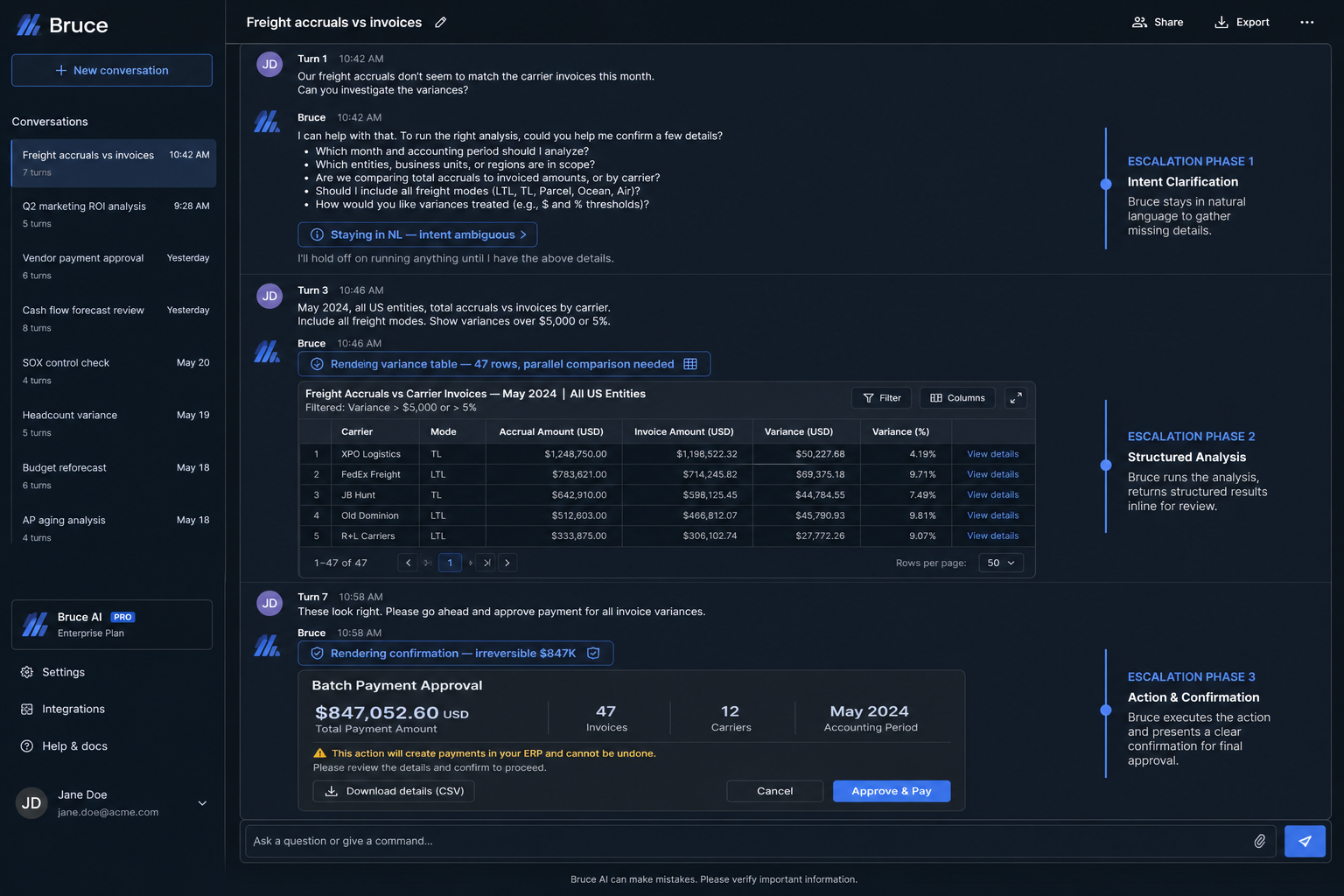
Tuesday, 4:47 PM — Rachel Kim, Controller
Month-end close. Rachel opens Bruce — not an AP dashboard, not a report builder. One NL-native session. She starts with what she has: “Our freight accruals don't match carrier invoices this month — help me figure out why before close.”
Turn 1 — stay in NL. Intent is ambiguous: cutoff timing, misclassified GL, duplicate blanket PO, mid-cycle carrier billing change. The agent asks clarifying questions. No GUI yet. Convergence before commit to a view.
Turn 3 — render_table. Forty-seven variance rows across carriers and GL accounts. Comparison cardinality exceeded threshold. The agent renders an inline table with a legible chip: “Rendering variance table — 47 rows, parallel comparison needed.” Rachel refines in language — “Group by root cause.” “Show only variances over $50K.” Language steers; GUI holds state.
Turn 7 — render_confirmation. Corrections identified. Batch payment ready: $847,000 to twenty-three vendors. Rachel says “Approve the corrected batch.” Risk threshold crossed. The agent renders an inline confirmation surface — amounts, recipients, audit trail, explicit Cancel and Approve. The agent proposes. Rachel commits.
The agent render policy
This is not vibes-driven UI. Elite agentic products encode an explicit render policy — Alignment · Awareness · Action · Risk — as agent decision logic, not user education:
Alignment — intent ambiguous → stay in NL. Awareness — state density or comparison cardinality exceeds threshold → render table, timeline, or dashboard inline. Action — simple, reversible, low-risk → execute in NL. Risk — irreversible or permission-sensitive → render confirmation surface; never chat-only commit.
The policy must be legible. Users trust agents that explain why the experience changed — not agents that spam widgets every turn or dump four hundred rows as markdown.
Wednesday, 9:00 AM — Elena Vasquez, VP Procurement
Same NL-native shell. Different domain. Elena opens Bruce before Q4 peak planning — not Ariba, not a BI dashboard. “Find suppliers most likely to miss lead times before Q4 and explain why.”
Turn 1 — stay in NL. The agent clarifies scope: packaging vs freight vs raw materials, which plants, what lead-time threshold counts as at-risk. Elena narrows to packaging and freight across the Midwest plants.
Turn 3 — render_table. Thirty-four suppliers. Parallel comparison needed. The agent renders an inline risk table — supplier, category, lead time, Q4 exposure, risk score — with the decision chip visible. Elena groups by root cause, drafts escalation emails for the top five, all in the same thread.
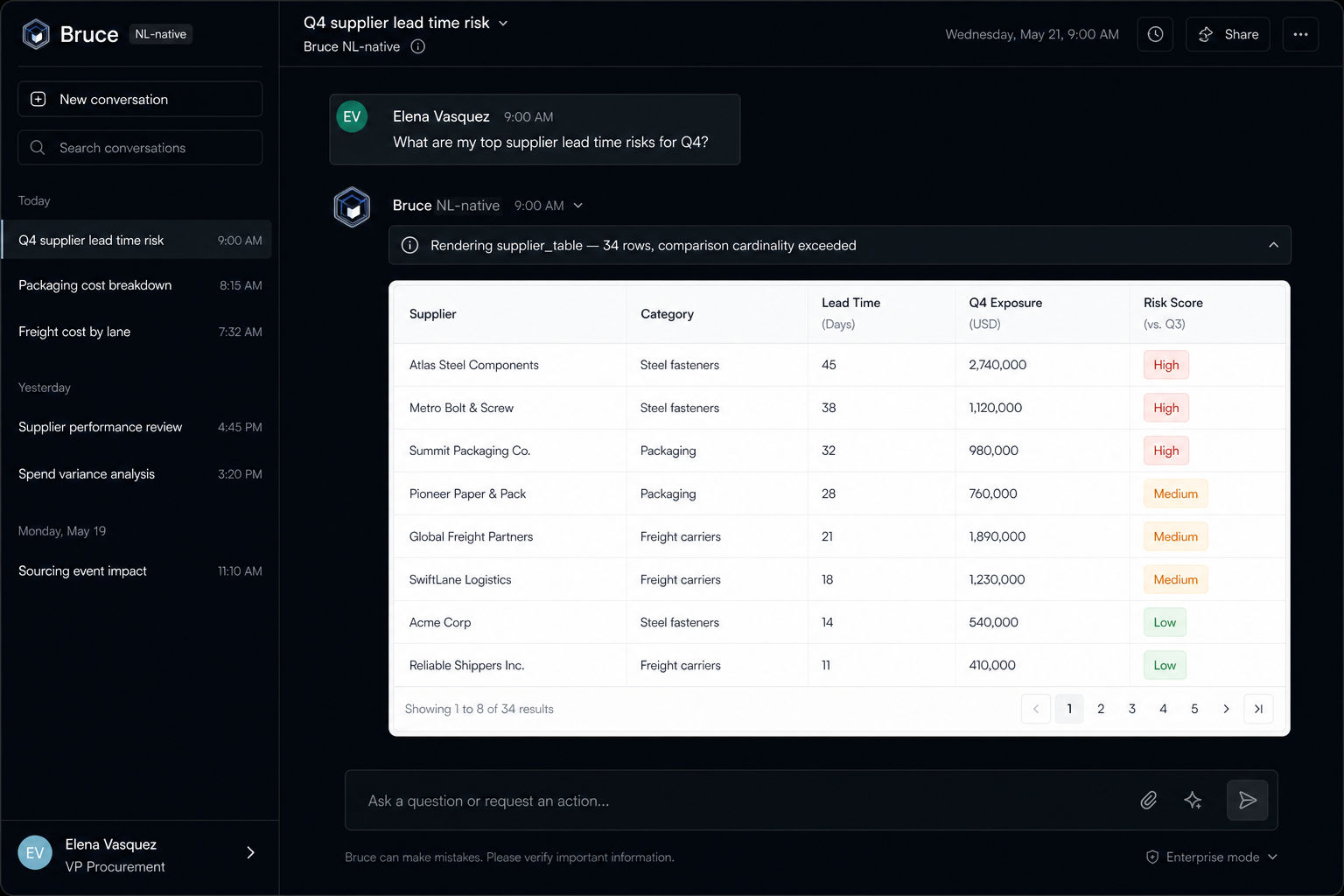
Turn 8 — render_confirmation. Elena says “Send to category managers.” External-facing. Five recipients. The agent does not confirm in a chat bubble — it renders a send confirmation surface: recipients, preview snippets, timing, permissions. Elena reviews. Then commits.
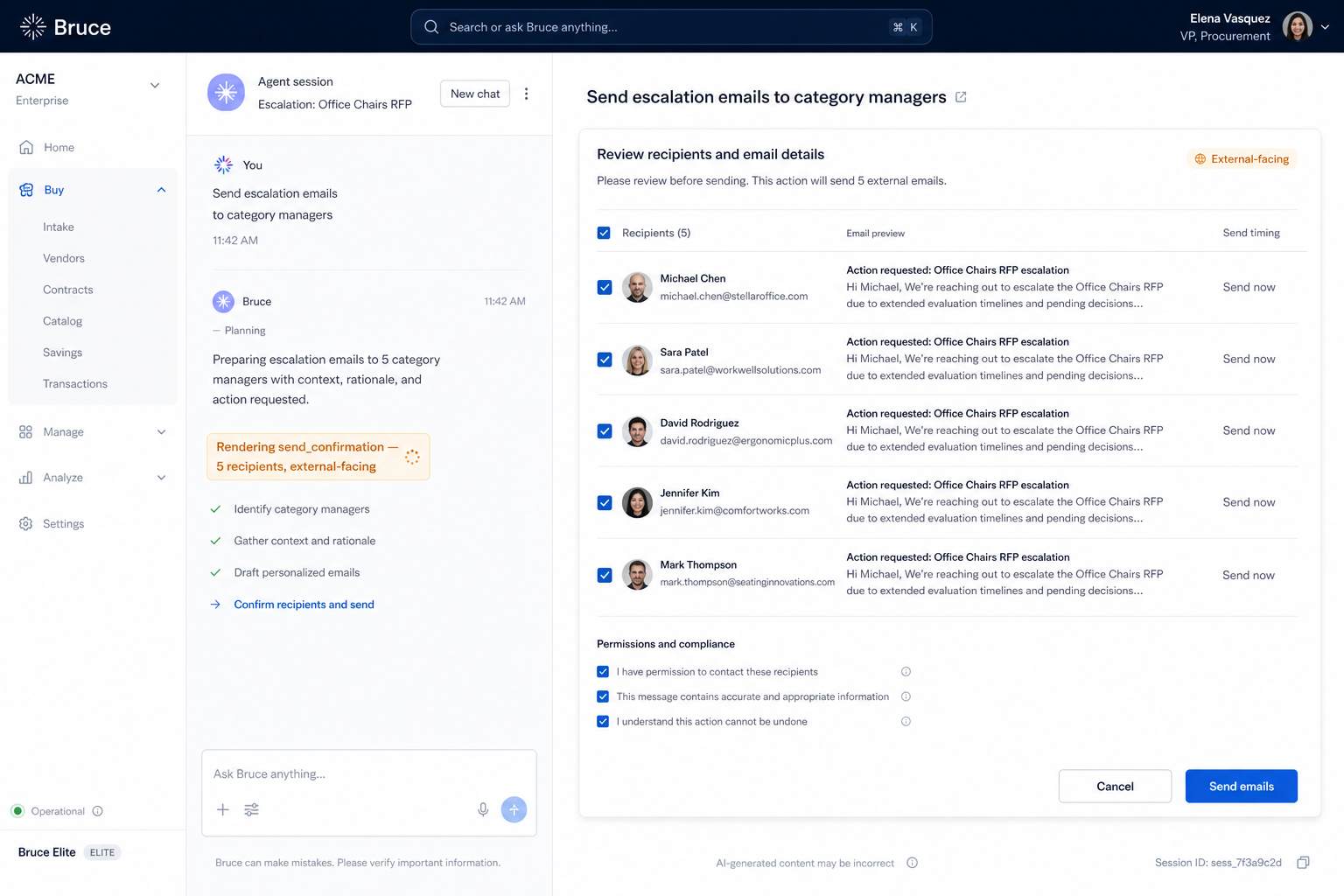
Finance close and purchasing command share one architecture. The domain changes. The render policy does not.
Thursday, 8:30 AM — Morgan Reyes, Enterprise AE
The pattern holds in GTM. Morgan opens Bruce before pipeline review — not a CRM export, not a spreadsheet she rebuilds every Monday. “Which open deals are single-threaded with no economic buyer engaged?”
Turn 2 — render_table. Twenty-three deals match. Comparison needed across account, stage, value, champion, and EB status. The agent renders an inline pipeline table — Harbor Goods flagged, three other six-figure opportunities single-threaded. Morgan sees the pattern in seconds, not after twenty minutes of CRM archaeology.
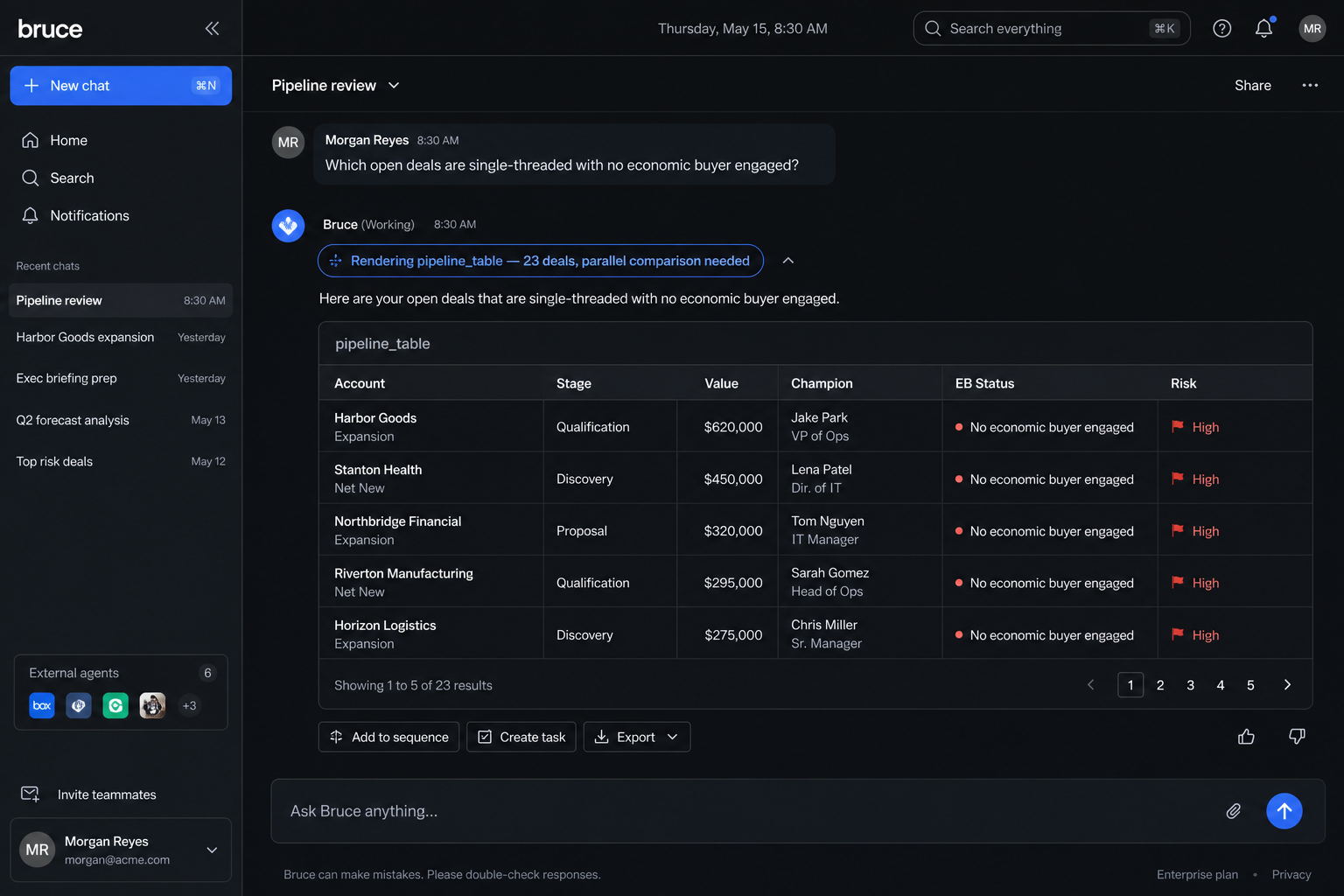
Turn 5 — render_confirmation. Morgan says “Draft multi-thread outreach for the top eight.” The agent generates champion memos — but before anything sends, it renders a bulk outreach confirmation: eight drafts, external-facing, guardrail note that economic buyers are not yet engaged. Morgan queues sends from the surface, not from a chat bubble. Same commit boundary as Rachel's batch payment and Elena's escalation emails.
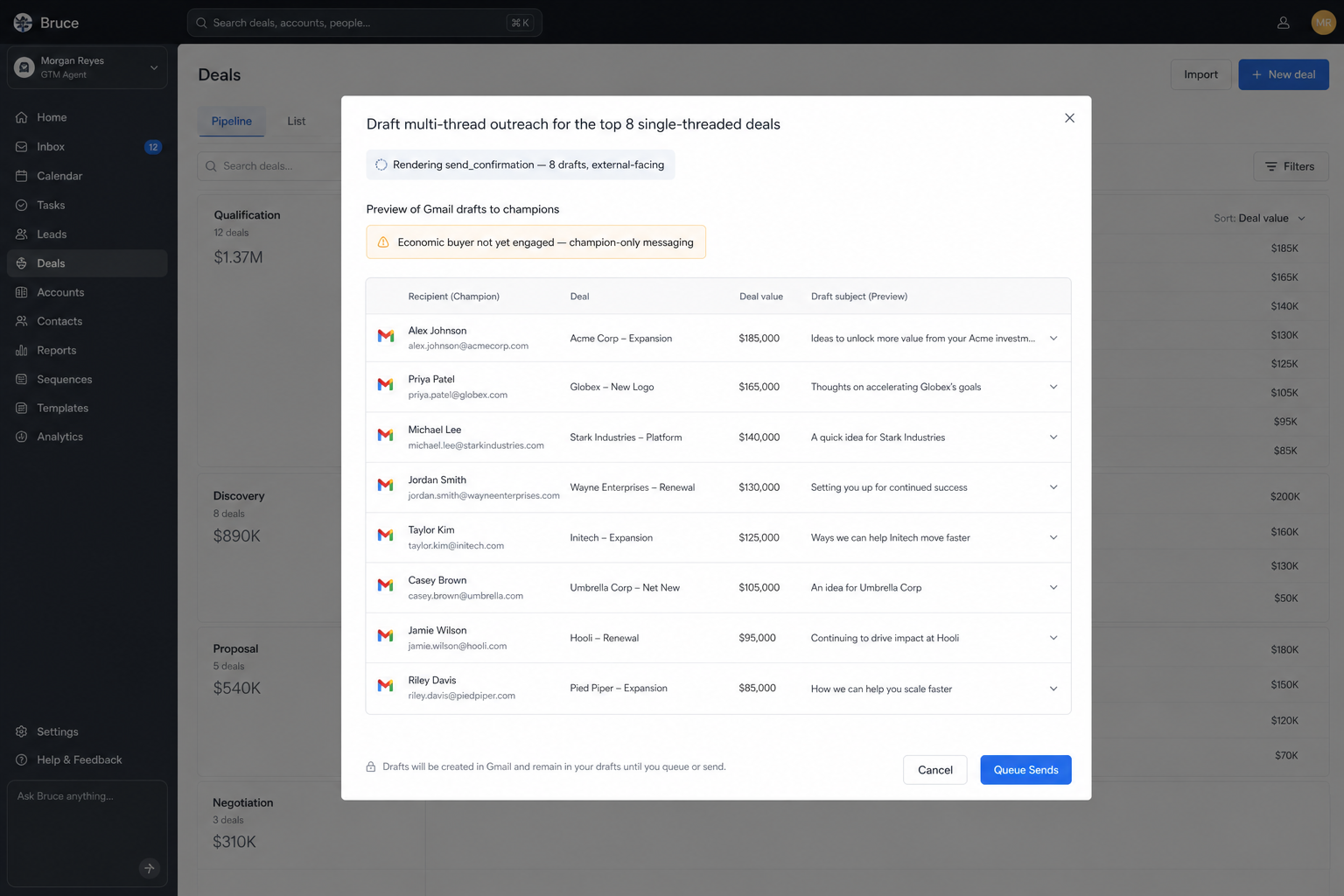
This is the same agent UX pattern that runs through deal execution, revenue leadership, and every workflow where ambiguity and accountability coexist. NL-native entry. Agent-driven escalation. Human commit at the boundary.
What separates elite from reckless
Three failure modes kill agent UX:
GUI spam — the agent renders a table on every turn because it can. Surfaces should escalate, not accumulate.
Markdown masquerading as GUI — four hundred vendor rows as a chat code block is not agent UX. It is laziness.
Chat-only commit — approving a batch payment, blanket PO, or bulk outreach through conversational confirmation. The agent must render explicit state at the commit boundary. Every time.
Elite agents also support collapse: “Actually, just summarize the top three issues.” The GUI artifact compresses back to NL when the job simplifies. The session breathes in both directions.
Chat is not the product. Intent is.
A lot of agent products mistake the chat box for the innovation. The innovation is that an agent can understand intent, reason over context, invoke tools, and synthesize the right experience for the moment.
Chat-only products force dense state and high-stakes decisions through a narrow window. Dashboard-first products force ambiguous intent through rigid forms. Agentic products do neither. They start in language and render GUI when the job demands it.
Building Bruce taught us this: users do not want to pick a UX mode. They want an agent that knows when prose is enough and when the job needs a table, a timeline, or a confirmation screen — and renders it inline, with a reason, in one session.
Build NL-native. Let the agent render complexity. Never let it commit without a surface.
Field Notes
Continue
Why Long Context Is Hard for Agents
Long context is working memory, not storage. Why agents struggle with relevance and time — and why converging frontier models make architecture the bottleneck.
Designing Guardrails for Autonomous Agents
Why production agents need governed autonomy: counter-metrics, context checks, drift controls, predictive critics, and control-plane enforcement.
Meeting Booked. Now the Real Work Begins.
Jordan Greene replied on email six. Bruce runs Harbor Goods from Calendar discovery through Sheets close — Google Workspace, not a parallel stack.