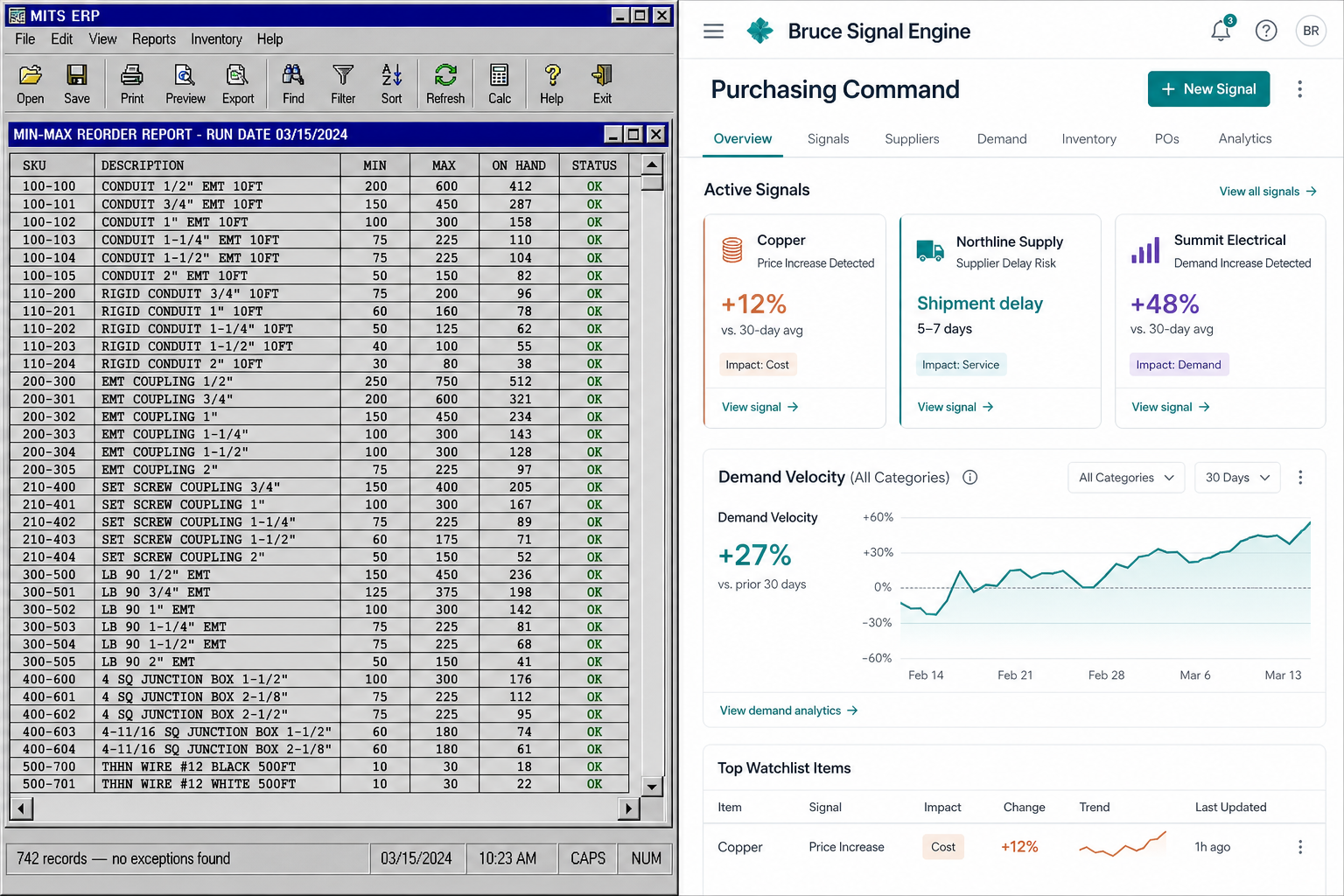
If you work in purchasing, you live in a world of conflicting signals. Copper is moving. A vendor just extended lead times on switchgear. Your North branch is out of QO220 breakers. A $200K school bid just hit inside sales. Aging POs are sitting unconfirmed. And your MITS min-max reorder report says everything is fine because min and max levels have not changed in six months.
$994K in dead stock. Fill rate slipping week over week. Turns at 3.6 and falling. Same MITS report — still all green.
This is the pattern we see across distributors: turns drift down, dead stock piles up, fill rates slip, and working capital gets trapped in the wrong SKUs — while the reorder report still says “OK.” The model is not broken because your team is bad at purchasing. It is broken because the model was built for a stable world, and distribution is not stable.
Purchasing in electrical distribution is not a static replenishment problem. It is a dynamic signal problem — closer to reading a market than filling out a spreadsheet. Prices move. Demand shifts by branch and by project. Field sales sees trends weeks before they show up in historical averages.
Stop managing inventory with frozen min-max rules. Start managing it with live signals — stockouts, velocity, supply chain risk, and field intelligence — prioritized like a trading desk.
Why Min-Max and Statistical Models Break Down
Min-max, safety stock, ABC classification, and moving-average demand forecasts all share the same flaw: they assume the past predicts the future. Set a minimum, set a maximum, reorder when you hit the floor. It works until it does not — and in electrical distribution, it stops working often.
The result is a double failure. You over-buy slow movers — turns drop, dead stock grows, cash sits on the shelf. At the same time, you under-buy hot items — stockouts rise, fill rates fall, and customers buy from someone who had it. Statistical models smooth out volatility. Distribution runs on volatility.
- They ignore commodity price trends — copper, steel, and resin move faster than your safety stock settings
- They do not see supply chain disruptions — vendor lead times change, allocations hit, plants go down
- They lag emerging demand — field sales quotes EV gear, controls, and lighting retrofits weeks before history shows a spike
- They treat all branches the same — North branch is on fire, South branch is slow, same min-max for both
- They miss project-driven demand — a single school or hospital bid can blow through branch inventory overnight
- They accumulate dead stock — slow movers sit above min because nobody revisited the max after demand shifted
- They erode turns — you keep replenishing to max on items whose velocity already dropped months ago
- They do not connect to PO pipeline reality — aging POs, unconfirmed lines, and vendor delays stay invisible
MITS min-max reorder report vs. Bruce Signal Engine
The Shift: From Replenishment to Signal-Based Purchasing
The future of purchasing in distribution is not better min-max tuning. It is signal-based — reading live data the way a trader reads a market, and acting on what is changing right now instead of what happened six months ago.
Legacy replenishment
- Reorder when inventory hits a static floor
- Demand forecasted from trailing averages
- Same rules across branches and categories
- Dead stock and stockouts treated as separate problems
- Field intelligence arrives weeks late
Signal-based purchasing
- Prioritize by urgency, velocity, and dollar impact
- Demand read from live trends, not frozen history
- Branch-level and category-level signals
- Dead stock, returns, and stockouts in one command view
- Field sales trends feed purchasing before orders land
Min-max tells you what to reorder. Signals tell you what to do today — what to chase, what to return, what to pre-position, and what to stop buying.
What Your Morning Actually Looks Like
Without Bruce
You open the MITS min-max reorder report — 742 SKUs, every row green, no exceptions found. You start working the list top to bottom. By 10 AM you have placed routine buys on three slow movers that already have 180 days of supply. Meanwhile, inside sales Slacks you: QO220 is out at North branch and a $140K school bid just converted. The aging switchgear PO from last month? Still unconfirmed. MITS does not track PO status.
With Bruce
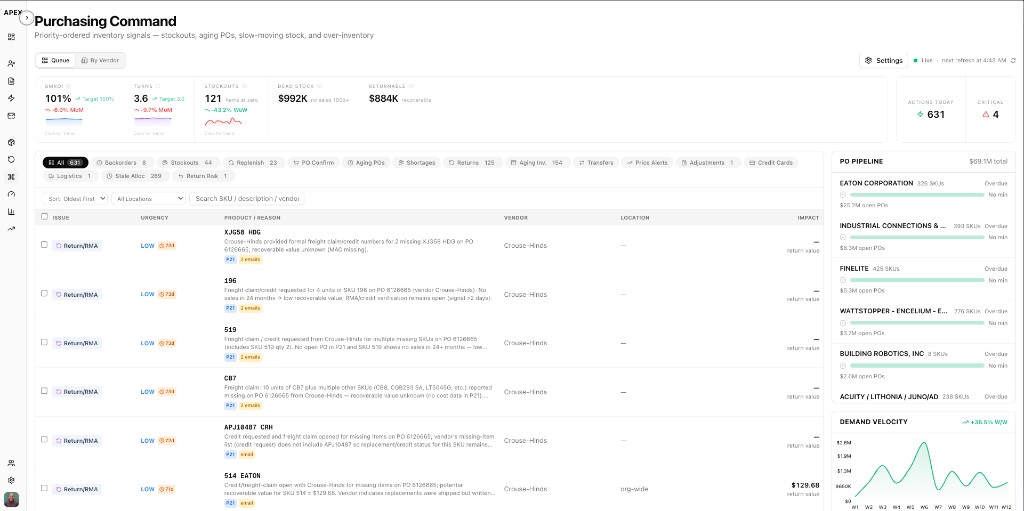
Bruce Purchasing Command opens with 355 signals — 2 critical. You start with the QO220 stockout affecting 14 customers. Next: an aging PO on switchgear holding up two jobs — Bruce drafted the vendor follow-up. Wire velocity is up 36% at North branch; you accelerate the THHN buy before copper moves again. Three school bids quoted this week show up as a field signal — you pre-position gear before orders land. The slow movers? They are on the list, but not at the top.
Purchasing Is a Stock-Market-Style Problem
Think about how a trader reads a market: price action, volume, momentum, news, and risk — all at once, prioritized by urgency. Bruce Purchasing Command applies the same logic to inventory — and surfaces the compound symptoms (turns, dead stock, fill rate, returnable dollars) as live KPIs, not quarterly surprises.
Demand velocity
How fast is this category moving? Up 36% week-over-week on wire and conduit at North branch — that is a signal, not noise.
Stockout risk
What will you run out of before the next PO lands? Priority-ordered by revenue impact and customer count.
PO pipeline
What is open, overdue, or unconfirmed? $69M in open POs means nothing if the critical lines are stuck.
Dead and slow stock
$994K in dead stock is capital trapped. Returns and RMAs are recoverable cash — if someone acts on them.
Commodity trends
Copper up 12% this quarter changes your buy timing on wire and cable — min-max does not know that.
Field intelligence
Outside sales is quoting three school projects on gear packages this month — purchasing should see that before the orders hit.
Bruce Purchasing Command — priority-ordered inventory signals
What Bruce Purchasing Command Looks At
Bruce aggregates signals from ERP, PO data, vendor feeds, commodity indices, and field sales activity into one priority-ordered command view.
Signal Categories
- Stockouts — items at risk now, ranked by urgency and revenue impact
- Backorders — customer orders waiting on inventory that is not coming fast enough
- Replenish — items trending toward stockout based on velocity, not static min levels
- PO confirm — open POs needing vendor confirmation or follow-up
- Aging POs — lines past expected delivery date, holding up jobs and quotes
- Shortages — branch-to-branch imbalances where one location is out and another has stock
- Returns and RMAs — recoverable inventory and vendor credit opportunities
- Aging inventory — slow-moving and dead stock tying up working capital
- Price alerts — commodity moves and vendor price changes affecting buy timing
Top-Level KPIs
- Fill rate — order line fill vs. target, with trend
- Turns — inventory turns vs. target, with trend
- Stockouts — count at risk, with week-over-week change
- Dead stock — dollar value of inventory with no sales in 120+ days
- Returnable — dollar value recoverable through returns and RMAs
Field Sales Trends Feed Purchasing
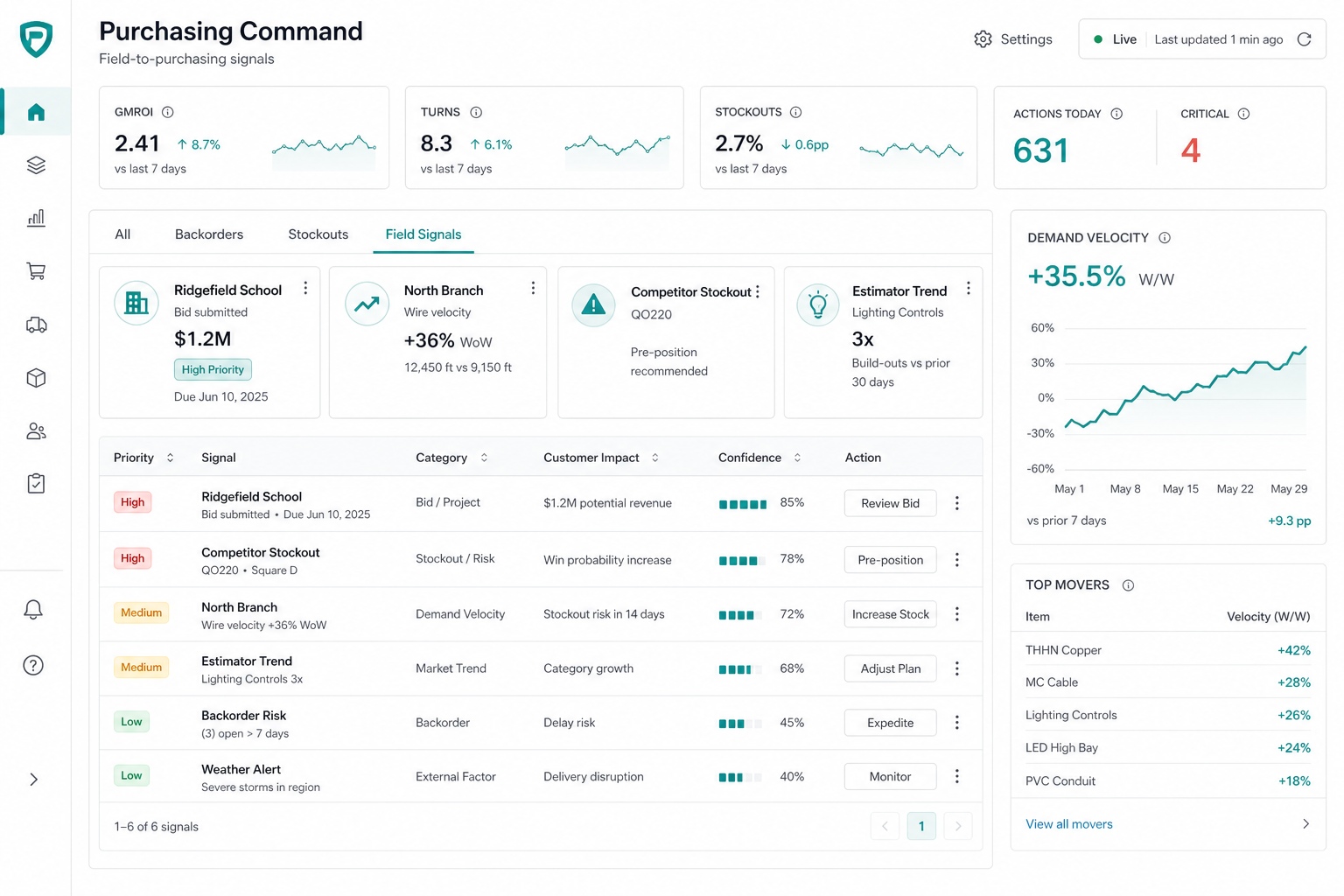
The biggest blind spot in min-max models is the field. Outside sales and inside sales see demand forming before it hits order history. Bruce connects field activity to purchasing signals.
- Open quotes and bid activity — large project packages signal upcoming demand spikes on gear, wire, and devices
- Quote categories trending up — if controls mentions are up 3x this month, purchasing should pre-position before stockouts hit
- Competitor stockout mentions — field reps hear when a competitor is out; that is a pre-positioning opportunity
- Job site purchase patterns — wire and conduit purchases suggest the next phase; devices and gear follow
- Lost quotes on availability — if you lost a bid because you were out of stock, that signal should change replenishment priority
- Customer expansion conversations — share-of-wallet growth in a category means velocity is about to change
Field-to-purchasing signals — how sales trends feed inventory decisions
The Daily Purchasing Loop
1. Open command
Start with Bruce Purchasing Command. Scan KPIs — are stockouts rising? Is dead stock growing? What changed since yesterday?
2. Work critical signals
Filter to critical and high-urgency items first. Stockouts and aging POs before routine replenishment.
3. Read velocity
Check demand velocity charts by category and branch. Is this a trend or a one-week spike?
4. Factor external context
Review commodity trends, vendor lead time changes, and field sales signals before placing buys.
5. Act and coordinate
Confirm POs, chase vendors, initiate returns, transfer stock between branches, adjust replenishment.
6. Track outcomes
Did stockouts drop? Did turns improve? Did you recover returnable inventory? Bruce tracks the results.
Old Way vs. Bruce Way
Old way: “Run the MITS min-max report — 742 records, no exceptions found.”
Bruce way: “355 signals today. 2 critical. Start with the stockout on QO220 at North branch — 14 customers affected.”
Old way: “Copper went up but our safety stock has not changed in a year.”
Bruce way: “Commodity alert: copper up 12% QoQ. Wire and cable velocity rising. Adjust buy timing on THHN.”
Old way: “Field sales says gear is hot but purchasing will not see it in the system for three weeks.”
Bruce way: “Three school bids quoted this week — gear and controls demand spike predicted. Pre-position before orders land.”
Old way: “$875K in returnable inventory and nobody is working the RMAs.”
Bruce way: “123 return actions queued, prioritized by recoverable value. Start with the Northline Supply credit memos.”
Common Mistakes to Avoid
Purchasing Cheat Sheet
“What needs action today?” → “Bruce, show me critical purchasing signals.”
“Are we about to stock out?” → “Bruce, which items are at stockout risk this week?”
“What is trending?” → “Bruce, show demand velocity for wire and gear at North branch.”
“What is the field seeing?” → “Bruce, what field sales trends should affect purchasing this week?”
“Where is my cash trapped?” → “Bruce, show returnable inventory and aging stock prioritized by value.”
Best Prompts
Morning Command
- Bruce, open purchasing command — what changed overnight?
- Bruce, show me critical and high-urgency signals.
- Bruce, which stockouts are affecting the most customers?
- Bruce, are there aging POs I need to chase today?
Demand and Trends
- Bruce, show demand velocity for [category] over the last 12 weeks.
- Bruce, what field sales trends should affect purchasing this week?
- Bruce, are commodity prices changing buy timing on wire or cable?
- Bruce, which branches have velocity spikes I should pre-position for?
Recovery and Optimization
- Bruce, show returnable inventory prioritized by recoverable value.
- Bruce, what dead stock should we markdown or return this month?
- Bruce, where can I transfer stock between branches to prevent stockouts?
- Bruce, summarize purchasing actions today — stockouts resolved, POs confirmed, returns initiated.
Example Scenarios
Commodity Spike on Wire
Copper rises 12% in a quarter. Min-max says reorder at the same quantity. Bruce flags a commodity alert, shows wire velocity up 28% at two branches, and recommends accelerating the buy on THHN before the next price increase — while holding off on overstocking fittings that are trending flat.
Field Signal Before the Order
Outside sales quotes three school projects on gear and controls packages this week for Summit Electrical Contractors. Order history shows nothing yet. Bruce surfaces the field signal, predicts demand spike on panelboards and lighting controls, and recommends pre-positioning at the serving branches before inside sales converts the quotes to orders.
Aging PO Holding Up Jobs
A switchgear PO from Northline Supply is 3 weeks past expected delivery. Min-max does not track PO status. Bruce flags it as a critical aging PO, shows 2 open customer orders waiting on the line items, and drafts a vendor follow-up with the specific PO lines and job names at risk.
Final Rule
Inventory is not static. Demand moves, commodities move, supply chains break, and field sales sees it first. Statistical reorder models cannot keep up — that is why turns fall, dead stock grows, and fill rates slip even when the ERP says everything is fine. Bruce Purchasing Command reads the signals — and puts the highest-impact actions at the top of your day.
Stop reordering on autopilot. Start reading the market.