Bruce helps outside sales reps run their territory like high-performing revenue operators.
In electrical distribution, relationships still win. Contractors, estimators, project managers, facility teams, purchasing managers, branch teams, quotation teams, and manufacturer reps all matter.
Bruce does not replace the seller. Bruce makes the seller sharper.
What Bruce Helps You Do
- Visit the right accounts first.
- Walk in with the right account, quote, project, and service context.
- Speak your notes naturally after the meeting.
- Turn every customer conversation into CRM updates, follow-ups, quote actions, and internal tasks.
Plan with Bruce. Sell with context. Speak your notes. Let Bruce handle the admin.
The Bruce Standard
Every field visit should have five things:
- A commercial reason: Why am I visiting this customer today?
- A prepared point of view: What do I know before I walk in?
- A specific ask: What do I need to learn, confirm, or move forward?
- A captured outcome: What changed after the conversation?
- A next step with owner and date: Who is doing what, and by when?
If a visit does not have these five things, it is just a check-in. Bruce helps turn check-ins into revenue-producing conversations.
The Daily Bruce Loop
1. Prioritize
Who should I visit and why? Bruce reviews your territory, open quotes, active jobs, customer activity, service issues, and route to recommend the highest-value visits.
2. Prepare
What should I know before I walk in? Bruce gives you the account brief: open quotes, recent purchases, active projects, missing categories, contacts, service issues, and recommended questions.
3. Sell
What should I ask while I am there? Bruce helps you turn the visit into a focused conversation around project capture, share of wallet, service recovery, expansion, retention, or competitive displacement.
4. Capture
What changed? After the meeting, speak to Bruce for 60 seconds. Bruce turns your voice note into structured CRM notes, opportunity updates, and next steps.
5. Coordinate
Who needs to act internally? Bruce creates the tasks for inside sales, quotations, branch operations, vendor/manufacturer partners, or your manager.
6. Follow through
What does the customer get, and by when? Bruce drafts the customer follow-up and tracks the next step so nothing gets lost.
Old Way vs. Bruce Way
Old way: “I'm nearby, so I'll stop in.”
Bruce way: “I'm stopping in because their Ridgeview School quote is due Friday, Graybar is in the deal, and we have a chance to expand from lighting into controls and emergency lighting.”
Old way: “I'll ask how things are going.”
Bruce way: “I'm going to ask whether we are getting the full bill of material, who owns the final package decision, and whether they need staged delivery or long-lead gear support.”
Old way: “I'll update CRM at the end of the day.”
Bruce way: “I'll speak to Bruce from the parking lot before I drive away.”
Old way: “I'll tell inside sales later.”
Bruce way: “Bruce creates the quote task, vendor pricing request, branch follow-up, and customer email before I leave the lot.”
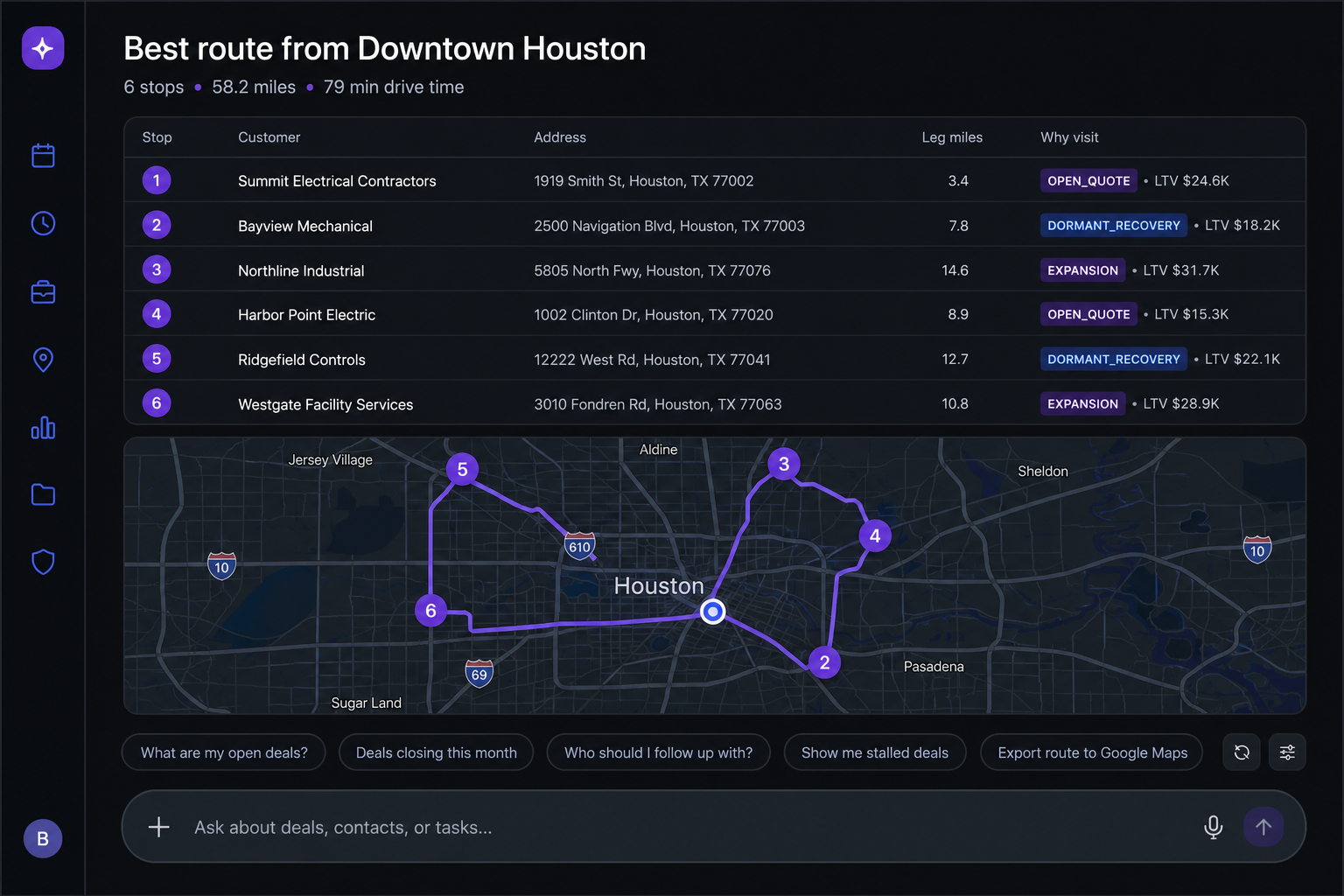
1) Visit Prioritization
Start every day by asking Bruce which accounts, prospects, and job sites deserve your time. Do not choose visits only by habit, geography, or who you already know best.
Use Bruce to identify where your visit can move an open quote, protect an at-risk account, expand share of wallet, recover from a service issue, capture an active project, create a vendor-supported opportunity, re-engage a dormant account, or prevent a competitor from taking the package.
What Bruce Looks At
- Open quotes and bid due dates
- Active jobs and quote size
- Quoted-but-not-won activity
- Recent order activity and drop in customer spend
- Counter activity and will-call patterns
- Service complaints, backorders, stock-outs, and delivery issues
- Credit or payment concerns and competitor mentions
- Product category gaps and branch inventory
- Upcoming projects and bid board activity
- Manufacturer promotions, rebates, and vendor programs
- Nearby job sites and house accounts needing field attention
“Bruce, build my visit plan for today.”
“Bruce, which accounts should I prioritize based on open quotes, bid deadlines, account risk, and expansion potential?”
“Bruce, where can I create the most revenue impact today?”
Illustration: Route prioritization with commercial reasons and map sequence
2) In-Person Conversation Context
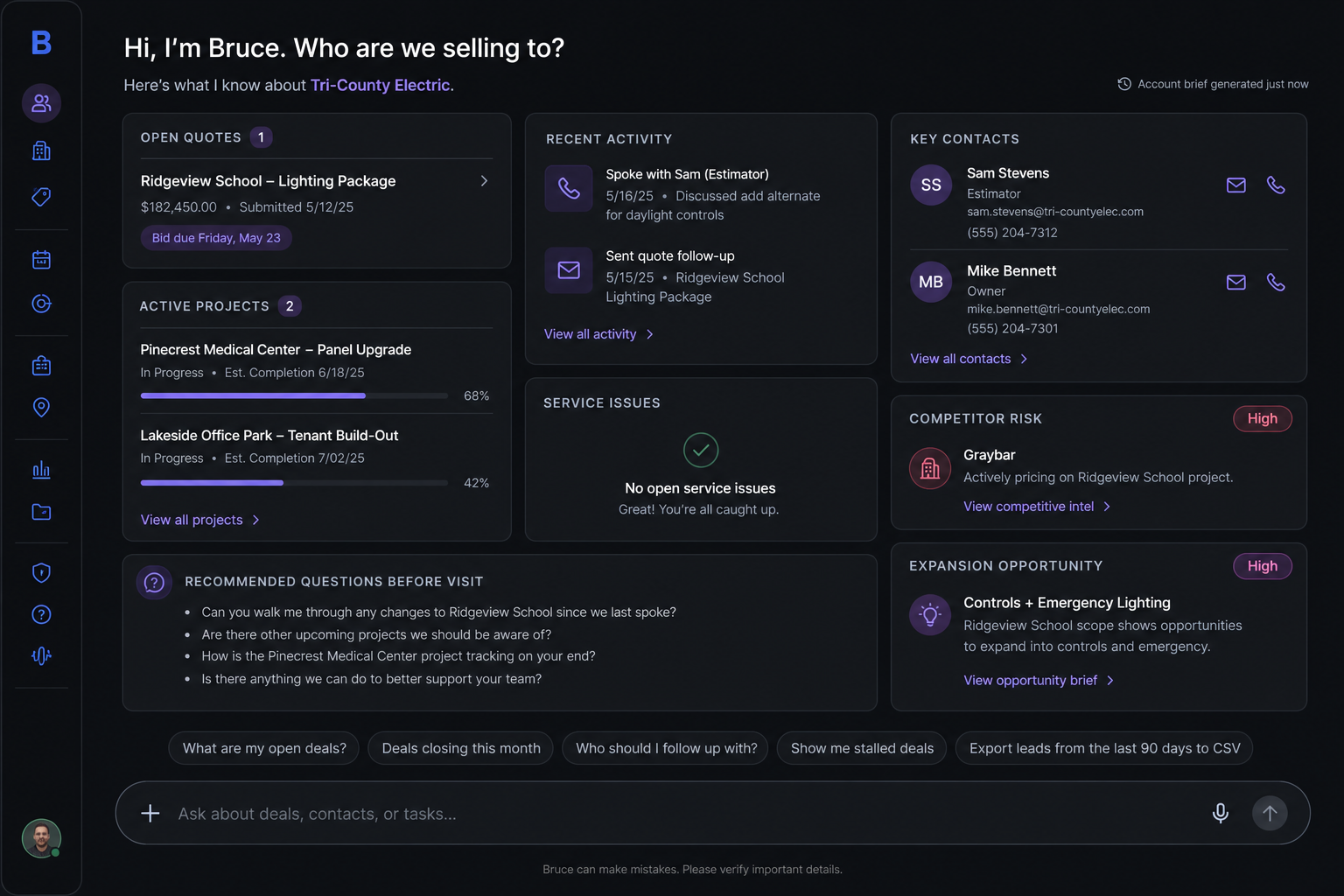
Never walk into a contractor office, job trailer, facility, or customer meeting cold. Before each visit, ask Bruce for the account brief.
- What the customer buys and what they do not buy from you yet
- Which projects are active and which quotes are open
- Which deadlines matter and who key contacts are
- What was promised last time and what service issues must be addressed
- Which competitors may be involved and which vendor programs can help
- What your best ask should be before you leave
“Bruce, give me the account brief for Tri-County Electric.”
“Bruce, what should I ask before I leave?”
“Bruce, are there any service issues, backorders, or stock-outs I need to address?”
Illustration: Pre-visit account brief with quotes, contacts, and recommended questions
3) Follow-Up Automation
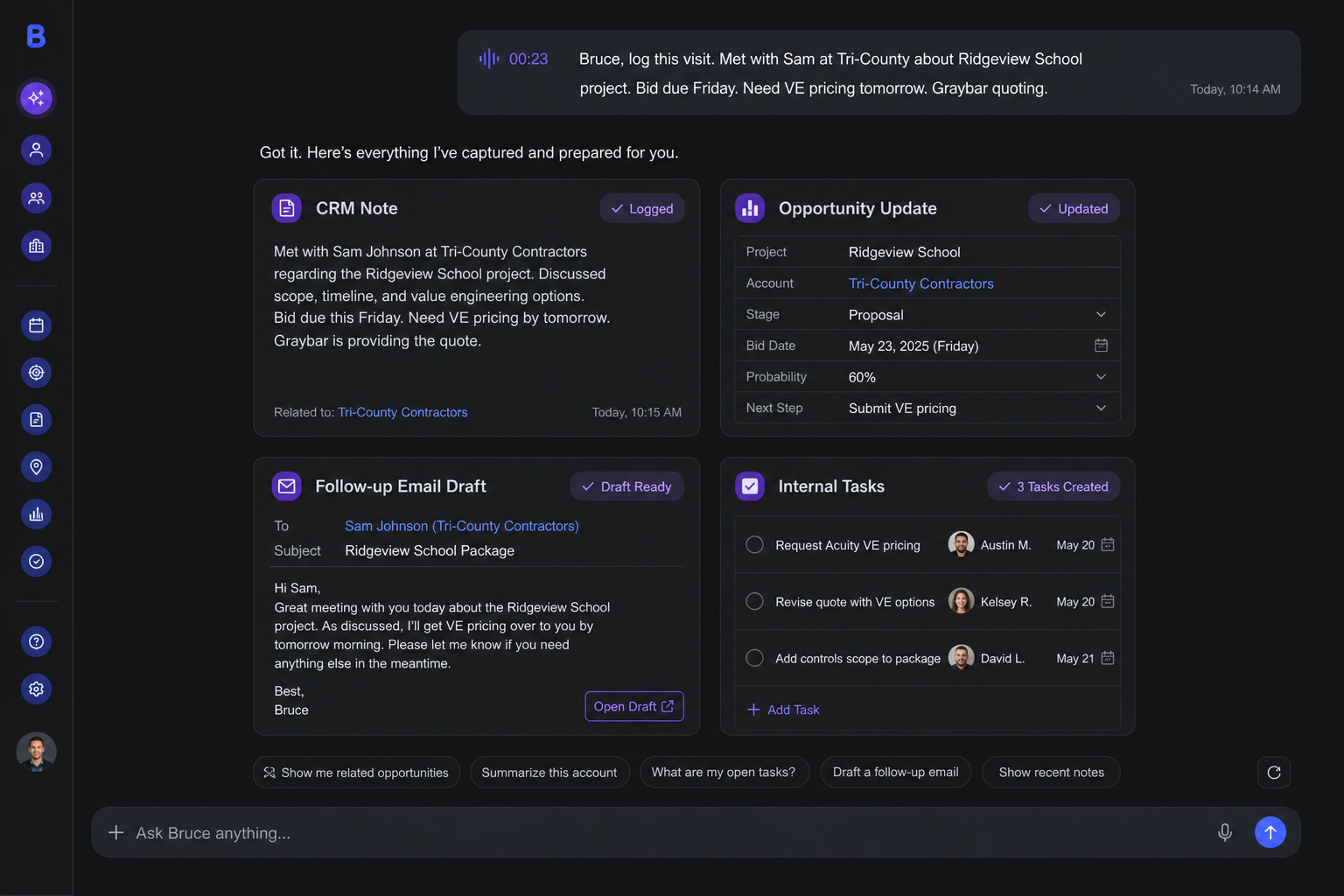
After every meeting, speak to Bruce before you drive away. Do not wait until the end of the day. Do not rely on memory. Give Bruce a 60-second voice note and let Bruce turn that note into action.
What Bruce Creates
- CRM meeting note
- Opportunity update
- Quote update and contact update
- Follow-up email
- Tasks for inside sales, quotations, and branch coordination
- Vendor/manufacturer pricing requests
- Delivery or operations follow-up
- Manager summary, competitive intelligence, and forecast update
- Next-step reminder
60-Second Voice Note Format
- Who you met with
- What you discussed
- What the customer needs
- What the risk or blocker is
- What happens next, who owns it, and by when
“Bruce, log this visit. Met with [customer/contact]. We discussed [project or issue]. They need [request]. Main risk is [competitor, pricing, service issue, delivery issue, or timing]. Next step is [action] by [date].”
Illustration: Voice note converted into CRM note, email draft, and internal tasks
Speaking to Bruce in the Field
Bruce is a field sales partner you can talk to from the truck, parking lot, job site, customer office, branch, counter, and between visits. Speak naturally. You do not need perfect CRM language.
Start of Day
- Bruce, build my visit plan for today.
- Bruce, which accounts need attention this week?
- Bruce, find accounts with open quotes, declining spend, or service issues.
Before a Visit
- Bruce, prepare me for this customer.
- Bruce, summarize recent purchases and open quotes.
- Bruce, give me five questions to ask.
After a Meeting
- Bruce, log this visit.
- Bruce, turn this into a CRM note.
- Bruce, draft the follow-up email.
- Bruce, create tasks for quotations and inside sales.
End of Day
- Bruce, summarize my day.
- Bruce, what follow-ups are still open?
- Bruce, what quote tasks did we create?
- Bruce, which accounts need attention tomorrow?
Daily Operating Rhythm
Morning: Plan the day
Ask Bruce which accounts, prospects, or job sites you should visit and why. Prioritize visits that can move quotes, protect accounts, expand share of wallet, recover service issues, capture active projects, and pull in vendor opportunities.
Before each visit: Get the brief
Review open quotes, recent orders, project status, bid deadlines, service issues, backorders, missing categories, competitor risk, and your recommended ask.
During the visit: Sell with context
Capture project name, bid date, decision-maker, estimator or buyer, competitor involved, product scope, missing categories, pricing concerns, delivery constraints, vendor support needed, and the next action.
After each visit: Speak the note
Before driving away, ask Bruce to log the visit and handle the CRM note, follow-up email, tasks, opportunity updates, and internal coordination.
End of day: Close the loop
Ask Bruce to summarize completed visits, opportunities advanced, at-risk accounts, follow-ups due, quote tasks, branch actions, vendor requests, and who to prioritize tomorrow.
What Good Looks Like
- Why did I visit this customer?
- What did I know before walking in?
- What did I ask?
- What did I learn?
- What changed in the account or opportunity?
- What does the customer need next?
- Who owns the next step?
- When is it due?
- Did the CRM get updated?
- Did the customer get a follow-up?
- Did the right internal team get notified?
Common Mistakes to Avoid
Seller Cheat Sheet
“Who should I visit? Bruce, prioritize my visits today.”
“What should I know before I walk in? Bruce, give me the account brief.”
“What should I ask while I am there? Bruce, what should I confirm before I leave?”
“What needs to happen after I leave? Bruce, log this visit and create the follow-ups.”
Best Prompts
Morning Planning
- Bruce, prioritize my customer visits for today based on open quotes, project urgency, account risk, expansion potential, and route efficiency.
- Bruce, which accounts in my territory need an in-person visit this week?
- Bruce, which open quotes are at risk and need field attention?
- Bruce, which customers have declining spend or service issues?
- Bruce, which job sites near me are worth visiting today?
Pre-Visit Prep
- Bruce, prepare me for my visit with [Account], including open quotes, purchases, projects, service issues, missing categories, and recommended questions.
- Bruce, what should I ask [Account] to uncover expansion opportunities?
- Bruce, what risks should I know before meeting this customer?
- Bruce, what did we promise this customer last time?
- Bruce, what should I confirm before I leave?
Post-Visit Capture
- Bruce, turn this meeting note into a CRM update, opportunity update, follow-up email, and internal task list.
- Bruce, summarize this visit for my manager.
- Bruce, what next steps should I create from this conversation?
- Bruce, what information is missing from my meeting notes?
- Bruce, create tasks for quotations, inside sales, and the branch team.
Example Full Workflow
Morning
“Bruce, build my visit plan for today.”
Bruce recommends visiting Tri-County Electric, Miller Mechanical, and North Ridge Job Site first based on quote urgency, competitor risk, and changing account activity.
Before the Visit
“Bruce, give me the Tri-County brief.”
Bruce summarizes Ridgeview School bid timing, VE request, possible Graybar involvement, and recommended questions on controls, emergency lighting, and decision ownership.
After the Visit
“Bruce, log this visit. Met with Sam at Tri-County... need Acuity pricing and revised quote tomorrow morning.”
Bruce creates the CRM note, follow-up email, and internal tasks to request pricing, revise the quote, add controls and emergency lighting, confirm lead times, and follow up before the deadline.
Final Rule
Bruce is how you run a better field sales day: use Bruce before the visit to choose the right accounts, before the conversation to walk in prepared, and after the meeting to capture what happened and drive the next step.
Visit customer. Speak to Bruce for 60 seconds. Move the account forward.