

Case study
Building an Agentic Retail Enterprise
How a luxury resale retailer turned listing, clienteling, pricing and store reporting into work agents execute across its existing systems, while employees keep every consequential decision.
Download the PDF- Customer
- A luxury resale retailer
- Industry
- Luxury resale retail
- Functions
- Merchandising & Catalog
- Clienteling
- Pricing & Inventory
- Store Operations & Intelligence
- of newly consigned items listed online with photos
- 9% → 69%
- of wishlist matches meet the brand, size and category rules
- 98.8%
- of wholesale report lines matched the point-of-sale report
- 100%
Executive summary
The company is a designer consignment and resale retailer with several stores, about 129,000 customers and about 19,000 active consignors. Every garment is one of a kind, so every item has to be described, photographed, priced and matched to a buyer by hand. The retailer runs that work on Bruce across the systems it already used: SimpleConsign at the point of sale, Shopify, Monday.com, Homebase, TextRequest and Jotform. Associates photograph an item and Bruce drafts a priced, described, studio-photographed listing for approval in a median 103 seconds; Bruce matches new inventory to customer wishlists, drafts the texts and checks consent; and staff ask the business questions in plain English. Since intake went live in June 2026, about 14,250 items have been published this way.
Retail execution moves from people re-keying items, chasing customers and stitching reports between systems to agents that complete that work across the existing stack, while employees approve every listing, price and customer message.
01
The structural challenge
Resale has no catalog. Each consigned garment arrives once, in one size and one condition, and has to be identified, priced, photographed and listed before it can sell, in a store or online. Inventory changes daily, and the customers most likely to want a piece are the ones who asked for it weeks ago.
The information to do that well existed, but in six applications that did not talk to each other: sales and consignor records in the point of sale, online orders in Shopify, drop-offs in Monday.com, hours in Homebase, conversations in TextRequest. Connecting them was people's work, so most new items never reached the website and follow-up depended on who had time.
The constraint was not a missing tool. It was the coordination between tools, which is the part agents can now carry while people keep the judgment.
02
The AI-native operating model by function
Bruce works in four of the retailer's functions, all in production.
Merchandising & Catalog
Production.
Functional objective: Turn every incoming garment into an accurate, commerce-ready listing, in store and online.
| Functional responsibility | Bruce executes | Humans lead |
|---|---|---|
| Product intake | Reads the associate's phone photos and fills brand, category, title, color, size and condition | Associates photograph the item and review the draft |
| Photography | Places the garment on a studio background and rejects broken cutouts, keeping the original | Staff can revert any photo |
| Listing copy | Writes the description and proposes measurements only on an exact style-code match | Staff approve measurements before they appear |
| Publishing | Checks photos and the consignor record, then publishes to the point of sale and Shopify in one step | Associates approve every publish |
Operating-model transformation: Listing used to be manual entry, so most items stayed in-store only. Bruce now drafts the whole listing from photos and checks it before it goes live; associates review and approve instead of typing.
Evidence of execution: Photo to published listing takes a median 103 seconds across 4,425 publishes in a 30-day window. In October 2026, 69% of newly consigned items were listed online with photos, against about 9% in March and April. Category is changed in review on fewer than 1% of drafts. The studio-photo gate, live at every location, rejects about 10% of cutouts and keeps the original.
Clienteling
Production.
Functional objective: Connect each customer to the one-of-a-kind items they want, and bring lapsed customers back, without over-messaging anyone.
| Functional responsibility | Bruce executes | Humans lead |
|---|---|---|
| Wishlist matching | Matches new inventory to each customer's wishlist every night, with brand, size, budget and per-item send caps | Staff approve each text before it sends |
| Personalized outreach | Drafts the text, has a second model review it, and drops matches that sold or moved stores | Staff own the store voice and the relationship |
| Lapsed-customer email | Builds a taste profile from purchase history and emails available picks | The team chooses the audience and cadence |
| Consent and measurement | Enforces opt-outs inside every send path, tracks replies and purchases, and holds out a control group | Leaders read the results and set the policy |
Operating-model transformation: Follow-up used to depend on which associate remembered a customer. Bruce now matches every new item to every wishlist and drafts the outreach; staff approve, and every message is measured against a holdout rather than credited on last touch.
Evidence of execution: In a July 2026 audit of 8,091 sends, 98.8% of matches met the brand, size and category rules, and 29% of customers replied to the April reactivation texts. Consent audits found no sends after an opt-out. Incremental sales lift is measured against controls and is not yet proven.
Pricing & Inventory
Production.
Functional objective: Price every item on evidence at intake, and keep aging inventory moving.
| Functional responsibility | Bruce executes | Humans lead |
|---|---|---|
| Intake pricing | Benchmarks 180 days of comparable sales and brand momentum and proposes a margin price and a faster-selling price | Associates set the final price |
| Aged-inventory repricing | Reviews unsold items at 14, 30, 45 and 60-plus days and queues new prices | Staff approve, reject or snooze each one |
| Pricing diagnostics | Logs every suggestion and every override and audits the gaps | The team decides which fixes to make |
Operating-model transformation: Prices used to come from memory and spot checks. Bruce now proposes two prices with their evidence; people decide, and their overrides become the data that improves the next suggestion.
Evidence of execution: After a benchmark fix, intake price error against the realized sale price fell from 32.8% to 22.5% on a held-out set. Auditing staff overrides surfaced two input bugs, both fixed in October 2026.
Store Operations & Intelligence
Production.
Functional objective: Keep stores, the website and the records in step, and put live numbers in front of the people who run the business.
| Functional responsibility | Bruce executes | Humans lead |
|---|---|---|
| Store coordination | Texts a store to pull an item the moment it sells online, and texts consignors as drop-offs move | Store teams pull items and handle exceptions |
| Reconciliation | Re-reads balances, merged customers and dropped records against the source systems every day | Managers resolve what cannot be fixed automatically |
| Reporting | Sends each store a weekly scorecard and checks wholesale reports line by line against the point of sale | Leaders review performance and act |
| Questions in chat | Answers staff questions with read-only queries and returns a chart, table, spreadsheet or dashboard | Staff ask, and decide what to do with the answer |
Operating-model transformation: Reports used to need an export and an analyst, and drift between systems went unnoticed. Bruce now reconciles the systems daily and answers questions in chat; people read and act.
Evidence of execution: Wholesale reports matched the point of sale on 1,382 of 1,382 lines from July to September 2026. One reconciliation pass corrected 617 of 632 stale consignor balances. Forty-five job families run on scheduled and event-driven queues.
03
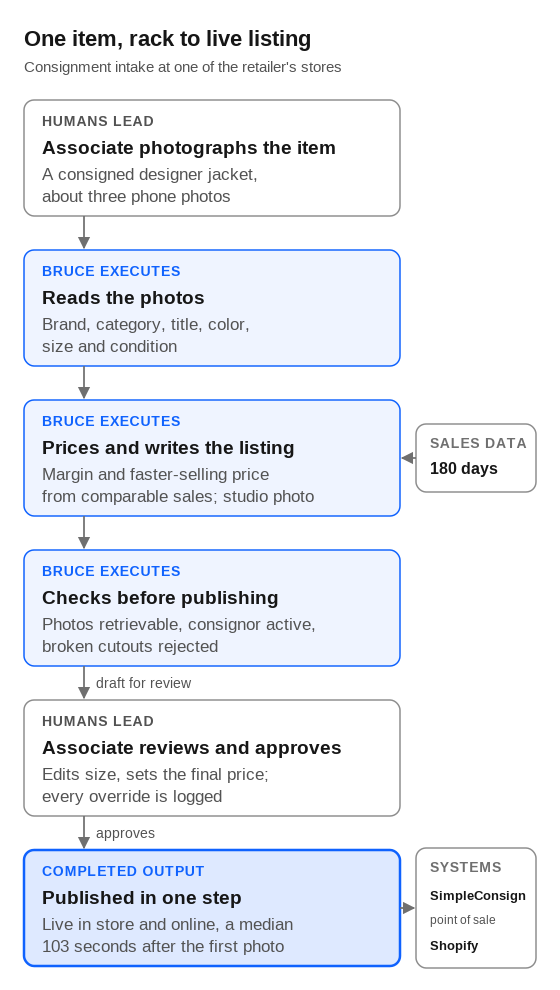
Inside the execution
Business Objective: Get a newly consigned designer jacket listed in store and online, accurately priced, on the day it arrives.
Trigger: A consignor drops off a jacket at one of the retailer's stores, and an associate photographs it on a phone, about three photos per item.
Intelligence & Context: Bruce reads the photos for brand, category, title, color, size and condition, and looks up recent comparable sales and the brand's momentum in the retailer's synchronized store data.
Reasoning & Decisions: A vision model drafts the attributes; a second model starts in parallel if the first is slow. Pricing returns a margin price and a faster-selling price with a confidence label. Before publishing, Bruce confirms the photos are retrievable and the consignor is active, and the photo gate rejects a broken cutout.
Execution: Bruce produces the studio photo and the description, then publishes to SimpleConsign and Shopify in one step once the associate approves.
Human Leadership: The associate reviews every field, usually edits the size, sets the final price and approves the publish. Every override is logged.
Completed Outcome: The jacket is live in store and online a median 103 seconds after the first photo, with a price on evidence and a record that matches across systems.
04
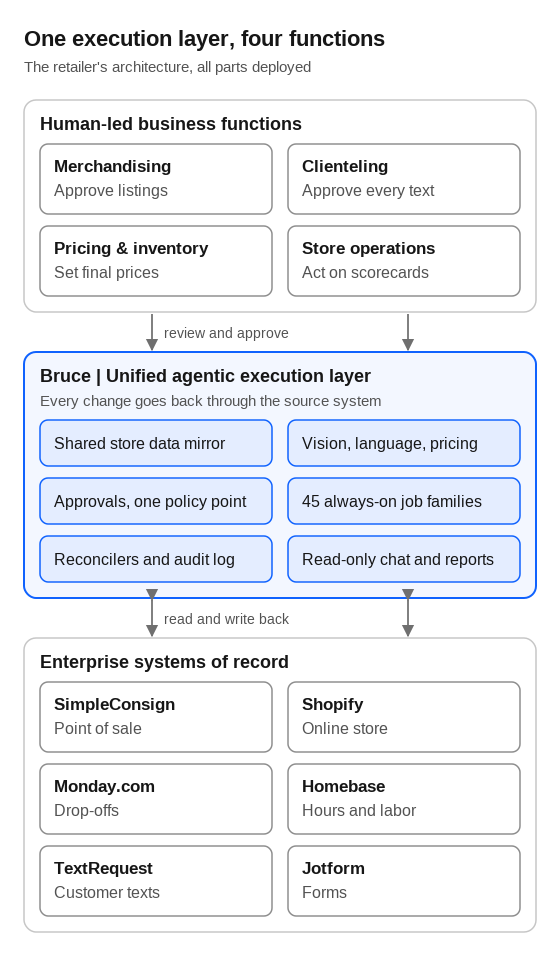
The unified enterprise execution layer
The retailer's four functions run on one execution layer rather than four tools. A synchronized mirror of the point of sale, Shopify, Monday.com, Homebase and TextRequest gives every agent the same records, while the original applications stay the systems of record and every change goes back through them. Vision, language and pricing models are coordinated in stages; 45 job families run on scheduled and event-driven queues with failure alerts; reconcilers catch silent drift. Data access in chat is read-only, every outside write passes one policy point, and anything that touches a customer or a record defaults to human approval. Adding a capability means adding tools and context to the same layer.
05
Business outcomes & human leverage
Execution Throughput: About 14,250 items published through intake since mid-June 2026, growing from 472 in June to 4,452 in September; nightly matching across about 129,000 customers; 45 job families running continuously.
Execution Velocity: A median 103 seconds from first photo to published listing. No timed manual baseline exists, so no speed-up multiple is claimed.
Execution Quality: 98.8% of wishlist matches meet the rules; 100% of wholesale report lines match the point of sale; 98% of stale consignor balances corrected in one pass; no sends after an opt-out.
Human Leverage: Associates review and approve instead of re-keying, and the share of new consignment listed online with photos rose from about 9% to 69%.
Business Impact: The retailer's leadership reports a 70% return on investment within 90 days. Labor savings and incremental sales lift are not claimed: both are measured against controls and not yet proven.
| Dimension | Traditional operating model | AI-native operating model |
|---|---|---|
| Intelligence | Records spread across six applications | One synchronized view of stores, customers and inventory |
| Decision-Making | Prices and follow-up from memory | Associates decide from two evidence-based prices and a ranked match |
| Execution | Manual entry, manual texts, exported reports | Listings, outreach, reconciliation and reports completed by Bruce |
| Human Role | Re-keying and chasing | Reviewing, approving and owning the customer |
| Business Outcomes | About 9% of new consignment online with photos | 69% online with photos; 70% ROI in 90 days, as reported by the retailer's leadership |
06
The enterprise implication
Retailers already own the systems that record their business; what they lack is the labor that connects them. The company shows a practical route: keep the systems of record, start with high-volume work such as listing and outreach, make execution dependable with approvals, reconcilers and measurement, and expand across departments on one foundation. Two lessons carry over to any retailer: accurate recommendations are not the same as incremental sales, so measure against a holdout; and a model's output is not a finished task until it is checked, approved and written back.
Humans lead; agents execute: the measure is not what the model suggests but what work is finished, checked and approved.
Download this case study
The full story as a PDF, to read offline or share with your team.