
Case study
Building the AI-Native Distribution Enterprise
How an industrial electrical distributor gave its buyers, managers and sellers one execution layer that sizes every buy, schedules every supplier return and measures every customer response across Epicor Prophet 21 and HubSpot.
Download the PDF- Customer
- An industrial electrical distributor
- Industry
- Industrial electrical distribution
- Functions
- Purchasing & Inventory
- Supplier Returns & Rebates
- Sales Leadership & Executive Visibility
- Business Development
- item-level stock signals raised since April 2026
- 15,000+
- customer quote and order emails measured for response time in 2026
- 17,000+
- scheduled reports, alerts and agent runs delivered since August 2026
- 500+
Executive summary
The distributor stocks thousands of electrical SKUs across its branches. Epicor Prophet 21 and HubSpot recorded every order, receipt and contact, but deciding what to buy, what to send back, how fast customers were answered and whom to call next still depended on people reading screens and inboxes.
Bruce now runs that work across four functions. It raises item-level stock signals with a calculated order quantity, recommends supplier returns under each vendor's policy, measures the sales team's response to every customer email, and runs approved outreach. Underneath, a live read of Prophet 21, HubSpot and the sales mailboxes gives the executive team one current view of sales, margin and responsiveness. Buyers, managers and reps make every purchase, return, price and customer decision. Since April 2026 Bruce has raised more than 15,000 stock signals; financial impact is still being measured.
Purchasing and sales management move from periodic reports that people assemble to continuous, item-level and rep-level execution that Bruce runs and people direct.
01
The structural challenge
An electrical distributor wins when the right stock is on the shelf, slow stock goes back to the vendor before its return window closes, and every quote is answered fast. At the distributor each of these lived in a different place: Prophet 21 screens and a buyer's memory for purchasing, vendor policy sheets for returns, individual mailboxes for customer response.
The intelligence was already in the data. What was missing was the work between insight and action: noticing, analyzing, deciding and typing, done periodically and by hand. Another dashboard would only have added another screen to watch. The constraint was the division of labor itself: skilled people spent their attention finding work instead of deciding it.
02
The AI-native operating model by function
Purchasing & Inventory
Functional objective: Keep the right stock at each branch with the least working capital.
| Functional responsibility | Bruce executes | Humans lead |
|---|---|---|
| Stock-risk detection | Watches every stocked item and branch for stockouts, backorders and supply that will arrive too late | Set stocking policy |
| Order recommendation | Sizes each buy from run rate, backorders, stock on order, measured vendor lead time and pack size; checks other branches first | Decide whether, how much and from whom to buy |
| Follow-through | Tracks late POs and short shipments, and closes each signal when supply arrives | Contact vendors |
| PO drafting | Groups the buyer's selected signals into one draft PO per vendor and branch, with vendor and item IDs from ERP records, and writes it to Prophet 21 once approved | Approve every PO |
Operating-model transformation: Buyers no longer hunt for problems. Each arrives with its context and an auditable quantity, and no purchase reaches the ERP without a person.
Evidence of execution: 15,812 signals on 6,043 SKUs since April 2026; 4,365 closed automatically when the replenishing PO was received.
Supplier Returns & Rebates
Functional objective: Recover cash from slow stock and keep margin honest after vendor rebates.
| Functional responsibility | Bruce executes | Humans lead |
|---|---|---|
| Return recommendations | Finds stock bought inside each vendor's return window that is not selling, and sizes the return to box quantity under 37 vendor-specific policies | Choose what goes back |
| Scheduled return alerts | Twice a month, emails the top-priority vendor's return list as a spreadsheet, checked against returns already in the ERP | Enter the return in Prophet 21 |
| Return follow-through | Tracks entered versus credited returns and closes aging-stock signals once a return is logged | Chase vendor credits |
| Rebate-aware margin | Judges rebated items at their rebated cost, and refreshes the gross-profit workbook whenever a rebate is finalized | Set pricing and goals |
Operating-model transformation: Returns no longer depend on someone remembering each vendor's window; the list arrives on schedule, sized and prioritized. Rebate claims themselves are still filed by people.
Evidence of execution: Since August 2026 Bruce has refreshed the gross-profit workbook each of the four times a rebate or cost adjustment was finalized.
Sales Leadership & Executive Visibility
Functional objective: Give leadership a live pulse on the business, and answer every customer request quickly.
| Functional responsibility | Bruce executes | Humans lead |
|---|---|---|
| Live business read | Answers any sales, margin or inventory question from live ERP, CRM and mailbox data, on the company's own sales definition | Ask, interpret, decide |
| Response measurement | Classifies customer email in 14 sales mailboxes and measures who answered and how fast | Set standards, coach |
| Quote-to-order visibility | Links emailed requests to Prophet 21 quotes and orders | Decide which quotes to chase |
| Sales command center and briefs | Refreshes base KPIs against per-rep baselines; sends each outside rep a daily account brief | Set targets; own accounts |
| Executive reporting | Delivers the Monday sales performance report, weekly strategic-account intelligence and acquisition alerts | Set direction |
Operating-model transformation: Leaders stop waiting for month-end reports and ask the business directly; sales management moves from anecdote to measurement.
Evidence of execution: About 35 of the distributor's employees use the live read, and command-center sales totals match the company's own sales definition within 0.05% for 2026 to date. Each outside rep has received a brief before 6 a.m. every business day since mid-September, and 9,447 emailed requests are linked to their Prophet 21 quotes across 690 customers.
Business Development
Functional objective: Open new accounts and recover construction work the company quoted but did not book.
| Functional responsibility | Bruce executes | Humans lead |
|---|---|---|
| Targeted outreach | Sends approved, segment-specific email, including owner-to-owner email from a senior leader's own inbox | Choose segments; approve lists; own replies |
| Public-bid monitoring | Reviews awarded construction bids each business day, screened against the ERP and CRM | Decide which leads to pursue |
| Safeguards | Suppresses distributors, duplicates and out-of-region contacts; holds lists for approval | Set suppression policy |
Operating-model transformation: Bruce carries the volume work; people choose whom to approach. When broad cold email underperformed, outreach moved to local owners.
Evidence of execution: 19,005 approved emails since December 2025, and two bid-monitoring routines running every business day. No outreach-sourced new customer has ordered yet.
03
Inside the execution
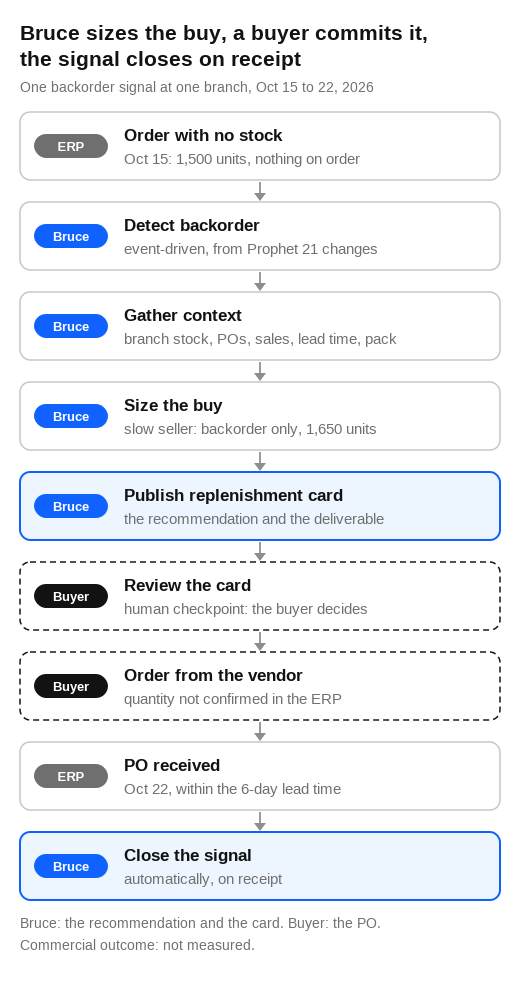
Business Objective: Fill a customer's 1,500-unit order for a wiring product at one of the distributor's branches.
Trigger: On October 15, 2026, the order landed with no available stock and no PO on order.
Intelligence & Context: Branch stock, open POs, sales history, the vendor's measured lead time (6 days), the pack size (150) and the item's return on inventory, all from Prophet 21.
Reasoning & Decisions: About $2,850 of revenue was at risk. Because the item sells rarely and earns little on inventory, Bruce recommended buying the backorder only, not restocking, and calculated 1,650 units: the backorder rounded up to full packs.
Execution: Bruce published a replenishment card to the purchasing queue: confirm the customer commitment, then buy from the vendor, with the quantity and its inputs shown.
Human Leadership: The buyer owned the decision, the vendor and the order quantity.
Completed Outcome: A PO for the item was received on October 22, within the vendor's lead time, and the signal closed automatically. The PO's quantity, and whether the card prompted it, were not confirmed in the ERP.
Bruce produced the recommendation and the card; a person took the system action; the commercial outcome was not measured.
04
The unified enterprise execution layer
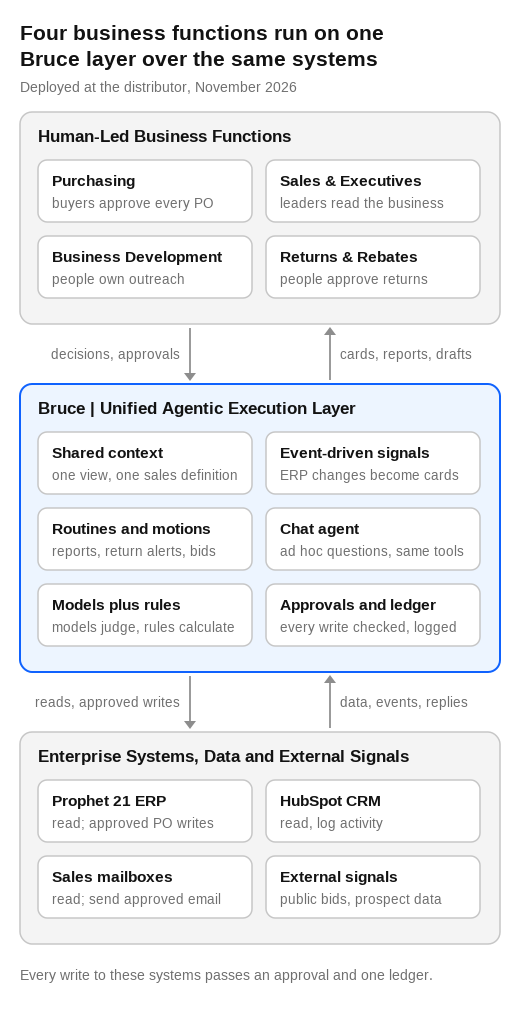
All four functions run on one Bruce deployment over the same Prophet 21, HubSpot and mailbox data, with one sales definition. ERP changes become signals, scheduled routines deliver reports, return alerts and bid monitoring, and the chat agent answers ad hoc questions with the same tools. Models assess and write; quantities and policies are computed by rules. Every external write passes a permission check, an approval where required and one ledger, so a shortage cannot be bought twice.
05
Business outcomes and human leverage
Execution throughput: 15,812 stock signals, 17,142 measured customer emails, 531 scheduled deliveries and 19,005 approved outreach emails.
Execution velocity: Median first reply to customer order emails fell from 17 minutes in July 2026 to 12 in October; quote replies held near 20. People send the replies; there is no pre-Bruce baseline.
Execution quality: Split shipments on stocked order lines fell from 1.99% in the year before stock signals to 1.46% since, while order volume also fell. There is no holdout.
Human leverage and business impact: Buyers and managers decide on prepared work instead of searching for it. Time saved and financial impact have not been measured.
| Dimension | Traditional operating model | AI-native operating model |
|---|---|---|
| Intelligence | Periodic reports; responsiveness invisible | Item-level signals and rep-level response data, continuously |
| Decision-making | Memory and month-end reviews | Decisions on prepared cards and return lists |
| Execution | People monitor, analyze and compile | Bruce monitors, sizes, alerts, reports and sends approved outreach |
| Human role | Searching and compiling | Deciding, approving, negotiating and selling |
| Business outcomes | Split shipments 1.99%; order reply 17 min | 1.46%; 12 min (context, not attribution) |
06
The enterprise implication
A distributor's ERP already holds the intelligence; what was missing was a layer that watches it continuously and turns it into work a person can approve in seconds. At the distributor, purchasing and returns shifted from monitoring to deciding, and sales management from anecdote to measurement. Because one foundation serves every function, adding a function means adding responsibilities, not another system. The next steps are rebate-claim automation and before-and-after measurement that can turn operational change into financial evidence.
When agents watch every item and every inbox, people stop searching for work and start deciding it.
Download this case study
The full story as a PDF, to read offline or share with your team.