
Case study
Building the AI-Native Distribution Sales Organization
How an electrical distributor that sells to other distributors moved the work between its ERP, its CRM and its mailboxes to Bruce, while reps keep the customers, the prices and the final word.
Download the PDF- Customer
- An electrical distributor that sells to other distributors
- Industry
- Electrical distribution (parallel market, distributor to distributor)
- Functions
- Inside sales
- Field sales
- Business development
- Sales performance and intelligence
- of quote requests left unanswered
- 15% to 9%
- field visits, calls and notes logged a month
- 0 to 90+
- dormant accounts buying again after outreach
- 28
Executive summary
The company sells electrical products to other distributors nationwide, usually when a part is needed now. Its sales ran on an ERP, a CRM, mailboxes and reps' memory, joined by hand.
Across four functions, Bruce flags unanswered quote requests, turns a field rep's business cards and visits into CRM records, runs capped outreach and delivers daily sales numbers. Leaders get a live pulse on the business, and reps check prices and stock from their phones. Reps keep prices, customers and approval of every CRM change and send.
Since the quote alerts went live, unanswered quote requests fell from about 15% to about 9%, and field activity in the CRM went from none to about 90 entries a month.
Reps stop reading, keying and remembering and start deciding, while Bruce does the work between the ERP, the CRM and the mailboxes.
01
The structural challenge
Why the traditional operating model constrains execution
The company wins on speed: a distributor emails a part number, and the first credible answer with stock and price usually gets the order.
The facts sat in three places that did not talk: Epicor Prophet 21 (P21) knew what was quoted and sold, the CRM knew the contacts, and the mailboxes knew what customers asked for. People joined them by hand, checking for unanswered requests, chasing quotes and typing in business cards. The field rep's CRM record shows no logged visits, calls or notes from January to August 2026.
The work between the systems, not another application, had to change.
02
The AI-native operating model by function
Redesigning the division of labor between humans and agents
Four functions, all in production; spoken visit logging is a pilot.
Inside sales
Functional objective: Answer every quote request fast and follow every open quote to a decision.
| Functional responsibility | Bruce executes | Humans lead |
|---|---|---|
| Request triage | Classifies every customer thread and times the reply | Reps answer and price |
| Unanswered-quote alerts | Checks all mailboxes, the CRM and P21, then alerts only on quotes nobody handled | Leaders set the window and recipients |
| Quote follow-up | Sends each rep a daily list of priced quotes not yet converted | Reps choose what to chase |
| Email-to-ERP matching | Links an emailed request to the quote keyed in P21 | Reps key every quote |
Operating-model transformation: The desk no longer relies on someone noticing a quiet thread; reps still own every price.
Evidence of execution: On November 20, 2026, one sweep reviewed 79 customer threads, found 24 quote requests, set aside 13 already handled by another rep or in P21, and sent 5 alerts.
Field sales
Functional objective: Turn what an outside rep learns on the road into CRM records, follow-ups and planned visits.
| Functional responsibility | Bruce executes | Humans lead |
|---|---|---|
| Business-card capture | Reads card photos, matches them to the CRM, proposes changes and holds conflicts | The rep approves every contact change |
| Visit logging | Writes typed or dictated visit notes to contacts and companies | The rep says who, when and what mattered |
| Daily inbox logging | Logs requests from the rep's contacts each evening and sends a summary | The rep follows up |
| Trip routing and follow-ups | Names branches near upcoming trips, sets reminders and drafts follow-up emails | The rep plans the route and sends every email |
| Pricing on the go | Answers price, stock and quote questions from P21 on the rep's phone, weekends included | The rep quotes the customer without waiting on inside sales |
Operating-model transformation: Field activity reaches the CRM the same day, and the rep prices and checks stock without a laptop or an inside sales rep. Spoken logging by phone is a pilot.
Evidence of execution: A routine owned by the rep has logged inbox requests every weekday evening since October 6, 2026: 58 notes and 24 summaries since mid-October.
Business development
Functional objective: Open new distributor accounts and win back lapsed ones without spending rep time on cold outreach.
| Functional responsibility | Bruce executes | Humans lead |
|---|---|---|
| Prospect sourcing | Finds distributor branches by region and removes current P21 customers | Leaders pick regions and segments |
| Sequenced outreach | Sends playbook emails under daily limits, per named sender | Reps approve the playbook; each sender runs draft-only or capped |
| Reply handling | Routes quote requests to reps; stops outreach to customers and decliners | Reps answer the buyer |
| Reactivation | Writes to lapsed accounts naming the brands and parts they bought | Reps take the order |
Operating-model transformation: Reps see only replies worth a conversation. Autonomy needs an owner: when drafts sat unreviewed, outreach stopped from June to August 2026.
Evidence of execution: From December 2025 to July 2026, 28 accounts at 21 companies, with no purchases in the prior 90 days, bought again after outreach. Accounts already buying every week did not grow.
Sales performance and intelligence
Functional objective: Give every rep and leader current sales, margin and inventory facts, and answer questions from the systems of record.
| Functional responsibility | Bruce executes | Humans lead |
|---|---|---|
| Daily scorecard | Reports revenue and gross margin by brand, for the day and month to date, from P21 | Leaders review and act |
| Per-rep account growth | Sends each of five reps a morning report on their own accounts | Reps decide where to spend the day |
| A pulse on the business | Keeps a live, read-only view of P21, the CRM and the company's other tools that leaders can question directly | Leaders decide what to act on |
| Inventory and executive briefs | Flags demand spikes and overstock; writes weekly executive and competitor briefs | Leaders set priorities |
Operating-model transformation: Reporting no longer waits for someone to build it: leaders ask Bruce about sales, margin and stock directly, and nine people at the distributor have created 40 routines, 24 of them active.
Evidence of execution: Asked on November 20, 2026 which items were out at the main location but stocked elsewhere, Bruce queried P21 and found 208 items, 1,514 units.
03
Inside the execution
From business objective to completed work: a week of field visits
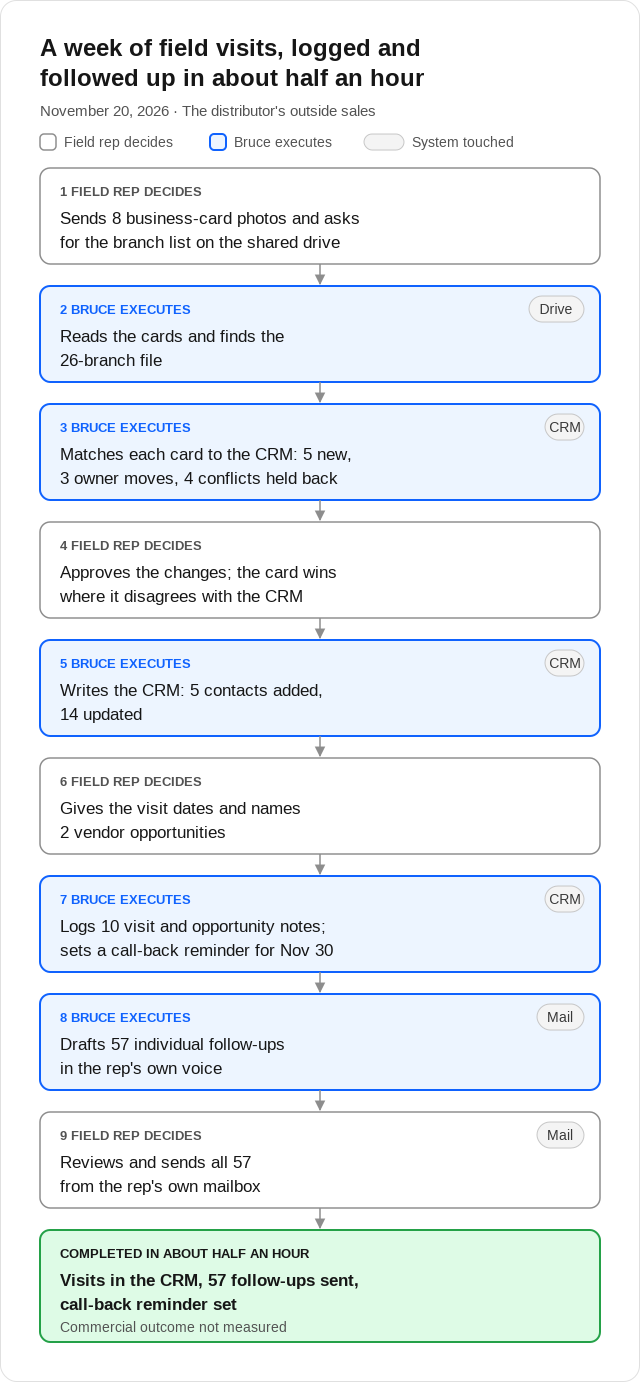
Business objective: Log a week of branch visits (November 16 to 20, 2026) and follow up while they were fresh.
Trigger: The field rep sent Bruce photos of eight business cards and asked it to find a branch list on the shared drive.
Intelligence and context: The cards, CRM contacts and owners, a 26-branch file, and the rep's earlier follow-ups as a model.
Reasoning and decisions: Bruce separated clear changes (five new contacts, three owner moves) from four records where card and CRM disagreed, held those back, and asked for visit dates rather than guess.
Execution: Bruce created 5 contacts, updated 14, logged 10 visit and opportunity notes, set a call-back reminder for November 30 and drafted 57 follow-up emails.
Human leadership: The rep approved four sets of changes, settled the conflicts from the cards, gave the dates, named two vendor opportunities and sent all 57 emails from their own mailbox.
Completed outcome: In about half an hour, a week of field work became CRM records and 57 sent follow-ups: flags were recommendations, drafts deliverables, CRM writes and sends authorized actions. The commercial outcome is not measured.
04
The unified enterprise execution layer
From individual functions to organizational capability
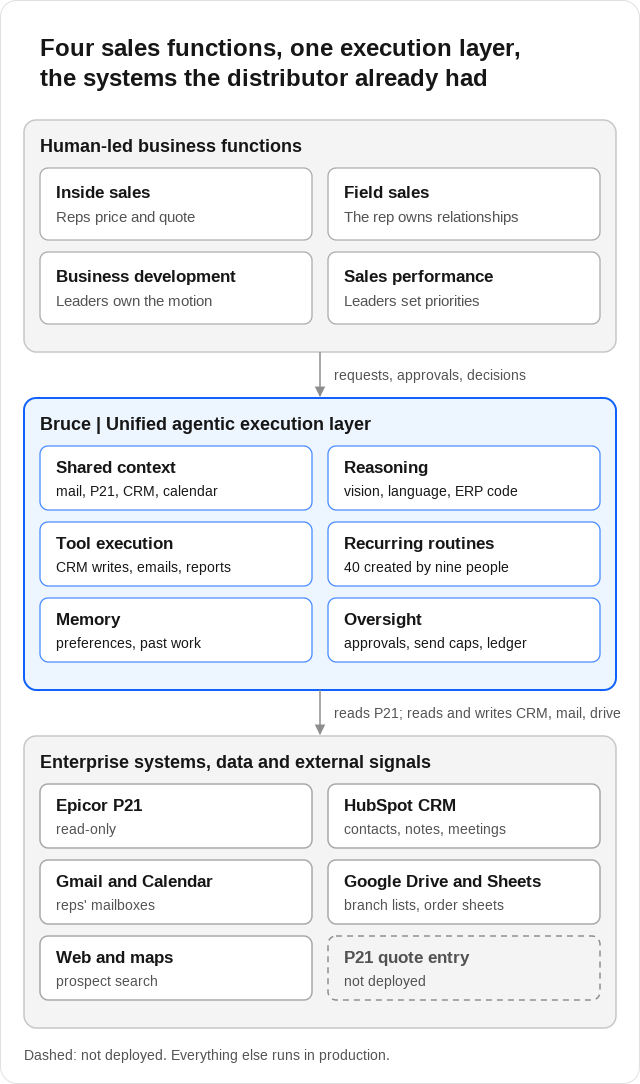
The four functions share one Bruce deployment: one context (customer mail, read-only P21, the CRM, calendars, shared drive), one set of models (vision, language, generated ERP queries) and one set of controls (approval cards, per-sender send limits, a ledger of every external write). Quote entry stays with reps.
05
Business outcomes and human leverage
Measuring the impact of the new division of labor
Execution throughput: In under a year: tens of thousands of customer threads classified, 11,000+ outreach emails, 1,100+ routine runs.
Execution velocity: Median first reply to a quote fell from 20.5 to 18.6 minutes, three weeks before the alerts against four months after.
Execution quality: Unanswered quote requests fell from 14.7% to 8.8%. Checks before each alert suppressed about 2,500 alerts for quotes already handled.
Human leverage: Reps keep pricing, calls, visits and approvals. About a quarter of the 348 pricing, quote and stock questions asked in chat came on weekends or outside 7 a.m. to 6 p.m. Time saved is not measured.
Business impact: 28 dormant accounts bought again after outreach, at the distributor's normal margin (correlational). No other financial impact is claimed.
Operating-model transformation scorecard
| Dimension | Traditional operating model | AI-native operating model |
|---|---|---|
| Intelligence | Mail, P21 and the CRM joined by people | A live read of P21, the CRM and mail that leaders question directly |
| Decision-making | Reps decided on what they checked by hand | Reps decide, with Bruce's checks in front of them |
| Execution | Reps typed, logged and chased | Bruce logs, alerts, drafts and reports |
| Human role | Data entry and inbox watching | Pricing, relationships and approvals, from a desk or a phone |
| Business outcomes | 14.7% of quote requests unanswered; no field activity in the CRM | 8.8% unanswered; about 90 field entries a month; 28 dormant accounts buying again |
06
The enterprise implication
The future of distribution sales
In distribution, the work that decides a sale sits between systems. This distributor shows it can move to an agent while people keep the judgment.
The pattern repeats: connect the ERP, the CRM and reps' own tools, start where requests are lost, and require approval where a mistake reaches a customer.
The ERP and the CRM did not change. What changed is who does the work between them.
Download this case study
The full story as a PDF, to read offline or share with your team.