
Case study
Building the AI-Native Design Risk Organization
How a consumer-brands design company moved IP risk review from a late, manual search to an explained check on every piece, and put trend and account intelligence on a schedule.
Download the PDF- Customer
- A consumer-brands design company
- Industry
- Consumer products
- Functions
- Product Design & IP Risk
- Trend & Merchandising Intelligence
- Account & Competitive Intelligence (pilot)
- registered U.S. trademarks each design is compared with
- ~500,000
- median time for a full IP check, upload to explained verdict
- ~2 min
- of IP checks finished with an explained verdict
- 99%
Executive summary
Consumer accessories are decided in weeks, and every piece on a line sheet is a small legal bet: a motif can echo a registered mark, a charm can copy a protected artwork. This design company, which supplies accessories to major retailers, uses Bruce to check every piece. Bruce reads each design, searches look-alike listings, roughly half a million U.S. trademarks, Copyright Office records and federal court dockets, and returns a plain-language Low, Medium or High read in about two minutes. Designers and counsel decide. In one October week the team checked 288 pieces from 13 line sheets this way, and the same layer delivers trend and account briefs on a schedule.
IP risk review moves from a late, manual search by a few specialists to an explained check that agents run on every piece, while designers and counsel keep every decision.
01
The structural challenge
An accessories supplier wins purchase orders by turning what is rising into designs before the season turns. Each line sheet carries dozens of pieces, and any one of them may echo a registered logo, reproduce a copyrighted artwork or practice someone's patent.
The evidence sits in sources never built to work together: trademark and copyright registries, court dockets, retailer and marketplace listings. Checking a piece by hand means searching each in turn, so review happens late, on the pieces someone already suspects. Trend direction has the same shape, split across social platforms, search trends and retailer assortments.
The constraint is not a missing search tool. Intelligence, judgment and action sit with different people at different moments, so the work itself has to be redesigned: agents search and compare, people decide.
02
The AI-native operating model by function
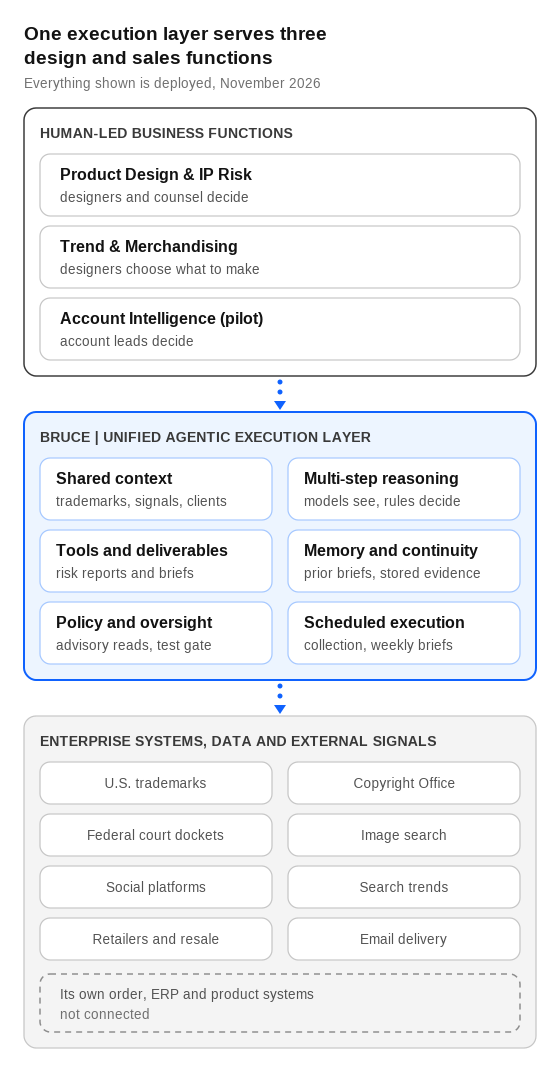
Bruce works in three of the company's functions: two in production, one in pilot.
Product Design & IP Risk
Production.
Functional objective: Bring every design to production with a clear, evidence-backed view of its IP exposure, early enough to change it.
| Functional responsibility | Bruce executes | Humans lead |
|---|---|---|
| Design intake | Splits a line sheet into pieces and reads each for shape, motif, styling and materials | Designers choose what to submit |
| Rights search | Searches look-alike listings, roughly half a million U.S. trademarks, Copyright Office records and federal court dockets | Counsel interprets registrations and enforcement history |
| Risk verdict | Applies fixed rules to give a Low, Medium or High read with its drivers and suggested changes | Designers decide to redesign, re-check or proceed |
| Quality control | Replays every past upload as a test before any rule change goes live | The team accepts or rejects any change that moves a verdict |
Operating-model transformation: A risk check used to depend on who remembered to search. Now every piece gets the same searches and rules, and the result arrives as an explanation a designer can act on. Bruce searches, compares and drafts; designers own the design response and counsel owns legal questions.
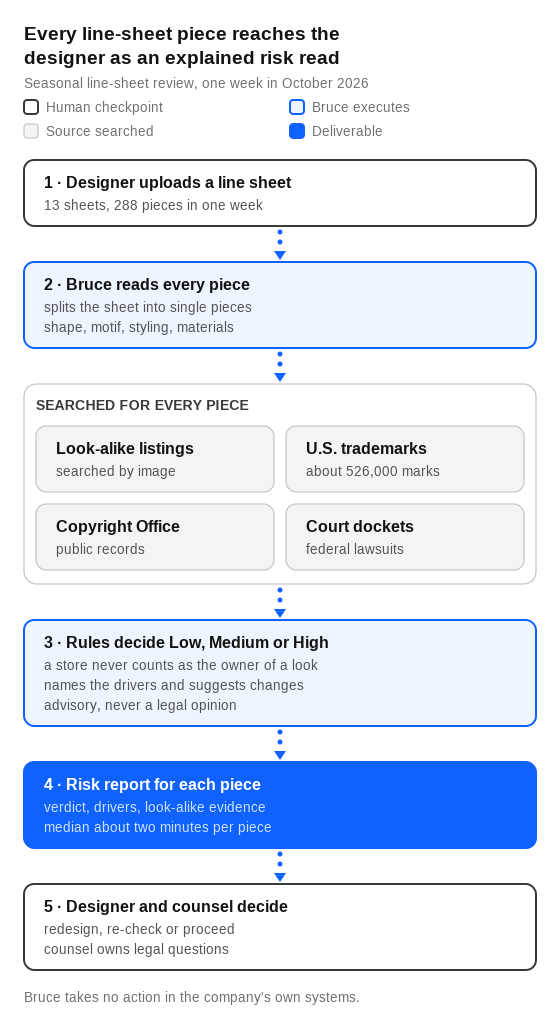
Evidence of execution: In one October week, the design team ran 13 line sheets through Bruce: 288 pieces, each with a verdict, its drivers and look-alike evidence.
Trend & Merchandising Intelligence
Production.
Functional objective: Show designers what to make next, and for which season, on evidence.
| Functional responsibility | Bruce executes | Humans lead |
|---|---|---|
| Signal collection | Collects from social platforms, search trends, resale marketplaces, reviews and about a dozen retailer sites | The team chooses which sources to watch |
| Looks and forecasts | Groups signals into named looks and dates key items by their seasonal rhythm | Designers decide what to make, and for which season |
| Client briefs | Writes a recurring brief that opens on the forecast and never leads with an item a client declined | Leadership decides what to act on |
Operating-model transformation: Trend work used to be feed and store-wall scanning in spare time. Bruce now collects continuously and writes a brief on what to design next; designers still choose.
Evidence of execution: Since May 2026, more than 120,000 market signals and 1,300 published looks; since August, regular trend briefs to the executive team and designers, each built around a design call for the next season.
Account & Competitive Intelligence
Pilot.
Functional objective: Know where the next purchase orders will come from and what competitors are doing.
| Functional responsibility | Bruce executes | Humans lead |
|---|---|---|
| Account research | Researches the company's retail accounts and competitors each week and writes a purchase-order brief | Account leads decide which buyers to pursue |
| Competitor monitoring | Reads competitor news and pages weekly and scores each signal | The team decides which competitors to track |
| Profile safeguards | Caps new competitors and keeps the list to the company's real peer set | People approve additions |
Operating-model transformation: Account research used to be occasional; now a brief arrives every week. It is a pilot: competitor signals are scored but not yet delivered as a digest.
Evidence of execution: The weekly strategy brief has gone to the executive team and designers every week since mid-August 2026, each produced in under five minutes.
03
Inside the execution
Business Objective: Clear a season's accessories line sheets for IP exposure before sampling and buyer presentations.
Trigger: In one October 2026 week, a designer uploaded 13 line sheets: ten for the coming season and three for a licensed collection.
Intelligence & Context: Bruce split each sheet into pieces, read each one, and searched look-alike listings, U.S. trademarks, Copyright Office records and federal court dockets, weighted by a list of brands known to enforce.
Reasoning & Decisions: Fixed rules, not a model's first impression, set each verdict. A store never counts as the owner of a look; a motif many owners have registered cannot reach High on one small filing; an enforcing brand's mark needs supporting evidence.
Execution: Bruce completed 288 checks that week, a median of about two minutes each, each with a risk report naming drivers and suggested changes: a completed deliverable, with no action in the company's own systems.
Human Leadership: Designers decided what to redesign, re-check or keep, and counsel owned legal questions. When the licensed-collection sheets exposed confident errors, the team reviewed every upload, corrected the rules and made those uploads a permanent regression set.
Completed Outcome: Every piece on the season's sheets reached the design team with an explained read. Which pieces changed, and any commercial result, is not recorded.
04
The unified enterprise execution layer
The three functions run on one execution layer rather than three AI tools. They share context (the trademark index, the market-signal store and each client's memory), multi-step reasoning in which models see and rules decide, and tools that produce finished deliverables. Memory keeps briefs from repeating and lets any verdict be replayed. Verdicts are advisory, a regression gate guards every rule change, and collection and briefs run on schedules. Adding a function means adding tools and context to the same layer, not another application. Everything shown is deployed; the company's order, ERP and product systems are not connected.
05
Business outcomes & human leverage
Execution Throughput: 379 IP checks, 288 of them in one week, plus continuous signal collection and weekly trend and strategy briefs.
Execution Velocity: A full check takes a median of about two minutes and under four minutes for nine in ten pieces. No manual baseline was recorded, so no speed-up is claimed.
Execution Quality: 99% of checks (379 of 384) finished with a verdict, every one produced by the same fixed rules and replayable from its stored evidence. Every past upload runs as a regression test, so a rule change cannot silently move a verdict a designer has already seen.
Human Leverage: Designers and counsel start from an explained read on every piece and can focus on the half rated Medium or High.
Business Impact: No financial or commercial result has been measured.
| Dimension | Traditional operating model | AI-native operating model |
|---|---|---|
| Intelligence | Sources searched by hand, when someone had time | Every source, every piece; market signals collected continuously |
| Decision-Making | Risk judged late, on suspected pieces | Designers and counsel decide from an explained read on every piece |
| Execution | Manual searches and ad hoc trend scans | IP checks and trend and account briefs completed by Bruce |
| Human Role | People gathered the evidence and judged it | People judge, approve and own the response |
| Business Outcomes | No recorded baseline | 99% of checks finished with a verdict, about two minutes each, every piece read by the same rules; no financial result measured |
06
The enterprise implication
Design-led businesses have treated IP risk as a late specialist review because gathering evidence was slow. When agents gather and compare on every piece, review moves to the moment a design is drawn, and the people who carry the risk spend their time on judgment: what to change, license or take to counsel. The pattern fits any function that decides on scattered external records, such as compliance, sourcing or brand protection. The next steps are fewer missed high-risk calls, competitor intelligence delivered as a digest, and a measured baseline.
Bruce's IP risk reads are advisory and are not legal advice.
An agent that checks every piece in two minutes does not replace the designer's judgment; it means that judgment is finally exercised on every piece.
Download this case study
The full story as a PDF, to read offline or share with your team.