Architecture
How we arrived at a seven-plane harness for enterprise

From a model that can use tools to a system an organization can operate.
Consider a sales workflow: read a request, resolve the items, prepare a quote, ask for approval, then update the business system. This is an illustrative workflow, but it captures the questions that shaped our Bruce harness review.
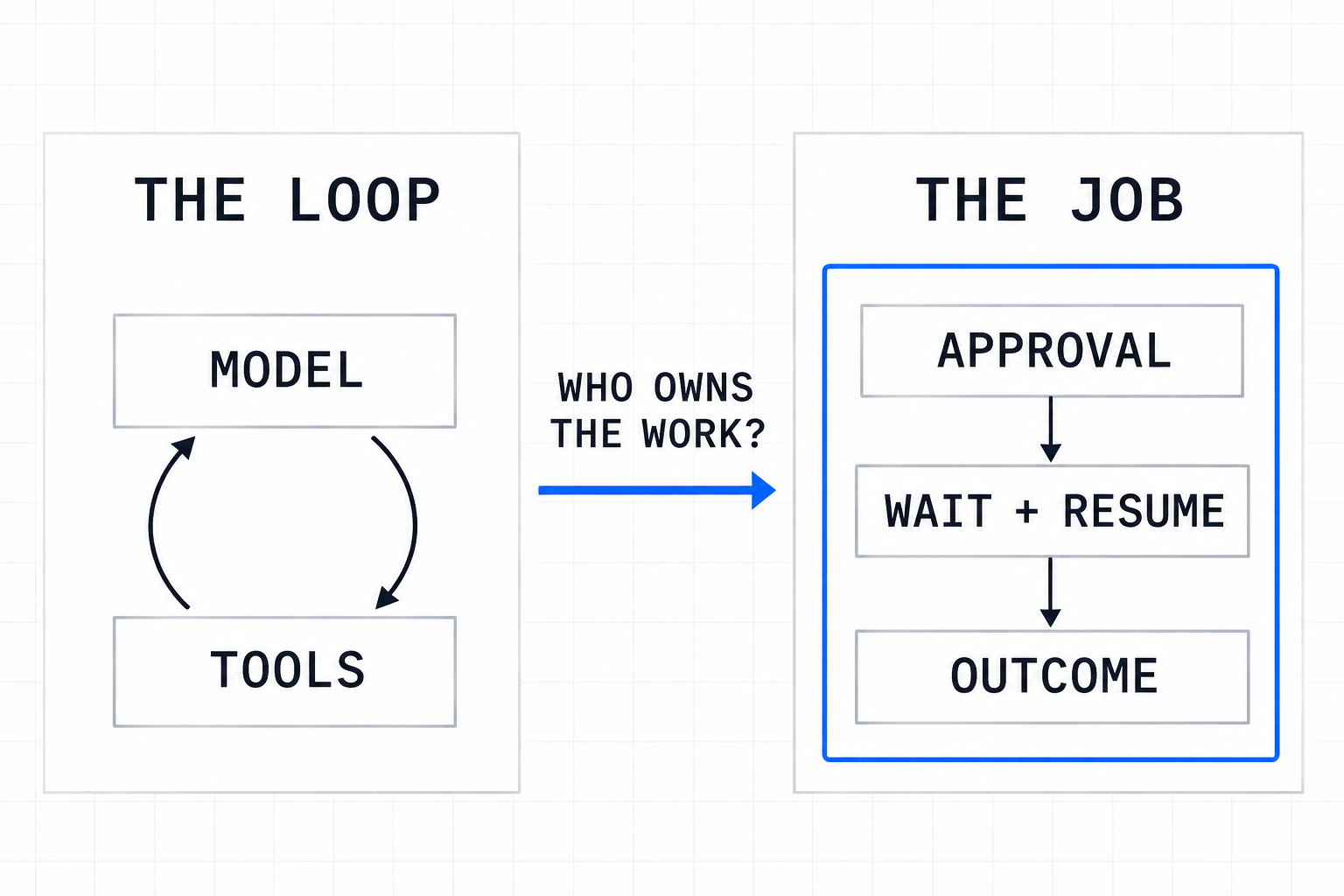
The first version of the problem looks like a model-and-tools loop. Give the model instructions, connect the tools, and let it decide the next step. Then the approver goes home. A worker restarts. An item mapping changes. The external write times out, and nobody knows whether it succeeded.
The model might still reason well. The job has lost its operating contract.
That was the starting point for our seven-plane design: put explicit responsibilities around enterprise work, including the parts that outlive a conversation. The original review moved from enterprise needs to harness mechanisms, then tested those mechanisms against concrete workflows. This article follows that path, with external research updated for this draft.
Start with the organization that has to run it
Deloitte reports 74% expect nearly half their processes redesigned around agents within four years; 5% say processes are highly prepared. These are separate survey questions. 1
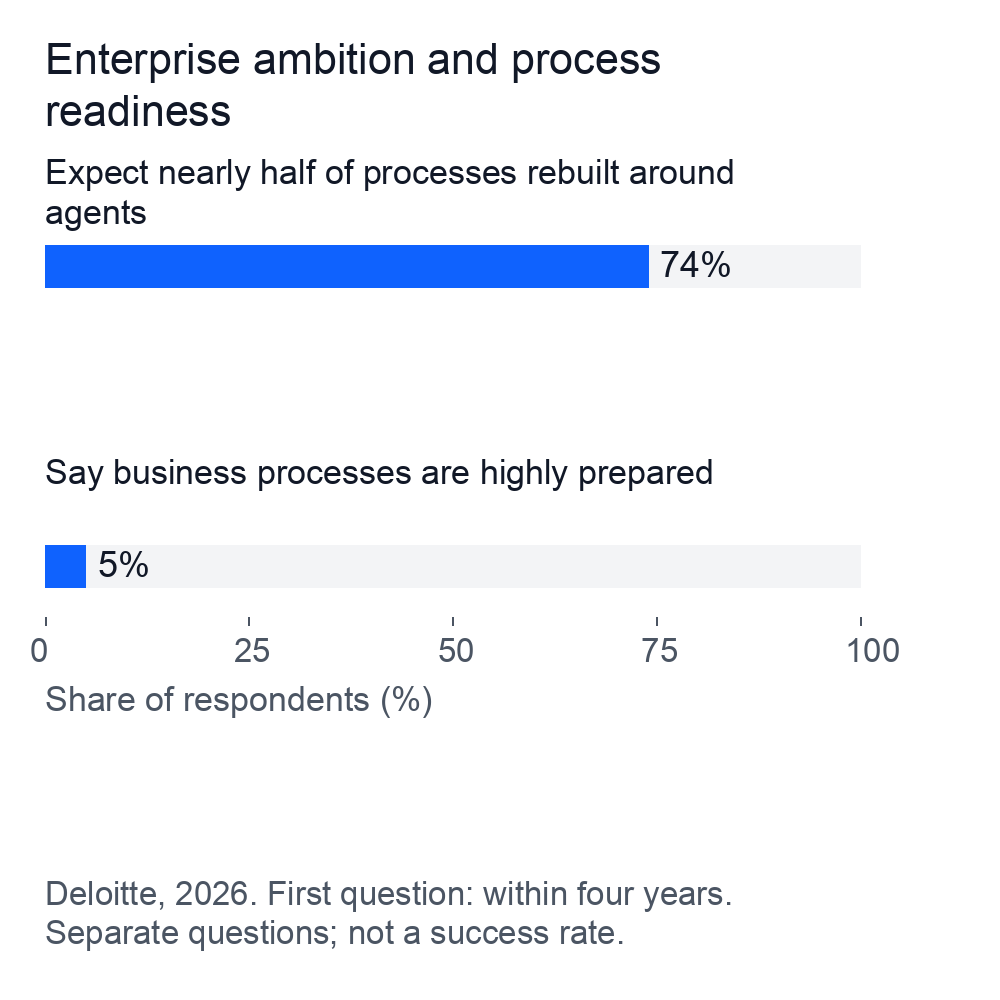
For our quote workflow, readiness means someone owns the agent, defines what it may read and change, and handles exceptions. There must be a way to suspend authority without rewriting a prompt. A successful demonstration does not answer those questions.
We therefore started with an operating contract: owner, objective, organization scope, allowed actions, spending limits and revocation. The harness carries that contract across model changes and worker restarts.
Deloitte also reports three barriers: 72% lack unified accessible data, 70% do not feel they can trust and govern agents, and 67% find integration too costly and complex. 1
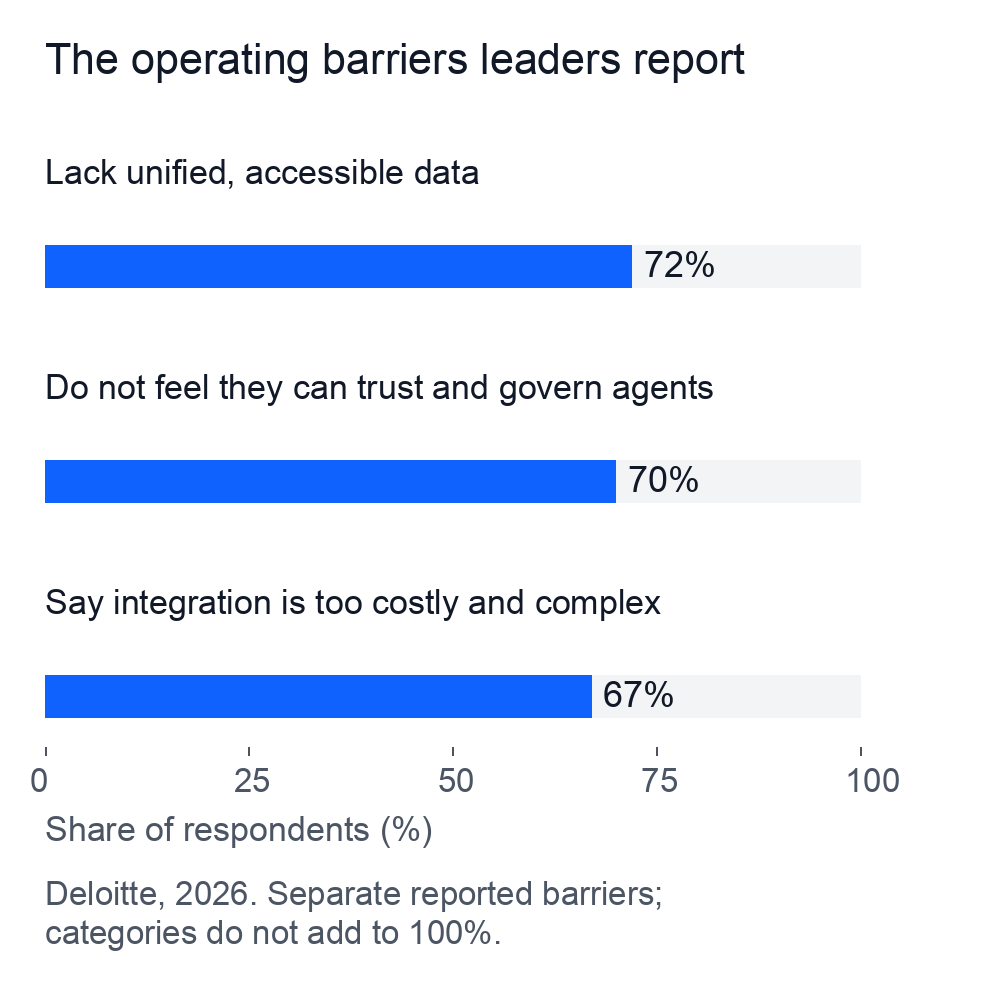
Our interpretation was architectural. Data access needs a governed state layer. Trust needs an enforceable authority boundary. Integration needs adapters with explicit execution and recovery semantics. The statistics motivate those requirements; they do not prove that seven planes are the only valid solution.
Give authority its own boundary
Suppose the model proposes changing a quote. A convincing explanation cannot establish permission. The organization, account, fields, values and requesting identity all matter.
Identity scale makes implicit trust particularly fragile. Palo Alto Networks' 2026 report, based on more than 2,900 cybersecurity decision-makers worldwide, puts machine identities at 109 for every human identity. That includes AI agents alongside other machine identities. It is not a count of agents alone. 2
We separated three responsibilities. Reasoning builds context and proposes a concrete action. Control evaluates that action against grants and policy, returning allow, refuse or ask. Capability executes the authorized operation through an adapter.
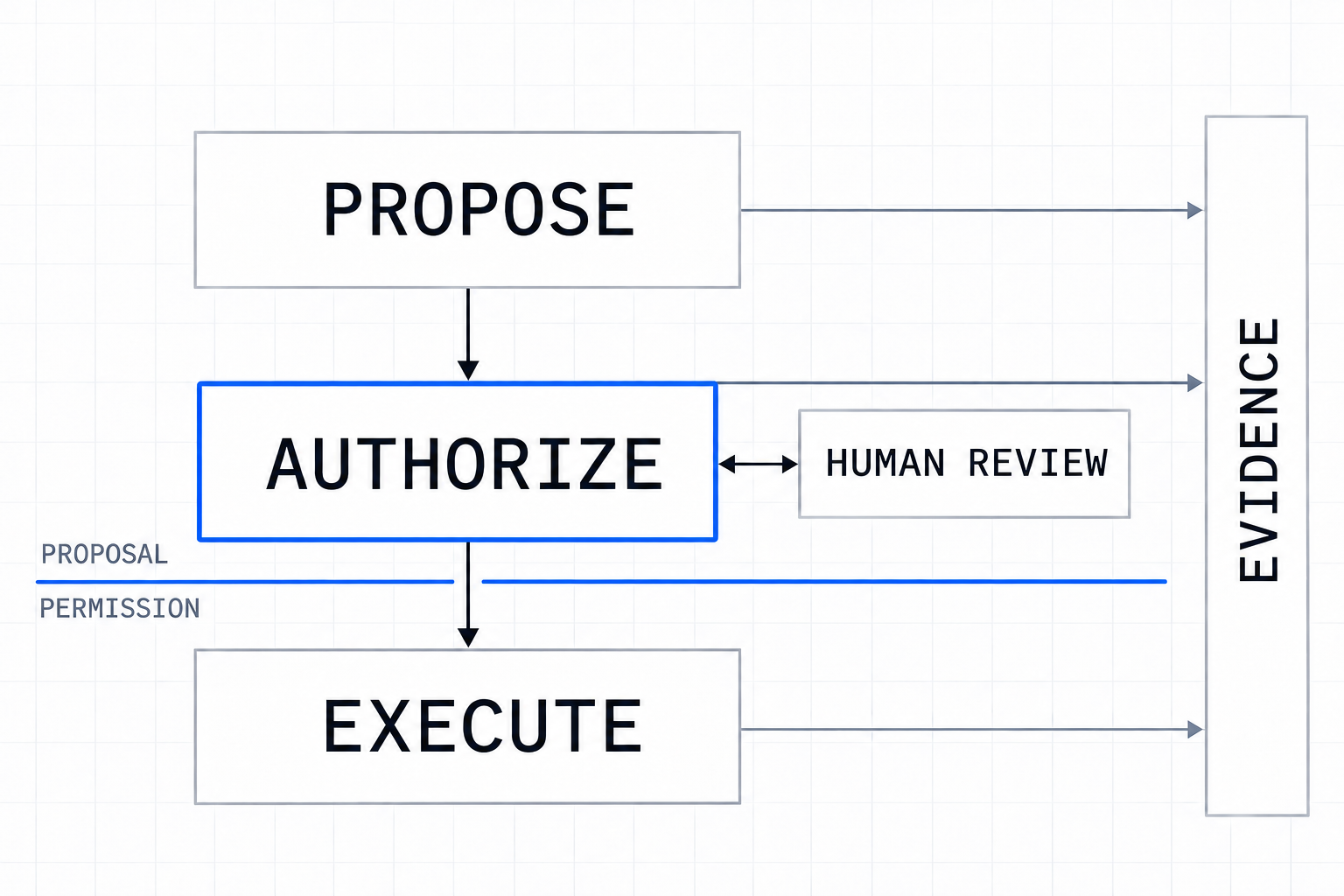
This boundary must cover every execution route, including generated code. Restricting a named tool is insufficient if a sandbox can reach the same vendor API with broader credentials. Our target design keeps credentials and write authority behind the execution boundary.
Authority also varies by operation. Reading a catalog, suggesting a price and submitting an order should have different rules. Gartner's proportional governance guidance distinguishes observing, advising, acting with approval and acting autonomously. 3 We apply that idea through scoped grants and action policies, with escalation when the proposed action exceeds them.
For a quote approval, the decision should bind to the exact proposed change. If the price changes afterward, the old approval should no longer authorize execution. That makes human approval a verifiable input to Control.
Make permission a decision we can explain
The operating contract became more concrete as we built the permission layer. “May this agent write?” is too broad. We need to ask which operation, for which person, on which records, through which agent, in which run.
Bruce composes organization, person, agent and routine settings. An organization-level deny is a ceiling. An organization rule requiring approval every time cannot be lifted to automatic execution below it. A person's setting, or their role's setting, supplies the personal rule within those ceilings. The agent normally narrows authority; an unattended routine also needs its approved write scopes.
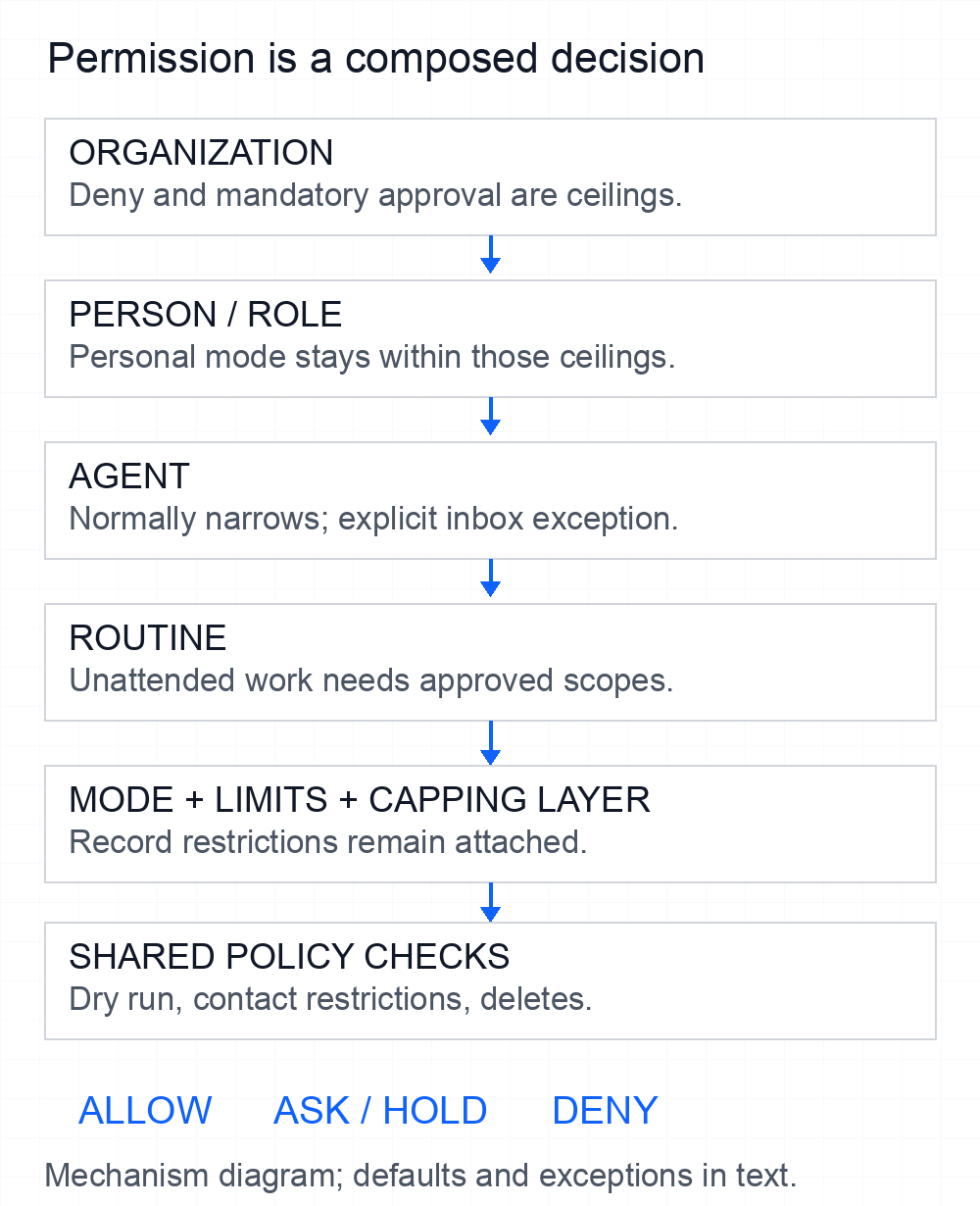
This is more nuanced than taking the strictest mode everywhere. Some organization settings are defaults rather than ceilings. Missing rows inherit defaults, with stricter defaults for strict-mode organizations. The resolver keeps the layer that capped the action and combines limits, so a refusal can explain whose rule needs to change. Inbox email has a specific agent-default exception; it does not give agents a general right to expand their authority.
Scopes also become finer as risk becomes clearer. A bulk CRM operation needs a separate bulk-write scope in addition to the ordinary write scope. Record rules restrict supported Salesforce changes to owned, assigned, new or explicitly matching records. A role's record restriction survives a personal mode exception. When a targeted record cannot be verified, the record check fails closed; an unclassifiable write instead requires a card.
After resolving grants, a shared policy table still applies hard rules. Dry runs do not write. Do-not-contact restrictions remain restrictions. Deletes need a person. A session grant can lift an ordinary ask, but cannot erase a deny or the organization's mandatory-approval ceiling.
That makes permission part of the workflow's explanation. The quote can say why it needs approval, and an administrator can change the relevant grant without changing the agent's prompt.
Let the job survive the worker
Now the quote is ready, but approval arrives tomorrow. Keeping a process alive overnight is an implementation detail the business should never depend on.
Orchestration owns a durable run: completed steps, pending decisions, deadlines and the next permitted transition. Waiting for approval becomes saved state. An authenticated answer resumes the owning run, even when another worker handles it.
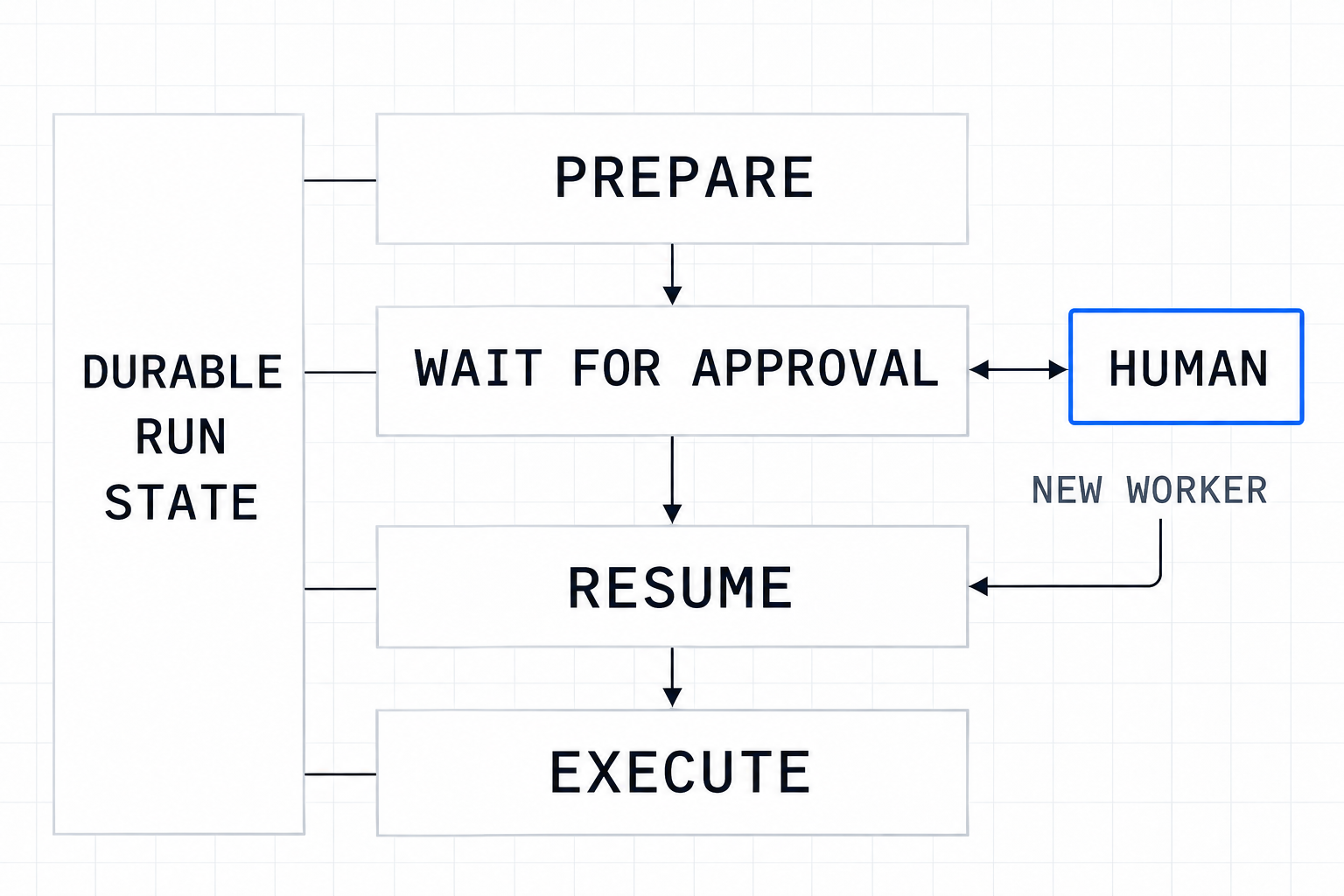
This is an established distributed-systems pattern. Temporal documents workflow recovery through recorded event history after infrastructure failure. 4 We use it here as a reference mechanism, not a claim that Bruce runs on Temporal.
Recovery still leaves an uncomfortable moment: the business-system write timed out. Did it fail before execution, or succeed before the response was lost?
The harness must distinguish a retryable failure from an unknown outcome. A durable operation identity can prevent duplicate attempts where the destination supports it. Stripe's API documentation provides a concrete example of idempotency keys and replayed responses, with defined limits. 5 Other adapters need their own contracts. A generic retry button cannot promise exactly-once effects across arbitrary systems.
For the quote, an unknown write should trigger reconciliation with the destination before another attempt. Orchestration owns progress; Capability owns the operation's execution semantics.
Record the effect, not just the approval
Approval answers whether a write may happen. The effect ledger answers whether it did happen. We built these as separate records because an approved card can still lead to a failed, partial or uncertain execution.
For supported host writes, Bruce claims a side_effect row before calling the destination. Its organization and idempotency key form a unique identity. Concurrent callers cannot both win that claim. The row carries the request hash, target, attempt and available approval, run, turn and tool-call links.
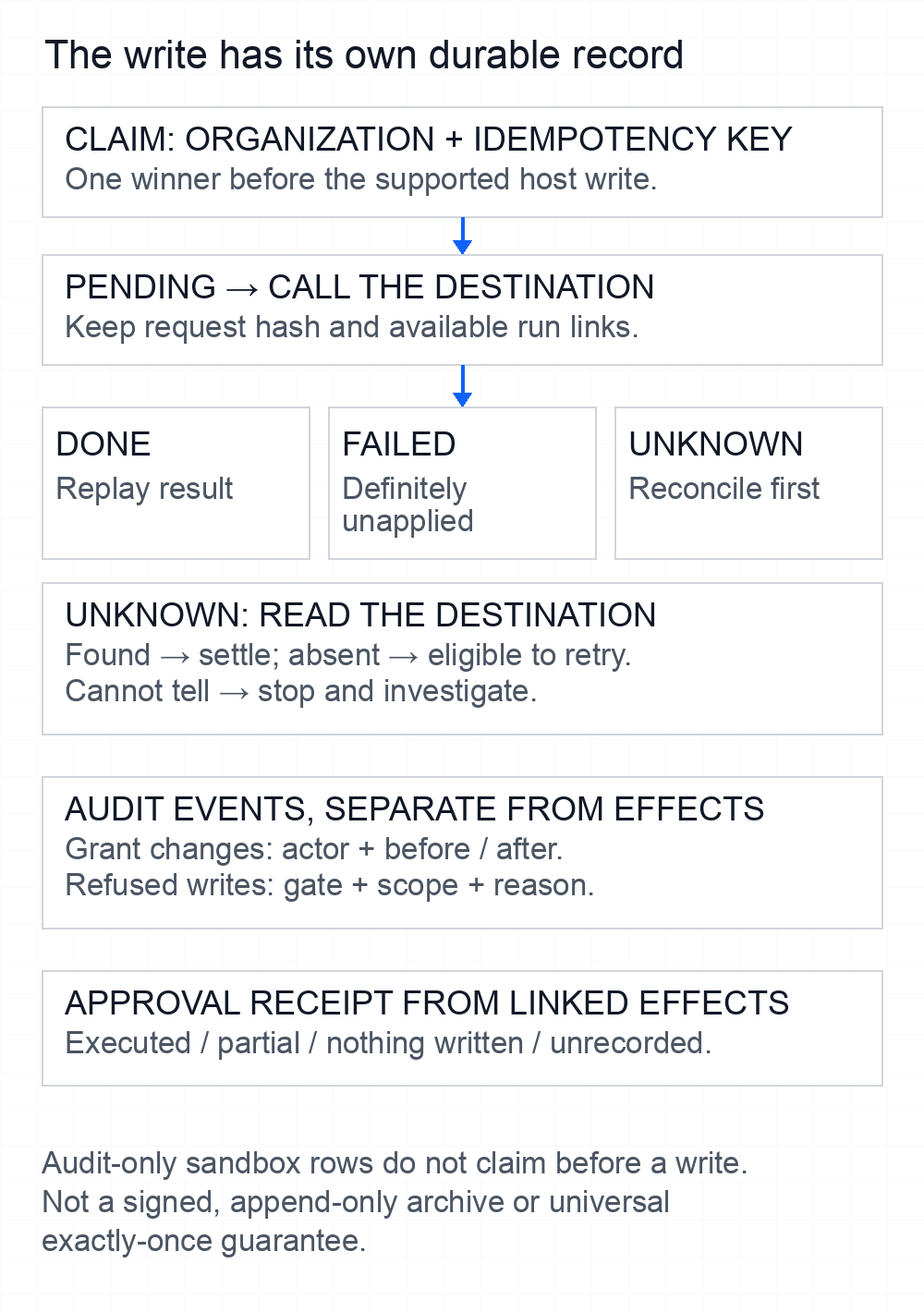
A completed key returns the recorded result. A definitely unapplied failure may be retried. An unknown outcome, including an uncertain timeout, needs reconciliation: found means record the existing result; not found can permit another attempt; cannot tell means stop for investigation. Dry runs use a separate key and record what would have been written.
The audit trail covers the decisions around that effect. Grant changes carry the actor and before-and-after state. Refused writes record the gate, surface, scopes and reason, with available run and turn links, even though there is no vendor effect. Relevant policy disagreements or additional stops have their own event. This lets an operator ask both what changed and what the harness prevented.
We also derive an approval's execution receipt from its linked ledger rows: executed, partially executed, nothing written, or unrecorded when recording coverage is absent. Permission to act never becomes proof that the action succeeded.
These guarantees have boundaries. Some sandbox writes are recorded after execution rather than claimed through the host effector. Audit helpers can log a persistence failure without failing the original operation. The current tables are not a signed, append-only archive or a complete replay of everything the model saw. Those stronger provenance properties remain goals from the design review.
Keep knowledge, work and context separate
When the run resumes, it needs the approved draft and the knowledge used to prepare it. Those have different lifetimes.
A confirmed item mapping is reusable knowledge. A quote draft is a versioned work product. The model resolving one line needs a selected subset of both. A conversation transcript should not be the only place these things exist.
That led to Memory and workspace. Memory preserves reusable knowledge with provenance and access scope. Workspace preserves the artifacts a run is producing. Reasoning assembles the context for the current step from those durable sources.
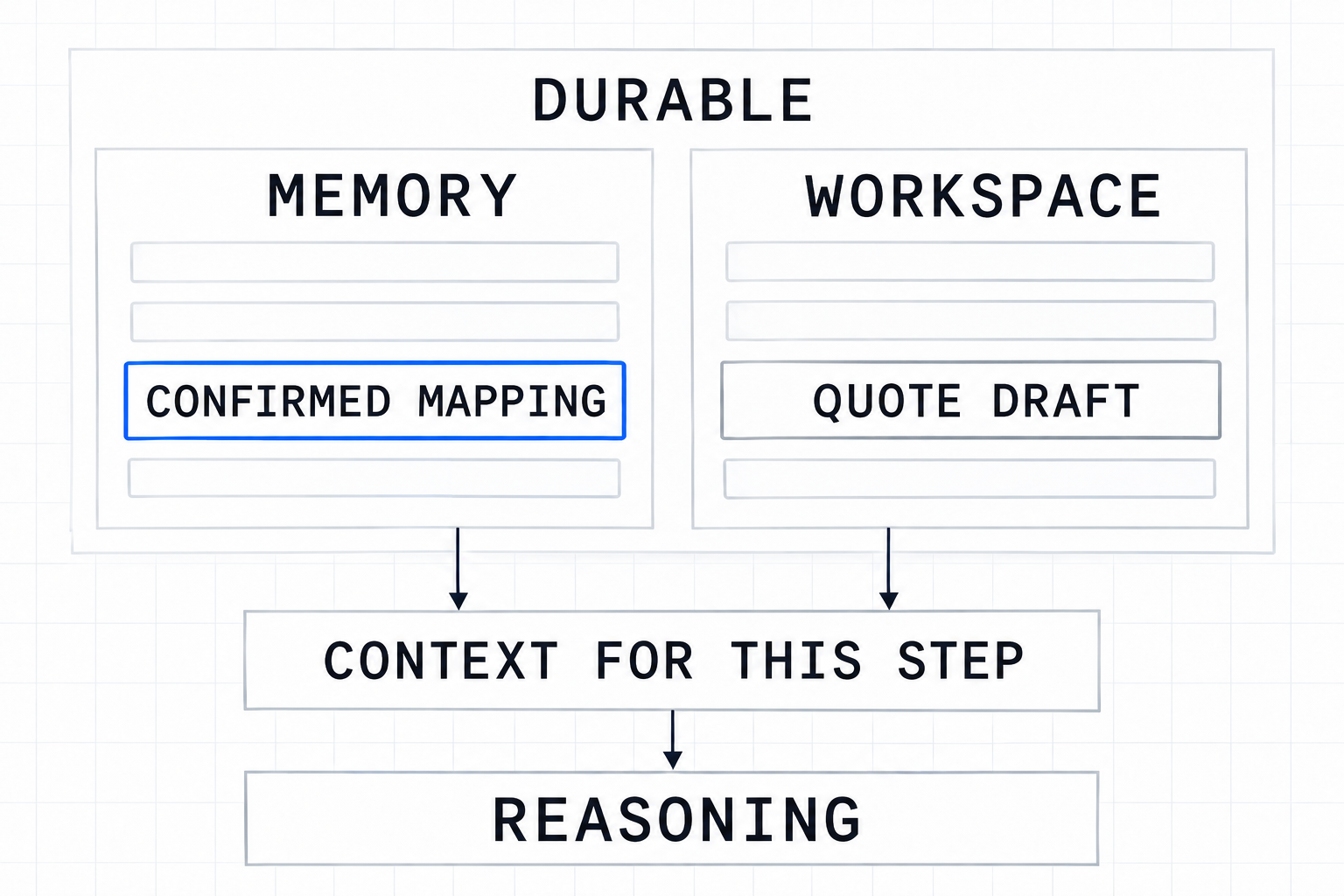
In our quote example, the workspace holds the draft version awaiting approval. Memory holds a confirmed mapping. The next model call receives the relevant line, mapping and policy, rather than the entire organizational history.
This separation makes corrections tractable. Editing the draft creates a new work version; confirming a mapping follows a knowledge-write policy. Model output does not automatically become trusted memory. Organization boundaries apply during retrieval as well as execution.
Design the human boundary as carefully as the API
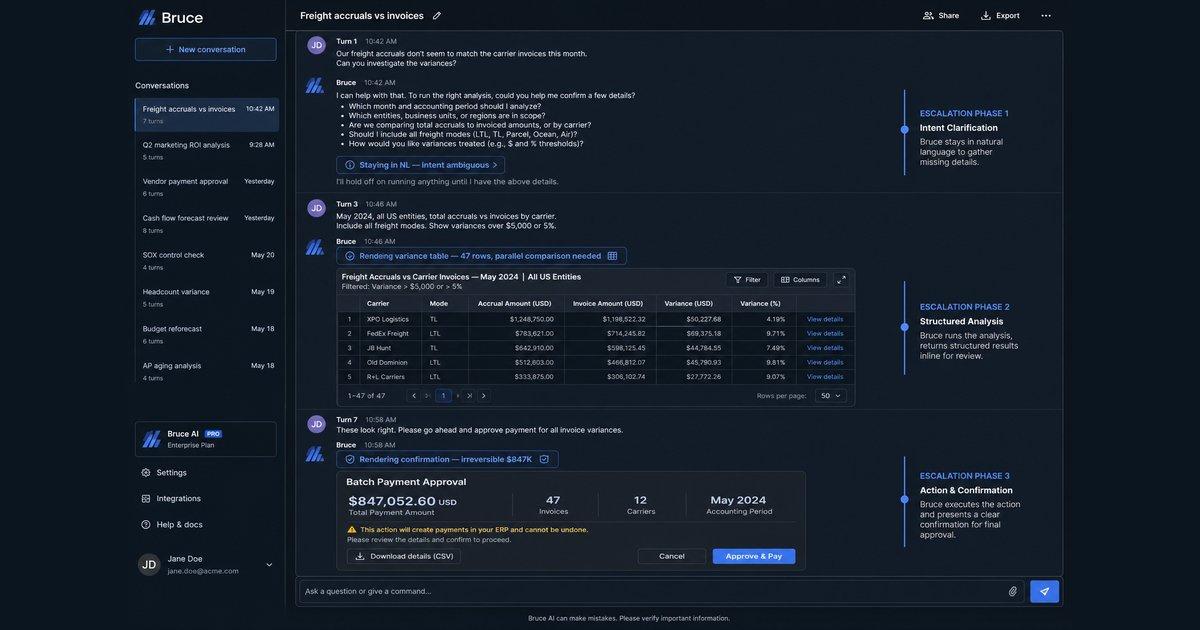
The approver opens the request on a phone. A paragraph saying the quote is ready leaves them reconstructing the proposed effect. They need the changed fields, old and new values, unresolved assumptions and the action their decision will authorize.
During the design review, we made visualization an explicit part of Surface and intake. Its renderer turns a proposal into an inspectable object: a diff, form, chart or draft. Intake turns messages, events and decisions into typed envelopes with identity and provenance.
The decision needs to be useful at the moment of review. A clear display is one part; binding the answer to the run, action and proposal version is another. A later edit should reopen the decision rather than silently inherit approval.
The same discipline applies when agents collaborate. A handoff should carry a typed task, relevant state and a completion condition. Shared work needs ownership and concurrency rules. Cemri and colleagues' failure taxonomy separates specification, inter-agent alignment and verification problems. 6 More agents introduce more boundaries to manage.
We would start the quote workflow with one responsible agent, adding specialists only where a measured benefit justifies coordination overhead.
Budget the work and prove the outcome
A resumable workflow can still become an expensive one. McKinsey's 2026 survey found about 20% reported AI operating costs constrained use. This covers AI broadly, not only agents. 7
We put budgets in the operating contract and meter them during execution: model usage, tool calls, elapsed time and retries. A run approaching its limit should produce an explicit pause, reduced plan or escalation. The model can recommend a cheaper path; Control decides whether spending may continue.
Completion needs a similarly explicit contract. McKinsey reports 80% saw improved individual productivity, while 37% attributed at least some organizational EBIT impact to AI. Different questions and scopes prevent treating those figures as a conversion rate. They do make the distinction between local assistance and enterprise outcomes worth measuring. 7
Evidence records what was proposed, authorized, executed and observed. For the quote, that means connecting the request, approved version, external result and delivered output. Writing a report, having a channel accept it and producing a useful result are separate checks.
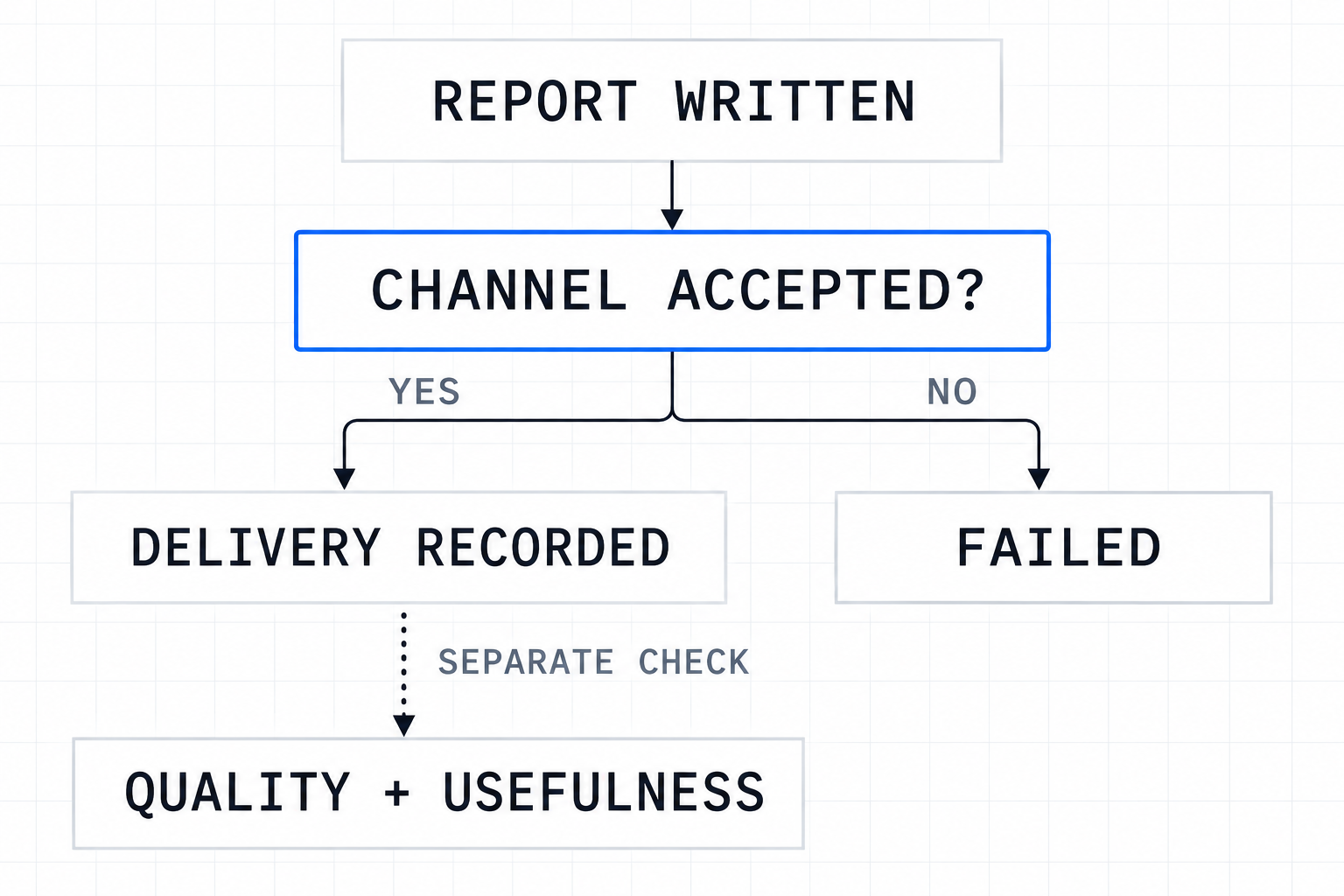
OpenTelemetry's agent observability guidance connects traces, metrics and logs with evaluation feedback. 8 We want that chain to include business results, not stop at model latency and token counts. A trace explains the run; an evaluation checks whether the result met its objective. Neither alone establishes business value.
The seven planes we arrived at
The resulting design gives each responsibility a home. Surface and intake makes requests and decisions understandable. Control grants authority. Orchestration preserves progress. Reasoning proposes steps. Capability executes operations. Memory and workspace preserve knowledge and work. Evidence records effects and evaluates outcomes.
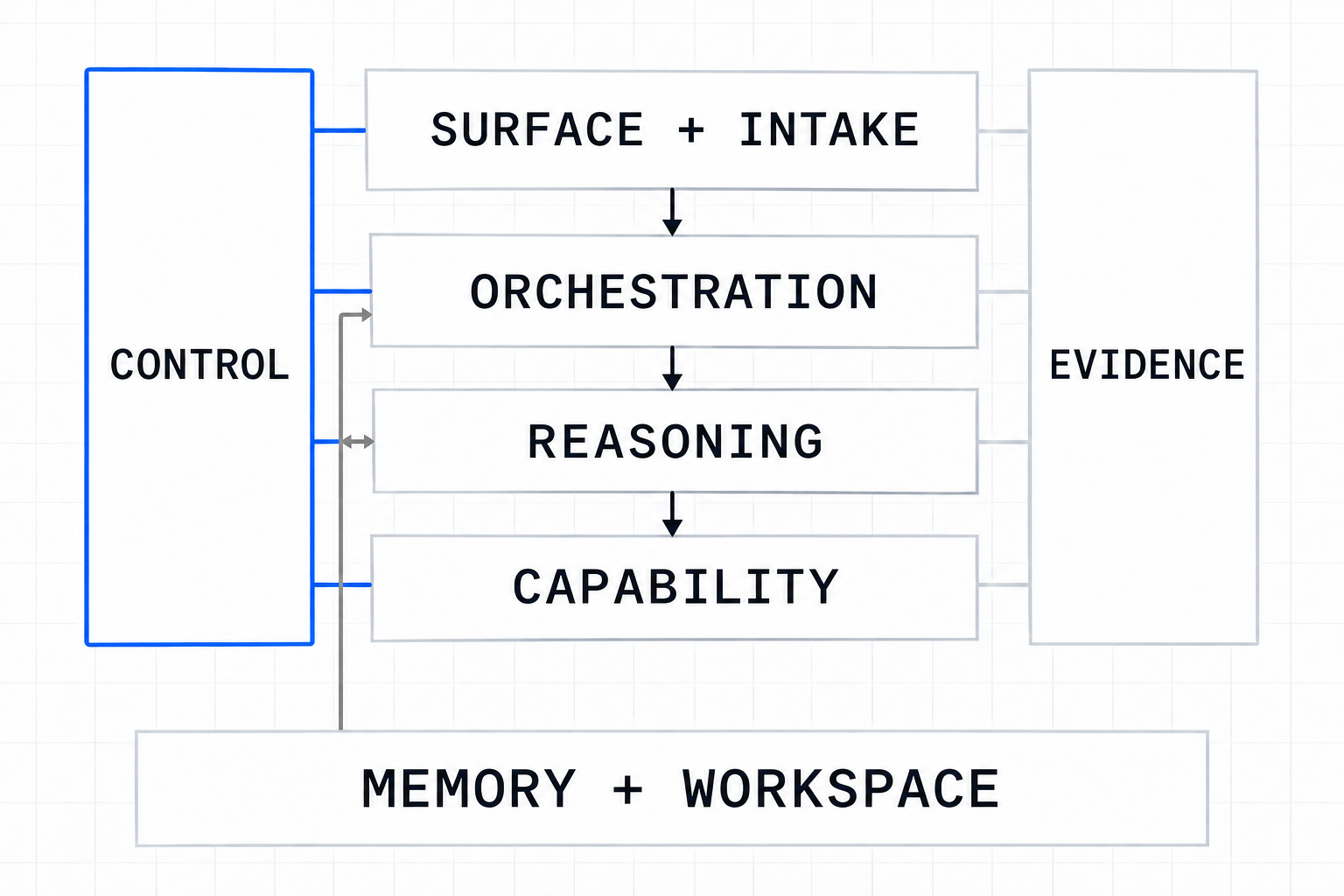
Control and Evidence cross the path because authority and proof matter throughout the job. The planes are responsibility boundaries, not seven required services or seven agents.
Bruce has implemented layered permissions, record restrictions, approval binding, effect and refusal records, a run budget meter, workspace persistence and delivery checks. The meter stops the next tool call after the priced usage reaches its limit; it does not interrupt a call already in flight or reserve spend before every call. The complete credential boundary, exclusive write routing and fleet-wide evaluation gates remain design work; current production coverage is not established by this article.
For our quote, the goal is concrete: an authorized person can inspect the proposed change, approve it later, survive a worker restart, avoid an unsafe duplicate write and inspect the result. That is the enterprise harness we are designing around the model.
External references and scope
[1] Deloitte, agentic AI readiness survey, 12 August 2026. 501 US senior-manager to C-suite respondents involved in agentic strategy or implementation; five industries; organizations at least piloting. Fielded April-June 2026. Self-reported expectations, readiness and barriers.
[2] Palo Alto Networks, 2026 Identity Security Landscape. Vendor research covering 2,900+ cybersecurity decision-makers worldwide; machine identities include agents and other nonhuman identities.
[3] Gartner, proportional agent governance, 26 May 2026. Analyst guidance on autonomy levels and corresponding controls.
[4] Temporal, Workflows documentation. Reference for recovery through event history; not a Bruce dependency claim.
[5] Stripe, Idempotent requests. API-specific retry semantics, including expiry and parameter constraints; not a universal exactly-once guarantee.
[6] Cemri et al., Why Do Multi-Agent LLM Systems Fail?, March 2025, v1. Research taxonomy, not a measurement of Bruce reliability.
[7] McKinsey, The state of AI in 2026, 25 August 2026. 1,719 participants across 97 nations; May 4-June 8 fieldwork; GDP-weighted. Findings concern AI broadly and report respondent perceptions.
[8] OpenTelemetry, AI agent observability, 6 March 2025. Technical guidance; no claim that its then-emerging conventions are stable today.
All external references checked 17 November 2026. Survey results motivate requirements; mechanism diagrams illustrate our design. Neither proves this architecture's effectiveness. The workflow is illustrative and contains no customer data.